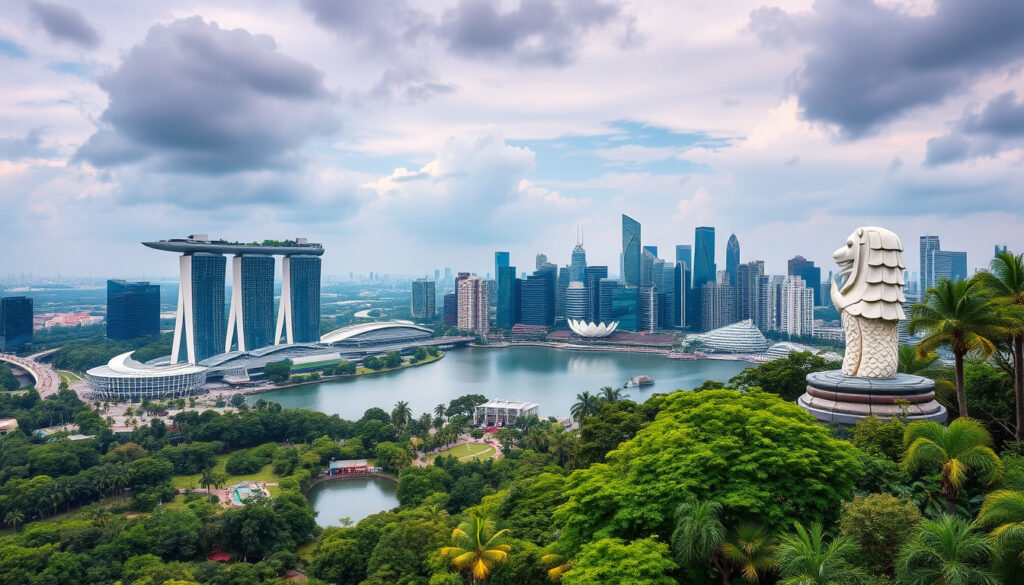
Interesting Places in Singapore: Top Sights & Hidden Gems
There’s the checklist version of Singapore — Merlion, supertrees, infinity pool — and the neighbourhood version, where every district is a short train ride from the last. Most first-time visitors land somewhere between the two, which is why practical details matter as much as the skyline: the city-state packs about 5.9 million people into roughly 734 square kilometres, and the MRT does most of the heavy lifting.
Population: About 5.9 million ·
Land area: About 734 square kilometres ·
Official languages: English, Malay, Mandarin, and Tamil ·
UNESCO World Heritage Site: Singapore Botanic Gardens (2015) ·
UNESCO intangible culture listing: Hawker Culture in Singapore (2020)
Quick snapshot
- Singapore Botanic Gardens is a UNESCO World Heritage Site, inscribed in 2015 (UNESCO).
- Hawker Culture in Singapore joined UNESCO’s Representative List of the Intangible Cultural Heritage of Humanity in 2020 (UNESCO).
- Singapore’s official languages are English, Malay, Mandarin, and Tamil (Singapore Government). (UNESCO)
- The “most visited” attraction title changes with the source and the measurement period; official visitor statistics and social-media favourites often disagree.
- Ticket prices, opening hours, and show times shift; confirm them on each attraction’s official website.
- Monthly rainfall averages don’t predict a single week; check the Meteorological Service Singapore forecast for your dates.
- Chinese New Year and Christmas are major festival periods that tighten hotel availability and build shopping crowds.
- The northeast monsoon, roughly from November to January, tends to bring more rain; the southwest monsoon period tends to be drier (Meteorological Service Singapore).
- Three days cover a Marina Bay day, a Botanic Gardens day, and one wildlife or island day.
- Decide between pay-as-you-go contactless and a Singapore Tourist Pass before Day 1 — the right choice depends on how many trips you’ll make. (SimplyGo (Singapore’s fare-payment service))
- A one-day Singapore Tourist Pass costs S$17, with five-day passes at S$45; it covers basic buses and MRT/LRT trains but not premium services such as the Sentosa Express (SimplyGo (Singapore’s fare-payment service)).
- Confirm attraction opening hours and ticket prices on official websites. (SimplyGo (Singapore’s fare-payment service))
Singapore at a glance
Singapore is a city-state, a country, and one island-metropolis at the same time; these eight facts — sourced from the Singapore Government, the Energy Market Authority, and the Info-communications Media Development Authority — set the parameters for the whole trip.
| Category | Detail |
|---|---|
| Capital | Singapore (city-state) |
| Population | About 5.9 million |
| Land area | About 734 square kilometres |
| Official languages | English, Malay, Mandarin, and Tamil |
| Currency | Singapore dollar (SGD) |
| Time zone | UTC+8 (Singapore Standard Time) |
| Calling code | +65 |
| Electricity | 230 V, 50 Hz; Type G sockets |
The implication: tiny land area plus reliable trains equals a destination where a short trip can still feel complete.
What is the best attraction in Singapore?
Ask a dozen people for the single best attraction in Singapore and you’ll get a dozen different answers. That’s because the city’s top sights separate into different currencies: skyline drama, green space, wildlife, and history. Visit Singapore, the Singapore Tourism Board’s visitor platform, organises the city by district and experience rather than a linear ranking, and the landmarks that appear most often across travel coverage are Gardens by the Bay, Marina Bay Sands, and the Singapore Botanic Gardens.
- Gardens by the Bay — the bayfront garden with the supertree Grove; the outdoor gardens are a free option, while the cooled conservatories are ticketed.
- Marina Bay Sands — the integrated resort that anchors the skyline; the waterfront around it connects to Merlion Park on foot.
- Singapore Botanic Gardens — the UNESCO World Heritage Site; as the Land Transport Authority’s travel guidance notes, much of the garden experience is free to enter.
For the strongest first-day answer, follow the MRT. Marina Bay works as one compact cluster: Gardens by the Bay, the Marina Bay waterfront, Merlion Park, and the central business district can all be combined by train and on foot, according to the route-planning guidance from the Land Transport Authority (Land Transport Authority — Singapore’s transport regulator).
Which is the most visited place in Singapore?
- Visitor surveys and travel roundups put Gardens by the Bay near the top of most counts.
- Marina Bay Sands is the most recognisable skyline landmark, but the resort is not the same as the waterfront loop around it.
- Singapore Botanic Gardens holds the highest formal distinction: a UNESCO World Heritage Site since 2015.
Which one is “the most visited” depends on the metric — ticket sales, footfall, or social-media mentions — and official visitor statistics don’t always agree with each other. Treat the title as context, not a verdict.
What is the prettiest place in Singapore?
- The Gardens by the Bay outdoor gardens at dusk, when the supertrees light up and the skyline comes into frame.
- The Singapore Botanic Gardens, where the green space feels a world away from the towers.
- The Marina Bay waterfront, especially the walk from Merlion Park towards the CBD.
Prettiest is subjective, but these three repeat across nearly every photography roundup of the city. The practical note: two of them are free, and all three are linked by the MRT.
The “best attraction” in Singapore is a cluster, not a single tick-box. A first-day loop around Marina Bay delivers the gardens, the skyline, and the Merlion without a single cross-island train ride.
The pattern: each of the three leading candidates wins a different category — skyline drama to Marina Bay Sands, floral spectacle to Gardens by the Bay, and heritage credibility to the Botanic Gardens. Choose by mood, not by ranking.
What are the top 10 places to visit in Singapore with family?
Family travel in Singapore works best when you separate the paid icons from the free green spaces and the food, because a day that mixes all three keeps everyone in a better mood. The list below follows the categories used by the official Visit Singapore platform and the most-cited family stops in travel coverage:
- Gardens by the Bay — the supertree Grove is free to explore; the conservatories are a ticketed add-on.
- Marina Bay Sands and the waterfront — the skyline walk from Merlion Park to the CBD, best as the light softens.
- Singapore Botanic Gardens — the UNESCO-listed green lung, and mostly free to enter.
- Sentosa — beaches, theme parks, and resorts; budget for the Sentosa Express premium fare.
- Mandai Wildlife Reserve — Singapore Zoo, Night Safari, Bird Paradise, and River Wonders grouped in one reserve.
- Chinatown — temples, shophouses, markets, and hawker food around Chinatown MRT.
- Little India — heritage, colour, and food around Little India MRT.
- Kampong Gelam and Arab Street — the cultural district around Bugis MRT, with a walk through heritage shophouses.
- ArtScience Museum — interactive galleries at Marina Bay, a strong indoor backup on a rainy day.
- A hawker centre — UNESCO-listed hawker culture, and the least stressful intergenerational meal in the city.
What are some fun family activities in Singapore?
Sentosa and Mandai Wildlife Reserve each deserve roughly half a day, mostly because of travel time and park size. Stacking both into one morning is the fastest way to turn a family day into a complaint loop.
For hands-on fun, the ArtScience Museum’s interactive galleries are a strong indoor pick, and the Mandai parks split neatly by time of day: the daytime zoos early, the Night Safari after dark.
- Morning: Singapore Zoo or Bird Paradise at opening time, before the heat builds.
- Midday: a hawker lunch, which is faster and cheaper than a sit-down restaurant.
- Late afternoon: Sentosa’s beaches, with the resort island’s paid attractions as an option.
The trade-off: the paid icons — Sentosa, Mandai, the conservatories — are where the budget goes, while the Botanic Gardens, outdoor gardens, and hawker centres carry the free and low-cost side of the trip. A balanced family day mixes one paid anchor with two free ones.
How expensive is it to visit Singapore?
Singapore has a reputation for being expensive, and hotels and bars can justify that reputation. But the daily cost of seeing the city is more controllable than most visitors expect: the currency is the Singapore dollar (SGD), and the two biggest everyday expenses — food and transport — have cheap, well-run options.
- Prices at hawker centres are generally lower than at restaurants and hotels.
- Hawker Culture in Singapore is on UNESCO’s Representative List of the Intangible Cultural Heritage of Humanity (2020).
Transport is where planning pays. Public bus and train fares are distance-based, so a short MRT hop is cheap and a cross-island journey costs more; you can also pay with a contactless bank card or mobile wallet through the SimplyGo fare system (SimplyGo — Singapore’s public-transport fare-payment service). Before you buy any pass, run your planned routes through the Land Transport Authority’s journey planner (Land Transport Authority).
Should you buy a Singapore Tourist Pass? It packages unlimited basic-bus and MRT/LRT travel at a flat daily rate, which makes it a strong option on days with many trips, according to transport-guide site SGTrains (SGTrains — Singapore rail and transport guide). On days with only a few journeys, a pay-as-you-go contactless card can work out cheaper than a pass, notes travel platform Traveloka (Traveloka — Southeast Asian travel-booking platform). The exact pass prices — from S$17 for one day to S$45 for five days — are in the quick snapshot.
What is famous to buy in Singapore?
- Food items and pantry staples — spice mixes, curry powders, and sauces that pack well.
- Tea — especially blends from regional heritage brands.
- Peranakan-style goods — textiles, ceramics, and jewellery from the Straits-Chinese culture.
Orchard Road is the city’s main shopping belt, and the heritage districts are where the distinctive souvenirs live.
A two-attraction day in Singapore can easily cost more than two full days of food and transport combined. Visitors who decide in advance which tickets are worth it enjoy the city more and stress less.
The implication: the daily variables in Singapore — hawker meals and MRT fares — are the ones you control, and both are cheap compared with the city’s hotels. Budget the big-ticket attractions first, then let the basics absorb the rest.
How many days do you need in Singapore?
For most first-time visitors, three well-planned days cover the highlights without feeling frantic, and a fourth day simply lets you slow down. The reason three days works is that the MRT connects most central tourist districts, and the sights naturally group into walkable, train-linked clusters.
Can I see Singapore in 3 days?
Day 1: Marina Bay cluster ·
Day 2: Botanic Gardens + one heritage district ·
Day 3: Sentosa or Mandai Wildlife Reserve
Yes, with two conditions. First, treat Sentosa and Mandai Wildlife Reserve as half-to-full-day commitments because of travel time and park size; putting both into one day rarely works. Second, accept that three days can cover Marina Bay, the Botanic Gardens, and one neighbourhood or wildlife area, but not every attraction in Singapore. The city rewards a return visit, and that’s not a flaw in the plan.
- Short on time? Cut the indoor-only attractions first; the outdoor gardens are free, and the waterfront delivers regardless.
- Have a spare evening? Add the Night Safari rather than revisiting the same cluster.
- Rain forecast? Swap outdoor time for the conservatories or the ArtScience Museum.
The catch: three days is enough only if you stop trying to see everything. The itinerary that works is the one that clusters stops by MRT line, not the one that chases every listicle entry.
What is the dress code in Singapore?
Singapore runs hot and air-conditioned at the same time, so the practical dress code is about layers, not rules. Light, breathable fabrics suit the tropical climate, and a thin layer handles the indoor air-con.
Dress tips for religious sites and dressier restaurants
- Temples and mosques — cover shoulders and knees; bringing a light scarf is the simplest way to comply.
- Hawker centres — no dress code beyond ordinary daytime clothes.
- Dressier restaurants and clubs — some enforce smart-casual or evening dress codes; check before booking.
Religious sites such as temples and mosques typically ask visitors to cover shoulders and knees, and some restaurants, bars, and clubs enforce smart-casual or evening dress codes. A light scarf covers both situations.
The heat is the real dress-code problem, not the fashion police. Light layers beat heavy outfits, and shoes that slip off quickly make temple visits smoother.
The trade-off: dressing for Singapore means dressing for outdoor heat and indoor air-con at once. Breathable layers solve both ends of the equation.
Do and don’ts in Singapore for tourists?
Singapore’s rules get an outsized share of travel headlines, but the practical list for visitors is short. It splits into legal basics and everyday etiquette.
Legal basics: drugs, gum, smoking, and litter
- Drugs — Singapore has strict drug laws with severe penalties; possession and trafficking are illegal.
- Chewing gum — restricted to therapeutic, dental, and nicotine products that are legally supplied.
- Smoking — banned in many indoor and outdoor public places, including most hawker centres.
- Litter — public-cleanliness rules are enforced in parks, streets, and hawker centres.
These are the rules that catch tourists because they differ from much of the rest of the world, and they apply to visitors exactly as they apply to residents.
Everyday etiquette in public spaces
- Eating, drinking, and carrying durians are not allowed on the MRT.
- Queueing is taken seriously in Singapore; join the line at hawker stalls, bus stops, and taxi stands.
- Priority seats on trains are marked; leave them for those who need them.
- Keep phone conversations and music at indoor volume on public transport.
When choosing a hawker stall, look for the hygiene grade displayed by the National Environment Agency. For emergencies, dial police on 999 and ambulance or fire on 995. Why this matters: the rules are simple because they are enforced consistently. Follow the basics — no drugs, no smoking in banned zones, no durians on the train — and Singapore is remarkably easy to move through.
What’s the best time of year to visit Singapore?
Singapore doesn’t have four seasons; it has a tropical rainforest climate with warm temperatures year-round. The real seasonal variables are rain and crowd levels.
Weather patterns by monsoon season
Northeast monsoon: roughly November–January, tends to bring more rain ·
Southwest monsoon: tends to be drier ·
Rainfall note: monthly totals are averages, not forecasts
The northeast monsoon, roughly from November to January, tends to bring more rain, while the southwest monsoon period tends to be drier. Rain rarely stops sightseeing, but a wet forecast is a signal to lean on the indoor attractions.
Festivals, sales, and crowd levels
- Chinese New Year — a major festival period; hotel availability tightens and shopping crowds build.
- Christmas — a major festival period; hotel demand and shopping crowds peak.
The practical takeaway: any month works, but book accommodation early for Chinese New Year and Christmas, and treat the monsoon months as a reason to keep indoor backups ready rather than a reason to cancel.
Wetter months bring lighter crowds at the outdoor gardens; festival months bring higher hotel prices and bigger shopping energy. Pick dates for the festival you want, then plan the indoor-outdoor mix around the forecast.
The pattern: Singapore’s weather stays constant while its calendar changes, so the best time to visit depends on whether you’re chasing festivals, lower hotel rates, or lighter crowds at the gardens.
How Singapore’s headline attractions compare
Five headline attractions, one pattern: the free outdoor experiences are often as compelling as the ticketed ones, so time of day and ticket cost matter as much as the name on the map.
| Attraction | Best for | Ticket status | Time to allow |
|---|---|---|---|
| Gardens by the Bay | Skyline gardens and the supertree Grove | Outdoor gardens free; conservatories ticketed | Half a day |
| Singapore Botanic Gardens | UNESCO-listed greenery; a slower morning | Mostly free | 2–3 hours |
| Marina Bay waterfront | Skyline loop from Merlion Park to the CBD | Free public promenade | 1–2 hours |
| Sentosa | Beaches, theme parks, resorts | Ticketed island and attractions; Sentosa Express is a premium fare | Half to full day |
| Mandai Wildlife Reserve | Zoo, Night Safari, Bird Paradise, River Wonders | Ticketed parks | Half to full day |
The trade-off: the two free options — the Botanic Gardens and the Marina Bay waterfront — are the easiest on the schedule, while Sentosa and Mandai demand the most time and the most tickets. Choose the paid icons for what they uniquely do, not because a listicle told you to.
A step-by-step 3-day Singapore plan
This plan follows the route-first logic used throughout: one MRT cluster per day, with a walking-friendly order and a budget note on each step.
- Day 1 — Marina Bay cluster. Start at the Gardens by the Bay outdoor gardens in the morning, walk the Marina Bay waterfront towards Merlion Park, and finish with the skyline as the light changes. The whole day is MRT-linked, and the free outdoor components keep the cost low.
- Day 2 — Botanic Gardens plus one heritage district. Spend the morning at the Singapore Botanic Gardens, then take the MRT to Chinatown for temples and food, Little India for colour and curry, or Kampong Gelam for the Arab Street shophouse quarter. Each district works as a self-contained afternoon.
- Day 3 — Sentosa or Mandai Wildlife Reserve. Pick one, because both deserve roughly half a day or more once travel time is counted. Sentosa is the beach-and-resort option, while Mandai groups Singapore Zoo, Night Safari, Bird Paradise, and River Wonders for the wildlife option.
Day 2 follows the Land Transport Authority’s route-planning logic: Chinatown, Little India, and Kampong Gelam are each practical to combine with their MRT stops and nearby walking routes, so a three-district day works without backtracking (Land Transport Authority).
Decide on transport: the Singapore Tourist Pass (S$17 for one day through S$45 for five days) covers basic buses and MRT/LRT trains but not premium services such as the Sentosa Express (SimplyGo).
What this means: a three-day trip is a sequencing problem, not a stamina test. The order that keeps working is simple — one bayfront day, one green-plus-heritage day, and one big-ticket island or wildlife day.
What’s confirmed and what’s still unclear
Before you book anything, separate what is firmly established from what will change by the time you arrive.
Confirmed facts
- Singapore Botanic Gardens is a UNESCO World Heritage Site, inscribed in 2015 (UNESCO).
- Hawker Culture in Singapore is on UNESCO’s Representative List of the Intangible Cultural Heritage of Humanity (2020) (UNESCO).
- Singapore’s official languages are English, Malay, Mandarin, and Tamil (Singapore Government).
- Smoking is prohibited in most indoor public places and many outdoor public spaces (National Environment Agency).
What’s unclear
- The exact “most visited” attraction varies by source and measurement period.
- Ticket prices, opening hours, and show times change; confirm each on the official website.
- Monthly rainfall totals are averages; check the Meteorological Service Singapore forecast for your dates.
- Which attraction is “best” depends on your priorities — free access, skyline views, wildlife, or heritage.
The catch: the confirmed list is short because Singapore’s real-world details — prices, hours, weather — change faster than any guide can track. Treat a guide like this one as the map, and official websites as the live update.
What the official sources say
Three institutional voices shape most of the practical advice here: a tourism board that thinks in districts, a heritage body that thinks in centuries, and a transport system that thinks in journeys.
The Singapore Tourism Board’s official visitor platform, Visit Singapore, treats the city as a set of districts and experiences — gardens, wildlife, heritage quarters, and the Marina Bay skyline — rather than a single must-see list.
Visit Singapore — the Singapore Tourism Board’s official visitor platform
UNESCO inscribed Singapore Botanic Gardens in 2015 and added Hawker Culture in Singapore to its Representative List of the Intangible Cultural Heritage of Humanity in 2020 — the two official stamps that anchor any credible “best of” list.
UNESCO — World Heritage Centre and Intangible Cultural Heritage listing
A visitor can reduce transport costs by grouping attractions in the same MRT corridor instead of crossing the island repeatedly, according to SimplyGo’s travel guide (SimplyGo travel guide — Singapore’s public-transport fare-payment service).
SimplyGo travel guide — Singapore’s public-transport fare-payment service
Why this matters: the official sources agree on structure, not on a single winner. That agreement is the signal that a route-first plan — districts, clusters, and MRT lines — will beat any bucket list.
The takeaway
Singapore’s interesting places are closer together than the number of guidebook pages suggests, and the MRT does most of the work of making them feel small. The visitors who enjoy it most treat the trip as a set of train-linked clusters — Marina Bay, the Botanic Gardens, one heritage district, and one big-ticket wildlife or island day — rather than a race through every attraction. For the first-time visitor, the decision is clear: build your days around those clusters and keep the budget for the tickets you genuinely want, or spend your holiday crossing the island twice just to check names off a list.
simplygo.com.sg, simplygo.com.sg, sgtrains.com, traveloka.com, mapa-metro.com, simplygo.com.sg
Frequently asked questions
What are the best free interesting places in Singapore?
The Marina Bay waterfront loop, the outdoor gardens at Gardens by the Bay, most of the Singapore Botanic Gardens, Haw Par Villa, and the public art and heritage streets in Chinatown, Little India, and Kampong Gelam.
Which Singapore attraction is the most walkable?
Singapore Botanic Gardens is the easiest single attraction to enjoy on foot, with mostly free access and paths throughout. The Marina Bay cluster — Gardens by the Bay, the waterfront, and Merlion Park — is the most walkable day loop.
How can I visit Gardens by the Bay and Marina Bay Sands in the same day?
Easily — they sit in the same MRT-linked cluster. Start at Gardens by the Bay, walk the waterfront towards Merlion Park, and you’ll pass the Marina Bay Sands skyline on the way. The whole loop suits a morning-to-sunset day.
What is the best way to avoid crowds at Singapore’s top attractions?
Arrive at opening time on weekdays, and avoid the major festival periods; Chinese New Year and Christmas are the busiest windows for hotels and shopping districts.
Are hawker centres worth visiting for first-time tourists?
Yes. Hawker Culture in Singapore is on UNESCO’s Representative List of the Intangible Cultural Heritage of Humanity, and the food is faster and cheaper than restaurant meals. Look for the hygiene grade displayed at each stall.
How do I choose between Sentosa and the city centre attractions?
Sentosa is a half-to-full-day commitment — beaches, theme parks, and resorts, with the Sentosa Express running on a premium fare outside the basic MRT and bus network. The city centre, by contrast, works in walkable two-to-three-hour blocks. Choose by how much time and ticket budget you have.
Is a hop-on hop-off bus useful for seeing Singapore’s attractions?
Usually not necessary — the MRT already connects most of the places covered here. If you’ll make many basic bus and MRT trips in a day, the Singapore Tourist Pass is the better tool, according to transport-guide site SGTrains (SGTrains). On light travel days, a pay-as-you-go contactless card tends to work out cheaper, notes travel platform Traveloka (Traveloka).
More related posts
 Guiga Korean BBQ Restaurant: Menu, Bookings & Late Hours
 Rolex Land Dweller Price – 2025 Models and Prices
 Evelyn Lam Leaves Mediacorp After 17 Years: Psychology Pivot
 Samsung Galaxy Z Series: Fold vs Flip, Specs, Price
 Best Restaurants in Marina Bay Sands: 2024 Dining Guide
 City Square Mall Parking: Rates, Free Hours & Tips
 Beauty in the Pot Vivo – Broths, Prices and Collagen Facts
 SG to JB Taxi 2025: Prices, Pick-up & Alternatives