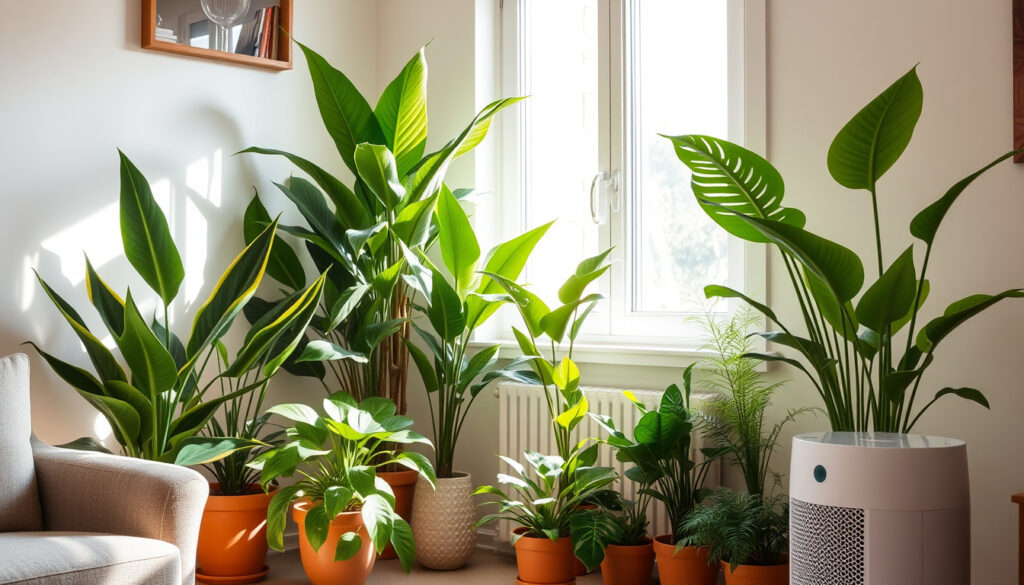
Best Indoor Plants for Air Quality: Science and Picks
Anyone who has bought a houseplant in the past decade has seen the same promise: this leafy green will scrub your air. The idea traces back to a 1989 NASA study that found certain plants can pull volatile organic compounds like formaldehyde out of sealed chambers, but your living room is not a sealed chamber — here’s what the science actually supports and which plants earn their spot on a windowsill.
NASA study year: 1989 · Chemicals tested: formaldehyde, benzene, trichloroethylene · Recurring top plants: snake plant, peace lily, spider plant · Mold claim to verify: 78% airborne mold reduction
Quick snapshot
- NASA’s 1989 Clean Air Study found indoor plants removed benzene, trichloroethylene, and formaldehyde in sealed chamber tests (NASA Technical Reports Server (NASA’s official document archive)).
- Pothos and philodendrons tolerate lower light, although growth slows (Purdue University Extension (university agricultural research)).
- Low-light foliage plants grow best in diffuse light and are grown mainly for foliage (West Virginia University Extension (university horticulture guidance)).
- Whether any plant removes 78% of airborne mold — the figure does not appear in NASA’s published Clean Air Study (NASA Technical Reports Server).
- How many plants a real room needs for a measurable air-quality change — no evidence-based target emerged from the research for this article.
- Which single plant removes the most CO2 in normal conditions — the researched sources do not settle it.
- — NASA publishes the Clean Air Study, the origin of most “air-purifying plant” claims (per NASA Technical Reports Server).
- — Drexel University’s reanalysis questions how much potted plants help in real homes (covered by the Philadelphia Inquirer).
- Match plants to light first — low light is roughly 25–75 foot-candles (Mississippi State University Extension).
- Treat ventilation and source control as the primary air-cleaning steps; plants are a supplement, not a replacement (Philadelphia Inquirer coverage of the Drexel study).
Six facts about the study and its aftermath, one pattern: the laboratory effect is real, and the translation to living rooms is generous.
| Label | What the research shows |
|---|---|
| Study and primary finding | NASA Clean Air Study (July 1989), conducted with the Associated Landscape Contractors of America: indoor plants removed benzene, trichloroethylene, and formaldehyde in sealed chamber tests (NASA Technical Reports Server). |
| Top plants on current lists | Snake plant, peace lily, spider plant, and chrysanthemum — the names that dominate most current round-ups. |
| Species set in the NASA research | Snake plant, English ivy, peace lily, Chinese evergreen, bamboo palm, dracaena, weeping fig (Ficus benjamina), gerbera daisy, and florist’s chrysanthemum (Wikipedia’s summary of the NASA Clean Air Study). |
| Low-light definition | 25–75 foot-candles (Mississippi State University Extension). |
| Distance trigger | Areas more than 8 feet from a window can fall into the low-light range (University of Arizona Cooperative Extension). |
| Artificial light | Recommended when natural light is not enough for sustained plant growth (University of Minnesota Extension). |
What are the best indoor plants to clean the air?
Start with the list that started it all. NASA’s 1989 Clean Air Study is the reason houseplants carry “air-purifying” labels today, and its tested species still anchor most current recommendations. The practical question is which of them can survive your light.
What are the best air purifying plants indoors?
- Snake plant, peace lily, and spider plant lead most current round-ups.
- Florist’s chrysanthemum is the name most often repeated when the question turns to broad VOC coverage.
- The full species set from the NASA research appears in the key facts table; most “best of” lists are reorders of that list.
The catch is that the NASA list is a chemistry result, not a care guide. Those plants performed in chambers with controlled light and airflow. In a real room, the plant that cleans air is the one that survives.
What are the best indoor plants for air quality and low light?
- Pothos and philodendron — the documented low-light-tolerant pair, with slower growth as the trade-off.
- Low light, quantified — 25–75 foot-candles (Mississippi State University Extension).
- North-facing windows — commonly provide suitable conditions for low-light foliage plants (West Virginia University Extension).
Low light is a measurable target, not a vibe. If a corner is more than eight feet from a window, the key facts table above gives you the numbers to treat it as low light.
What are the best low-maintenance indoor plants for clean air?
- Pothos and philodendron — forgiving of dim rooms and uneven care.
- Snake plant and peace lily — present in the NASA-tested set and in most current lists.
Low maintenance means forgiving light needs, not zero care. The same research that put these plants on lists also shows that lower light slows growth — so a low-light plant is a slower-growing, slower-cleaning plant.
What are NASA’s top 10 air purifying plants?
- Most “NASA top 10” lists are built from the species set in the key facts table; the ranking changes from site to site because NASA did not publish a consumer top 10.
Treat any numbered list as a starting point, not a verdict. The plants on it will be real; the order will be editorial.
Apartment dwellers and office workers face the same trade-off: the plant that cleans air best in a NASA chamber is useless if it can’t survive the light. Pothos and philodendron are the documented low-light picks; flowering species like chrysanthemum need far more exposure to do their job.
The pattern: the same plants keep appearing because the controlled science is solid. But a plant that dies in a dark corner filters zero air — choose by light first, NASA list second.
The catch: matching light to plant is the single decision that decides whether the NASA list helps at all.
Do plants improve air quality in the home?
Short answer: yes in sealed tests, barely measurable in real rooms. The original NASA study ran in sealed or highly controlled environments, and a 2019 Drexel University reanalysis — covered by the Philadelphia Inquirer (established metro newspaper) — reported that plants remove airborne chemical pollutants too slowly to provide the air-cleaning effect often attributed to them.
What pulls dust out of a house?
- Ventilation and air exchange — the mechanism that removes indoor VOCs at rates plants cannot match.
- Plants — dust settles on leaf surfaces, which is why leaves need occasional wiping; they are not a whole-home dust removal system.
If you want less dust, clean and ventilate. A plant’s leaf surface can catch a little, but the Drexel analysis found the overall air-cleaning contribution of houseplants in normal buildings is small.
Does ficus clean air?
- Ficus benjamina (weeping fig) — part of the NASA-tested species set in the key facts table.
Yes, in the controlled sense. The weeping fig can help remove VOCs such as formaldehyde in chamber tests. In a real room, its contribution faces the same ventilation math as every other houseplant — noticeable in a terrarium, minor in a ten-foot-ceiling living room.
What this means: plants are a supplement, not a system. Opening a window or running an exhaust fan does more for a typical room than a shelf of potted plants.
Can plants remove mold from the air?
Mold is where the marketing goes farthest. Search for plants that purify air from mold and you will find a statistic repeated as fact: houseplants remove “78% of airborne mold.” This article could not trace that figure to any published study.
What plant removes 78% of airborne mold?
- No traced source — the 78% figure does not appear in NASA’s Clean Air Study, which targeted chemical VOCs, not mold spores.
- The number circulates on social posts and retailer pages, but the documented science behind it is missing.
The published study that started the plant-air trend tested benzene, trichloroethylene, and formaldehyde — not mold. That is the whole scope, and it does not include spores.
The “78% airborne mold” figure circulates widely on social posts and some retailer pages. The research for this article could not trace it to a primary or secondary study.
What kills mold spores in the air naturally?
- Source control and ventilation — the first response to mold is fixing leaks and reducing humidity.
- Filtration for spores — mechanical filtration, not plants, is the documented category of solution.
Mold needs moisture to grow. Remove the moisture source and you remove the mold problem; keep the moisture and no plant changes the outcome.
Is there a houseplant that kills mold?
- None documented — the researched science covers chemical VOCs, and no plant in the NASA-tested set was evaluated for killing airborne mold spores.
“Mold-killing houseplant” is marketing shorthand. The plants people recommend for bathrooms tolerate humidity; they do not eliminate spores.
What is the best indoor plant to combat mold?
- Moisture-tolerant plants — they can survive a bathroom’s humidity, but survival is not spore removal.
If your concern is bathroom mold, the best “plant” is a working exhaust fan and a habit of drying wet surfaces. Houseplants come after the moisture problem is solved.
Do plants in the bathroom prevent mold?
- Not by removing spores — the documented NASA-era effects are chemical VOC removal, not mold control.
Bathrooms with good ventilation and no chronic leaks do not need plants to stay mold-free.
Which plants purify the air from mold?
- No plant in the researched sources is documented for airborne mold removal.
The honest answer is none of them. Treat mold as a building problem first.
The 78% airborne mold figure is not from NASA’s published study — the 1989 report targeted chemical VOCs, not spores. For anyone with a mold problem, the fix is reducing humidity and fixing leaks, not adding a plant.
The catch: mold is a moisture problem, not a plant deficiency. Until the leak is fixed and humidity drops, no houseplant changes the outcome.
The upshot: mold is a moisture problem, and ventilation is the remedy — plants are decoration, not remediation.
Which plant removes the most CO2?
Houseplants absorb CO2 through photosynthesis, but the rate depends on light, leaf area, and growth. NASA’s Clean Air Study measured VOC removal, not CO2 removal. No single indoor plant is proven as a clear winner in normal home conditions — and lower light directly slows growth, which means less photosynthesis.
The same dim corner that makes a plant easy to keep also makes it a weak CO2 scrubber. Light is the ceiling on every plant’s air-cleaning performance.
The implication: CO2 claims are usually overblown. A plant’s CO2 performance is capped by the light you can actually give it.
How many indoor plants do you need to clean the air?
A widely repeated NASA-derived rule of thumb says one plant per 100 square feet of space. The catch is that real-world air exchange removes VOCs at rates that would require impractically large numbers of plants to match — a point made in the Wikipedia summary of the NASA Clean Air Study. The Drexel reanalysis reached the same conclusion from a different angle: plant removal is simply too slow for real rooms.
One plant per 100 square feet sounds neat, but the research says matching real-world air exchange would need a jungle, not a windowsill. For most households, opening a window does more than adding a tenth plant.
Why this matters: plant counts matter less than air exchange. If you want cleaner air, the cheapest “plant” is an open window.
How can I naturally purify my indoor air?
Natural purification is an order of operations. First, reduce what pollutes the air; second, ventilate; third, let plants play a supporting role. The research is explicit that plants are not a substitute for source control, ventilation, filtration, or fixing moisture problems (Philadelphia Inquirer coverage of the Drexel study).
Natural purification methods beyond plants
- Open windows and use exhaust fans to dilute indoor pollutants — air exchange does the heavy lifting.
- If your home runs on air conditioning rather than open windows, mechanical air exchange matters even more — see our Mitsubishi Aircon System 3: Price, Symbols, Problems & Settings guide for how that fits together.
Source control for VOCs and mold
- Remove or reduce the sources of VOCs, dust, and moisture before buying plants.
- Fix leaks and lower humidity — that is the documented first response to mold.
Then add plants as a small supplement. If you are shopping for the right species, a local nursery is the fastest way to match plants to your light — our Plant Nursery Near Me: Compare Local Garden Centres guide is a practical starting point.
The pattern: purification is an order of operations, not a shopping list — source control first, ventilation second, plants third.
How the top air-purifying plants compare
Four ways to think about plant placement, one pattern: light decides everything.
| Plant or setup | Documented light guidance | What the research adds |
|---|---|---|
| Pothos | Tolerates lower light, though growth slows. | A forgiving starter plant for dim corners. |
| Foliage houseplants (snake plant, peace lily, dracaena) | Grow best in diffuse light (West Virginia University Extension). | Grown mainly for foliage rather than flowers. |
| Low-light rooms | Areas more than 8 feet from a window can fall into the low-light range (University of Arizona Cooperative Extension). | North-facing windows are a reliable starting point. |
| Dark rooms | Natural light may be insufficient; artificial lighting is the documented fix (University of Minnesota Extension). | This is the path for sustained growth, not a decoration choice. |
The trade-off: every plant on this list works only as hard as its light allows.
Air-purifying plant care specs at a glance
Six light-related specs, one pattern: the research gives you exact numbers, and most rooms fall short of them.
| Spec | Documented value |
|---|---|
| Low-light range | 25–75 foot-candles. |
| Distance trigger | Areas more than 8 feet from a window can qualify as low light (University of Arizona Cooperative Extension). |
| Window direction | North-facing windows suit low-light foliage plants. |
| Light preference | Diffuse, indirect light. |
| Growth trade-off | Lower light slows growth, including in pothos and philodendron (Purdue University Extension). |
| Artificial light | Needed when natural light can’t sustain growth (University of Minnesota Extension). |
What this means: if you can’t meet the light number on the spec, the care advice changes before the plant list does.
Pros and cons of using plants for cleaner air
The honest trade-off is between what the controlled science shows and what a real room delivers.
Upsides
- Science-backed: NASA’s chamber tests documented VOC removal.
- Low-light options exist: pothos and philodendron tolerate dim rooms.
- Foliage plants are forgiving: diffuse light plus modest care keeps them growing.
Downsides
- Real-room effect is slow: the Drexel reanalysis found plant removal too slow for normal buildings.
- Not a substitute: plants don’t replace ventilation, filtration, or moisture remediation.
- Mold claims overreach: the 78% figure is not in NASA’s study.
- CO2 angle is untested: NASA measured VOCs, not CO2.
The balance favors buying plants — for what they add to a room, not for a filtration job the research says they can’t do.
How to choose and place air-purifying plants
Six steps, in the order that matters: light before lists, placement before promises.
- Measure your light. Treat spots more than 8 feet from a window as low light.
- Choose tolerant species. Pothos and philodendron are the documented low-light picks.
- Place in diffuse, indirect light. North-facing windows are a proven starting point.
- Dust the leaves periodically so photosynthesis stays efficient.
- Ventilate the room. Air exchange, not a shelf of plants, does the heavy lifting.
- Add artificial light when natural light can’t sustain growth.
The implication: follow the light, not the list, and the rest becomes easier.
How the plant-air quality story evolved
Two dates shape the whole debate.
- — NASA publishes the Clean Air Study, documenting that indoor plants remove benzene, trichloroethylene, and formaldehyde from sealed chambers (Wikipedia’s summary of the NASA Clean Air Study).
- — Drexel University’s reanalysis argues that plant removal rates are too slow to clean real rooms, as covered by the Philadelphia Inquirer.
The trend line matters: the science moved from “plants clean air” to “plants barely register next to ventilation.” The lists you see online are mostly a decade behind the research.
What’s confirmed and what’s still unclear
A quick separation, because this topic has an unusually large gap between the two columns.
Confirmed
- NASA’s 1989 study documented VOC removal in sealed chambers.
- Snake plant, peace lily, and chrysanthemum are among the species in that tested set.
- Pothos and philodendron tolerate lower light, with slower growth as the trade-off (Purdue University Extension).
What’s still unclear
- Whether any plant removes 78% of airborne mold.
- Whether a small number of houseplants produces a noticeable improvement in a real home.
- Which single plant removes the most CO2 in normal indoor conditions.
- Whether plants can replace mechanical filtration for dust, spores, or allergens.
The trade-off: every unproven claim on a plant page makes the real science harder to see. Trust the chamber results, doubt the marketing numbers.
What the researchers say
Three sources, one throughline: the laboratory effect is measurable, the living-room effect is marginal, and light decides everything.
Several common indoor plants removed benzene, trichloroethylene, and formaldehyde from sealed test chambers.
— NASA Clean Air Study (1989)
Plants remove airborne chemical pollutants too slowly to provide the air-cleaning effect often attributed to them in normal buildings.
— Drexel University reanalysis, as covered by Philadelphia Inquirer coverage of the Drexel study
Pothos and philodendrons can handle lower light, although growth slows.
— Purdue University Extension
The throughline: choose plants for the life they bring to a room, not for a filtration job they can’t perform.
Where that leaves your home
The NASA study is real, and it is routinely oversold. In a sealed chamber, plants pulled chemicals from the air; in a living room, the same plants work at a rate that ventilation easily outpaces. For apartment dwellers in humid, window-limited spaces, the choice is clear: buy plants you can keep alive, then treat an open window, an exhaust fan, and fixing leaks as the real air-quality system — plants are the bonus, not the fix.
Frequently asked questions
What is the easiest air-purifying plant to keep alive?
Pothos and philodendron are the most forgiving of the commonly recommended picks because they tolerate lower light, though they grow more slowly in dim rooms. Snake plant and peace lily also appear on nearly every air-quality list and survive typical indoor neglect when matched to the right light.
How much light do air-purifying plants need?
Low light is roughly 25 to 75 foot-candles, and spots more than 8 feet from a window usually fall into that range. Low-light foliage plants grow best in diffuse light, and north-facing windows are a reliable source of it. If your room is darker than that, add artificial lighting.
How do I clean dust off houseplant leaves?
Dust settles on leaf surfaces and can slow photosynthesis. Wipe leaves gently every few weeks, and accept that a dusted leaf is not the same as a dust-filtered room — houseplants are not HEPA filters.
Can air-purifying plants replace an air purifier?
No. The Drexel University reanalysis found plants remove airborne pollutants too slowly to deliver the air-cleaning effect commonly claimed for real rooms. Keep the air purifier, fix the moisture problem, and treat plants as a supplement.
Are air-purifying plants safe for pets?
The NASA study evaluated air, not pet safety, so a plant’s presence on an air-quality list says nothing about toxicity. If you share your home with pets, check each species against a recognized plant-toxicity database before buying.
Do air-purifying plants need special soil?
The NASA research focused on air, not soil, so it offers no special soil recipe. Practical care guidance centers on matching light and avoiding overwatering, which matters more than an expensive potting mix.
More related posts
 Samsung Galaxy Z Fold7 Call Assist: Setup, Live Translate & More
 McDonald Happy Meal Toy Singapore – 2024 Promotions Dates and Tips
 Plant Nursery Near Me: Compare Local Garden Centres
 Cé La Vi Singapore Reviews: Worth the Hype? (2025 Guide)
 Gold Chain for Men: Sizes, Styles & Prices in Ireland
 Samsung Galaxy Z Series: Fold vs Flip, Specs, Price
 Spicy Wife Nasi Lemak Reviews: Menu, Price & Halal
 Pizza Capricciosa Near Me: Ireland’s Top Choices