What Is a 3D Filament? Types, Uses, and Selection Tips
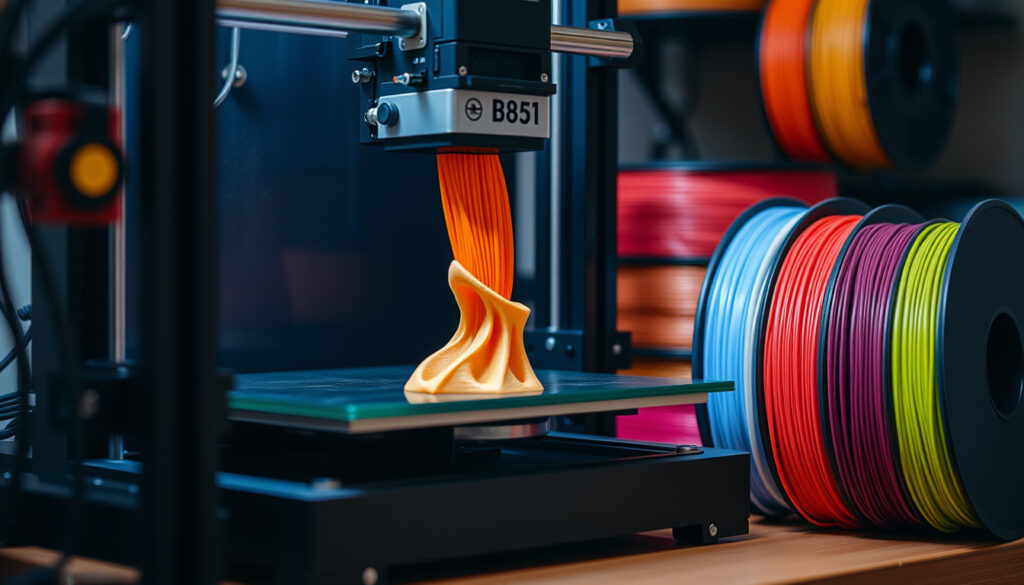
If you’ve watched a 3D printer build an object from a thread of plastic, you’ve already seen a 3D filament in action. That thin spooled material is the essential feedstock for fused filament fabrication (FFF) 3D printers, but not all filaments behave the same way.
Common filament diameter: 1.75 mm · Standard spool weight: 1 kg · Estimated global market size (2023): ~$1.2 billion · Most common material: PLA · Typical extrusion temperature range: 190–260 °C
Quick snapshot
- 3D printing filament is a thermoplastic feedstock for FFF printers (The CAD Hub (3D printing education platform)).
- Most filaments are made from petroleum-based plastics (ABS) or plant-based plastics (PLA). (The CAD Hub (3D printing education platform))
- Filament is supplied on spools, typically 1 kg (3DJake (3D printing retailer)).
- Exact number of filament manufacturers worldwide.
- Long-term durability of newer composite filaments without independent testing.
- Environmental impact of biodegradable vs. non-biodegradable filaments.
- 1980s: Early additive manufacturing patents emerge.
- 2009: Expiry of key FDM patents leads to desktop 3D printer boom.
- 2010s: Proliferation of new materials like PETG, TPU, composites.
- 2020s: Focus on industrial-grade and sustainable filaments.
- Increased development of bio-based and recycled filaments.
- Integration of smart sensors in spools for inventory tracking.
- Growing adoption of 3D printing in medical and aerospace applications.
Five key facts define the basic specs of 3D printer filament, from standard diameters to common materials.
| Label | Value |
|---|---|
| Typical Diameter | 1.75 mm or 2.85 mm |
| Common Material | PLA (Polylactic Acid) |
| Spool Weight | Usually 1 kg |
| Extrusion Temp (PLA) | 190–220 °C |
| Category | Thermoplastic Polymer |
| PLA Bed Temperature | 50–60 °C (3D To Print Shop (filament retailer)) |
| PETG Extrusion Temp | 220–250 °C (3D To Print Shop) |
| ABS Extrusion Temp | 230–260 °C (3D To Print Shop) |
| TPU Extrusion Temp | 220–240 °C (3D To Print Shop) |
The implication: temperature ranges overlap, but each material demands a specific sweet spot for reliable printing.
What is a 3D filament made of?
Thermoplastic polymers in filament
- 3D printing filament is a thermoplastic feedstock — it melts when heated and solidifies when cooled, making it ideal for layer-by-layer extrusion (Wikipedia (general encyclopedia)).
- Most filaments are made from petroleum-based plastics like ABS or plant-based plastics like PLA.
- Manufacturers may add fillers (carbon fiber, wood particles) to alter mechanical properties.
Common additives and fillers
- Carbon fiber increases stiffness and reduces weight.
- Wood particles give a wood-like appearance but require specific nozzle settings.
- Glow-in-the-dark and metallic additives are also available.
Material properties comparison
Three common materials, one clear pattern: ease of printing trades off against heat resistance and strength.
| Material | Ease of Printing | Strength | Heat Resistance | Flexibility |
|---|---|---|---|---|
| PLA | Very easy | Moderate | Low (~60°C) | Low |
| PETG | Easy | High | Moderate (~75°C) | Low |
| ABS | Moderate (needs enclosure) | High | High (~100°C) | Low |
| TPU | Moderate (needs direct drive) | Low | Moderate (~80°C) | High |
The trade-off: PLA prints easily but deforms in a hot car; ABS withstands higher temperatures but requires ventilation and an enclosure (Polyfab3D (3D printing supplier)).
What do you use 3D filament for?
Rapid prototyping
- Filament is used to create physical objects by extruding melted plastic layer by layer (The CAD Hub).
- Designers iterate quickly on form, fit, and function before committing to a final material.
End-use parts and functional components
- PETG is commonly recommended when a part needs more toughness, better heat resistance, and better water resistance than PLA (The CAD Hub).
- ABS is chosen for higher heat resistance and for post-processing such as acetone smoothing (The CAD Hub).
Educational and hobby projects
- PLA is widely recommended as the easiest first filament for beginners, ideal for decorative models, toys, and school projects (The CAD Hub).
- TPU is the flexible filament choice when a part needs to bend, absorb shock, or act like a gasket or wearable (The CAD Hub).
Artistic and design objects
- Specialty filaments with wood, metal, or glow-in-the-dark particles allow aesthetic finishes without painting.
- Designers use multi-material prints to combine rigid and flexible sections in one object.
The catch: picking the wrong filament for a job turns a fast prototype into a warped failure. Match material to use case from the start.
What is 3D filament on a 3D printer?
Spool and feeding mechanism
- 3D printer filament is one continuous slender plastic thread spooled on a reel for ease of storage and printer feeding (Raise3D (industrial 3D printer manufacturer)).
- Spools typically weigh 1 kg and hold about 330 meters of 1.75 mm filament.
Filament path: from spool to print head
- The printer’s extruder pulls filament from the spool, using a geared motor to push it through a Bowden tube or direct drive.
- Filament diameters are generally 1.75 mm or 2.85 mm (3DJake).
How the print head melts the filament
- The hotend heats the filament to a semi-liquid state, then deposits it through a nozzle (typically 0.4 mm diameter).
- Layer heights range from 0.1 mm to 0.3 mm, building the object from the bottom up.
The pattern: consistent diameter and temperature control are non-negotiable — any variation ruins the print.
Is filament like plastic?
Filament as thermoplastic
- Yes, filament is essentially thin plastic thread, typically made of thermoplastics (Reddit community r/3Dprinting (user discussion)).
- ABS is what LEGO is made out of; PLA is a corn-based plastic.
Types of plastics used
- PLA (Polylactic Acid) is a biodegradable polyester derived from renewable resources like corn starch.
- ABS (Acrylonitrile Butadiene Styrene) is a petroleum-based thermoplastic known for impact resistance.
- PETG (Polyethylene Terephthalate Glycol) combines ease of printing with durability.
Elasticity and flexibility differences
- TPU is a flexible filament, known for its elasticity (FilaScope (filament selection guide)).
- PLA and ABS are rigid; PETG offers a slight flex under load.
The catch: calling filament “plastic” is accurate, but the variety of plastic types means very different print behaviors.
What filament do I need for a 3D printer?
Choosing based on printer type
- The choice of filament depends on the printer’s build volume and hotend temperature capabilities — a stock printer may not reach 260°C needed for ABS.
- Flexible filaments like TPU require a direct drive extruder for reliable printing (FilaScope).
Best filament for beginners
- PLA is generally recommended for beginners due to its ease of printing and low warp (The CAD Hub).
- PLA is the most forgiving option when print success matters more than mechanical performance (FilaScope).
Material-specific requirements and print settings
- PETG is often described as balancing strength and printability better than ABS for many general-purpose functional parts (Polyfab3D).
- ABS becomes more attractive when heat resistance above roughly 60°C matters, such as in cars or near electronics (FilaScope).
What this means: start with a spool of PLA, learn the basics, then graduate to PETG or TPU as your projects demand more.
Material comparison: PLA vs. PETG vs. ABS vs. TPU
Four materials, one decision: which property matters most for your print?
| Property | PLA | PETG | ABS | TPU |
|---|---|---|---|---|
| Printing difficulty | Low | Medium | High | Medium |
| Bed adhesion | Easy | Good | Needs brim/raft | Good |
| Heat resistance | ~60°C | ~75°C | ~100°C | ~80°C |
| Flexibility | Rigid | Rigid | Rigid | Flexible |
| Outdoor durability | Poor | Good | Moderate | Good |
| Cost per 1kg spool | $20–$30 | $25–$35 | $25–$40 | $30–$50 |
The implication: there is no single best filament — only the best for your specific use case, budget, and printer.
Specifications at a glance
Six key settings, one pattern: temperature and bed adhesion are the first variables to dial in.
| Material | Nozzle Temp (°C) | Bed Temp (°C) | Print Speed (mm/s) | Cooling Fan |
|---|---|---|---|---|
| PLA | 190–220 | 50–60 | 40–60 | Full |
| PETG | 220–250 | 70–85 | 40–50 | Minimal |
| ABS | 230–260 | 95–110 | 30–50 | Off (enclosure) |
| TPU | 220–240 | 40–60 | 20–30 | Minimal |
The catch: these are starting points — every printer and spool behaves slightly differently, so always run a temperature tower first.
How to choose your first filament (step by step)
- Start with PLA. It prints at low temperatures, doesn’t require a heated bed (though it helps), and produces minimal fumes (The CAD Hub).
- Check your printer’s hotend. Most stock hotends can reach 240°C, enough for PETG but not for ABS. If you want ABS, upgrade to an all-metal hotend.
- Match the material to the use case. For decorative items, use PLA. For functional parts that need strength, use PETG. For flexible parts, use TPU. For high heat, use ABS.
- Buy a 1 kg spool. It’s the most cost-effective size and gives you about 30–40 small prints.
- Store filament properly. Keep it in a dry, sealed container with silica gel. Moisture ruins print quality (3DPrinting.com (3D printing news and guides)).
For beginners, the choice is clear: start with a spool of PLA, learn the printer’s quirks, then experiment with other materials as your skills grow.
Timeline: How 3D filament evolved
- – Early additive manufacturing processes and patents emerge.
- – Expiry of key FDM patents leads to a boom in affordable desktop 3D printers.
- – Proliferation of new filament materials including PETG, TPU, and specialty composites.
- – Increased focus on industrial-grade materials and sustainability in filament production.
The pattern: each decade brought new materials, driven by patent expirations and growing demand for stronger, more versatile prints.
Confirmed facts vs. What’s unclear
Confirmed facts
- Filament is a thermoplastic feedstock (Wikipedia).
- PLA is a common, relatively easy-to-print material.
- Filament is supplied on spools.
What’s unclear
- The exact number of filament manufacturers globally.
- Long-term durability of specific, newer composite filaments without independent testing.
Expert perspectives on 3D filament
“3D printing filament is the thermoplastic feedstock for fused filament fabrication 3D printers.”
“ABS is what LEGO is made out of. PLA is a corn based plastic.”
“PETG is commonly recommended when a part needs more toughness, better heat resistance, and better water resistance than PLA.”
— The CAD Hub (3D printing education platform)
Summary
3D printing filament is a thermoplastic thread that turns digital designs into physical objects. A beginner’s smartest first step is a 1 kg spool of PLA — it prints reliably, costs little, and builds confidence. As projects demand more strength, heat resistance, or flexibility, PETG, ABS, and TPU are proven alternatives. Start with PLA, then experiment based on what your prints need to endure.
blog.uavmodel.com, youtube.com, 3dprinting.com, ebay.com, youtube.com, youtube.com, youtube.com, thecadhub.com
For a deeper dive into material options, check out this comprehensive guide to 3D filament types that covers compatibility and material specifics.
Frequently asked questions
What is the difference between PLA and ABS filament?
PLA is easier to print, biodegradable, and has lower heat resistance. ABS is stronger, more heat-resistant, but requires an enclosure and good ventilation due to fumes.
How should I store 3D printer filament?
Store filament in a dry, airtight container with silica gel desiccant. Moisture causes bubbles and poor layer adhesion during printing.
What does ‘stringing’ mean and how do I fix it?
Stringing is when thin strands of plastic appear between separate parts of a print. Reduce the nozzle temperature, increase retraction distance, or lower print speed.
Can I use any filament in my 3D printer?
No. Check your printer’s hotend temperature limit (usually 240°C for PTFE-lined hotends) and whether it has a direct drive extruder for flexible filaments like TPU.
What safety measures should I take when 3D printing with filament?
Print in a well-ventilated area, especially with ABS which emits styrene fumes. Use an enclosure to contain fumes and prevent warping. Avoid touching the hotend.
What is the strongest 3D printer filament?
For most desktop printers, PETG is a good balance of strength and ease of printing. For extreme strength, polycarbonate (PC) or nylon offer higher tensile strength but require high-temperature hotends.
More related posts
 La Roche-Posay Sunscreen Review: Worth the Hype
 O-Level Results 2026: Release Dates & Key Information
 City Square Mall Parking: Rates, Free Hours & Tips
 Dewakoin99 Gacor Login: Access the Situs Slot Site
 Punjab Kings vs Mumbai Indians Match Scorecard: 2026 Head-to-Head
 Thunder vs Nuggets: Prediction, Picks & Head-to-Head
 Singapore to Sydney Flights: Time, Airlines, Cost & Schedule
 Singapore Dollar Rate in Bangladesh Today (SGD to BDT)