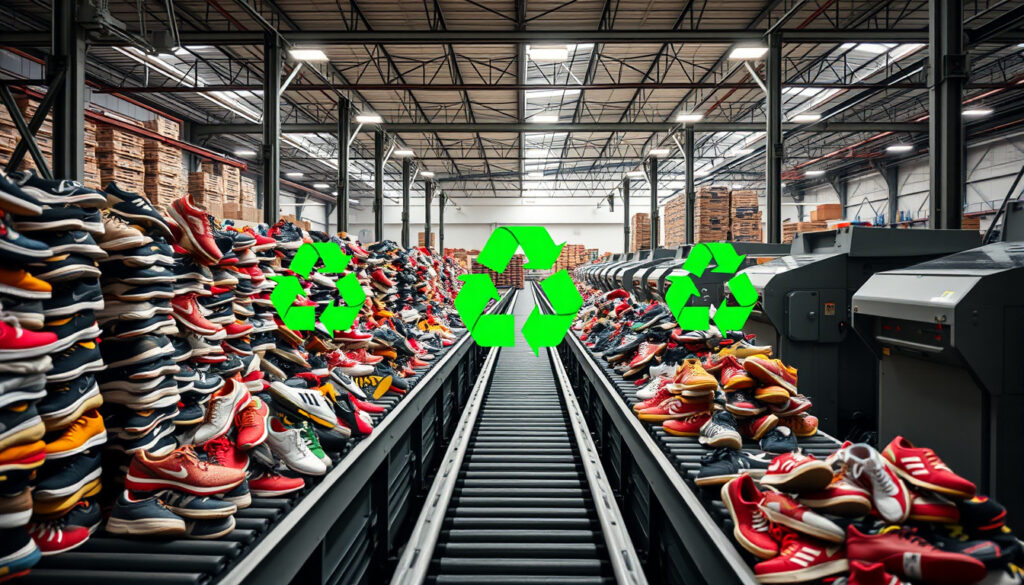
Tuas Warehouse Shoe Recycling Project – What You Need to Know
Tuas Warehouse Shoe Recycling Project: Full Overview
A pioneering shoe recycling initiative launched in Singapore’s Tuas industrial district has collected over 400,000 pairs of used sports shoes since July 2021, yet faces significant challenges in repurposing the accumulated materials. The project, developed through a collaboration between Sport Singapore and materials science company Dow, aims to transform donated footwear into granules for surfacing applications across the island.
The programme was designed to address mounting footwear waste in Singapore, where approximately 22 million pairs of shoes are purchased each year. By converting discarded athletic footwear into reusable material, organisers sought to divert waste from the country’s limited landfill capacity on Semakau Island while reducing reliance on imported rubber tire crumbs.
Despite achieving its collection targets, the initiative has encountered obstacles in securing sufficient end-users for the processed granules. With nearly 300,000 pairs currently stored at a warehouse facility along Gul Drive, project partners are seeking expanded participation from businesses, developers, and government agencies to translate collected materials into completed installations.
What is the Tuas Warehouse Shoe Recycling Project?
The Tuas Warehouse Shoe Recycling Project represents Singapore’s most ambitious effort to address footwear disposal through material recovery. Established in July 2021, the programme collects used sports shoes from donation points islandwide and processes them into granules at a dedicated facility managed by B T Sports, a company specialising in sports facility surfaces.
Key Insights from the Programme
- Landfill Diversion: More than 400,000 pairs collected since launch, preventing shoes from entering incineration or Semakau disposal routes
- Repurposing Gap: Approximately 70,000 pairs have been successfully converted into finished products across 18 completed projects
- Material Performance: Laboratory analysis conducted by Dow and Singapore’s institutes of higher learning confirmed superior safety characteristics compared to conventional tire crumb alternatives
- Carbon Reduction: Using locally processed granules instead of imported tire crumbs reduces transportation emissions and supports Singapore’s net import dependency for rubber materials
- Scale Mismatch: Annual collection targets of 170,000 pairs have been consistently exceeded, creating storage pressures at the Tuas facility
- Demand Stagnation: Waning interest from potential end-users has stalled the project’s momentum despite abundant material supply
| Fact | Details |
|---|---|
| Lead Operators | Sport Singapore (SportSG) and Dow |
| Facility Location | Gul Drive, Tuas industrial area |
| Warehouse Manager | B T Sports |
| Programme Start | July 2021 |
| Total Pairs Collected | Over 400,000 pairs |
| Pairs Repurposed | Approximately 70,000 pairs |
| Completed Projects | 18 installations |
| Annual Target | 170,000 pairs |
| Current Stockpile | 300,000–330,000 pairs |
| National Shoe Purchases | Approximately 22 million pairs yearly |
Where is the Tuas Warehouse Located and What Are Its Features?
The processing and storage facility operates from Gul Drive in Singapore’s western industrial zone, an area characterised by manufacturing and logistics operations. This location provides strategic access to major transportation routes while maintaining sufficient space for the substantial volume of donated footwear arriving daily from collection points throughout the city-state.
B T Sports, the partner responsible for day-to-day warehouse management, brings expertise in sports facility surfaces to the initiative. The company handles the grinding and granulation of collected shoes, transforming intact footwear into raw material suitable for surfacing applications.
Facility Operations
The warehouse serves dual functions as both a receiving station for donated footwear and a processing centre where materials undergo size reduction. Equipment at the site grinds shoes into granules of consistent dimensions, preparing them for distribution to construction and installation projects across Singapore.
Hayden Hoon from B T Sports has noted the space trade-offs inherent in managing large volumes of incoming materials. While the accumulating inventory represents successful collection efforts, the facility faces constraints in storing processed granules awaiting application projects.
Storage limitations have emerged as the programme scales beyond initial projections. Partners continue to manage incoming donations while seeking additional end-users to clear stockpiles and maintain operational efficiency at the Tuas site.
How Does the Shoe Recycling Process Work at the Tuas Warehouse?
The material recovery process begins when donated shoes arrive from public collection points distributed across Singapore. Items are sorted to remove non-recyclable components, after which the remaining footwear undergoes grinding to produce granules approximately 2-4 millimetres in diameter.
Material Transformation Stages
The grinding process separates rubber soles from textile uppers, creating a mixed granule product that retains the functional properties of athletic footwear materials. These granules serve as an alternative to conventional rubber tire crumbs, which Singapore currently imports to meet demand for running tracks, playground surfaces, and similar installations.
Laboratory testing conducted jointly by Dow and researchers at Singapore’s universities and polytechnics validated the technical performance of shoe-derived granules. Findings indicated improved safety profiles, including better shock absorption and reduced hardness compared to tire-based alternatives.
End-Use Applications
Processed granules have been installed across diverse settings since the programme launched. Completed projects include running tracks, playground surfaces, jogging paths, and bike lanes. Notably, one installation was completed atop a residential condominium, demonstrating the versatility of the material for urban applications.
- Running tracks at sports facilities
- Playground safety surfaces
- Jogging paths in residential developments
- Bicycle path surfacing
- Condominium recreational areas
Analysis confirmed that shoe-derived granules demonstrate superior safety characteristics and a lower carbon footprint compared to imported tire crumbs. This positions the recycled material as an environmentally preferable alternative for sports surfacing projects throughout Singapore.
How Can Individuals and Businesses Participate?
Public participation primarily occurs through shoe donation, with collection points available throughout Singapore for residents wishing to contribute usable athletic footwear. Donated shoes must be sports-related items, as the programme specifically targets athletic footwear rather than formal shoes or sandals.
Donation Guidelines
Individuals can drop off shoes at designated collection points, where items are subsequently transported to the Tuas facility for processing. The programme accepts worn athletic footwear in various conditions, as the grinding process accommodates materials regardless of surface wear.
For businesses and organisations, partnership opportunities exist for firms seeking to utilise granules in construction or renovation projects. Developers building running tracks, playgrounds, or recreational facilities can incorporate shoe-derived materials as an alternative to imported rubber products.
Collaboration Opportunities
Project partners actively seek additional collaborators to expand demand for processed granules. Firms constructing new sports facilities, renovating existing premises, or developing recreational spaces may benefit from incorporating the recycled material while supporting Singapore’s sustainability objectives.
For entities interested in participation, contacting Sport Singapore or Dow directly provides pathways to explore potential collaboration arrangements. The programme’s expansion depends partly on identifying additional projects capable of absorbing the substantial inventory currently held at the Tuas warehouse.
Experts emphasise that future initiatives should align collection capacity with projected demand. The current programme’s experience demonstrates the importance of coordinating material recovery efforts with end-user commitments to avoid accumulation and storage challenges.
Project Timeline and Key Milestones
The programme has progressed through distinct phases since its inception, with collection efforts consistently outpacing repurposing capacity. Understanding the timeline provides context for the challenges currently facing the initiative.
- July 2021: Official launch of the SportSG-Dow shoe recycling collaboration
- 2021–2022: Establishment of collection infrastructure and initial donation drives
- 2022: First completed repurposing projects using processed granules
- 2023: Cumulative collection reaches and exceeds annual targets
- 2024: Reports emerge of accumulating inventory at the Tuas warehouse
- Present: Approximately 70,000 pairs repurposed across 18 projects; over 400,000 pairs collected total
What is Confirmed Versus Uncertain About This Project?
| Established Information | Information That Remains Unclear |
|---|---|
| Located in Tuas industrial area along Gul Drive | Specific details about collection point locations |
| Focuses on sports shoe material recovery | Long-term funding sustainability |
| Partnership between SportSG and Dow | Plans for facility expansion or relocation |
| Over 400,000 pairs collected since July 2021 | Specific timeline for clearing current stockpile |
| Approximately 70,000 pairs repurposed across 18 projects | Mechanisms for scaling end-user engagement |
| Material demonstrates superior safety profile versus tire crumbs | Future involvement of additional government agencies |
| B T Sports manages warehouse operations | Criteria for prioritising which projects receive materials |
Environmental and Sustainability Context
Singapore’s waste management infrastructure faces persistent pressure from urban consumption patterns. With approximately 22 million pairs of shoes purchased annually across the city-state, footwear represents a meaningful component of solid waste streams that must be managed within the country’s limited disposal capacity.
The Semakau Island landfill serves as Singapore’s final disposal destination for waste that cannot be recycled or incinerated. The National Environment Agency oversees broader recycling initiatives across the city-state, and the Tuas programme contributes to extending the operational lifespan of critical waste management infrastructure while reducing the environmental burden of footwear disposal.
Paul Fong, Dow’s country director, has articulated the company’s commitment to material circularity over donation or resale pathways. This approach prioritises keeping materials within production cycles rather than dispersing them through charitable distribution, aiming to maximise environmental benefit through direct recycling into new products.
The granules produced from recycled shoes serve as a domestic alternative to imported tire crumbs. Singapore’s status as a net importer of rubber materials means that every kilogram of shoe-derived granules displaces transportation emissions associated with international supply chains.
Expert Perspectives and Sources
Media coverage by Channel NewsAsia has documented the programme’s development, including coverage of both achievements and ongoing challenges. Video reports have captured conditions at the Tuas facility, showing accumulated inventory awaiting repurposing applications.
Hayden Hoon of B T Sports has highlighted the fundamental trade-off between storage constraints and environmental benefit, noting that accumulating materials, while challenging, ultimately prevents shoes from entering landfill disposal systems.
Technical validation from academic institutions, including Singapore’s universities and polytechnics, provides independent verification of the processed material’s performance characteristics. This research support strengthens the programme’s credibility for potential end-users evaluating shoe-derived granules as an alternative to conventional options.
For additional context on Singapore’s waste management approach, the National Environment Agency oversees broader recycling initiatives across the city-state.
Summary and Current Status
The Tuas Warehouse Shoe Recycling Project has demonstrated successful collection infrastructure while facing significant challenges in translating gathered materials into completed installations. With over 400,000 pairs of shoes collected but only about 70,000 pairs repurposed after nearly four years of operation, the programme illustrates the importance of aligning supply-side collection efforts with demand-side end-user commitments.
Partners continue seeking collaborators willing to incorporate shoe-derived granules into upcoming projects. The initiative’s environmental benefits remain documented through laboratory analysis and completed installations, though realising these benefits at scale depends on expanded participation from businesses, developers, and government agencies. For readers interested in Singapore’s broader sustainability landscape, coverage of other recycling initiatives and environmental developments provides additional context on the country’s waste reduction efforts.
Frequently Asked Questions
What types of shoes does the programme accept?
The initiative accepts donated sports shoes and athletic footwear. Items are processed regardless of wear condition, as the grinding procedure accommodates various surface states.
Where can I drop off shoes for recycling?
Public collection points are available throughout Singapore for shoe donations. Specific locations can be confirmed through Sport Singapore or partner organisations.
What happens to shoes after collection?
Collected shoes are transported to the Tuas warehouse, where they undergo grinding to produce granules. These granules are then distributed for use in sports surfacing applications.
What projects have used the recycled material?
Completed installations include running tracks, playground surfaces, jogging paths, bike lanes, and recreational areas at residential developments across 18 distinct projects.
How does the material compare to conventional options?
Laboratory analysis confirms that shoe-derived granules offer superior safety characteristics and a lower carbon footprint compared to imported rubber tire crumbs.
Can businesses participate in the programme?
Yes, businesses and developers can partner with the initiative to utilise granules in construction projects or support the programme through other collaboration arrangements.
Why has material accumulated at the warehouse?
Collection has consistently exceeded repurposing capacity. Waning interest from potential end-users has slowed the conversion of collected materials into completed projects.
What are the environmental benefits of the programme?
Benefits include diverting shoes from landfill disposal, reducing reliance on imported rubber materials, and lowering carbon emissions associated with transportation and waste incineration.
Who manages the Tuas warehouse facility?
B T Sports, a company specialising in sports facility surfaces, manages day-to-day operations at the Gul Drive warehouse location.
What is needed to expand the programme’s impact?
Expanded participation from end-users—developers, sports facilities, and government projects—is needed to absorb current inventory and align future collection efforts with demonstrated demand.
More related posts
 Best Online Brain Games: Reduce Dementia Risk
 Watch Movies Online Free: Legal Sites for Jason Statham & More
 Human Washing Machine Japan: Price & How It Works
 Lee Na-young: biography, career, marriage, and 2024 return
 Hong Kong Country Code: +852, ISO Codes and Calling Guide
 Gold Chain for Men: Sizes, Styles & Prices in Ireland
 Ah Yat Seafood Restaurant: Menu, Locations & Singapore Guide
 Banh Mi Thit by Star Baguette – Prices, Locations, Full Review