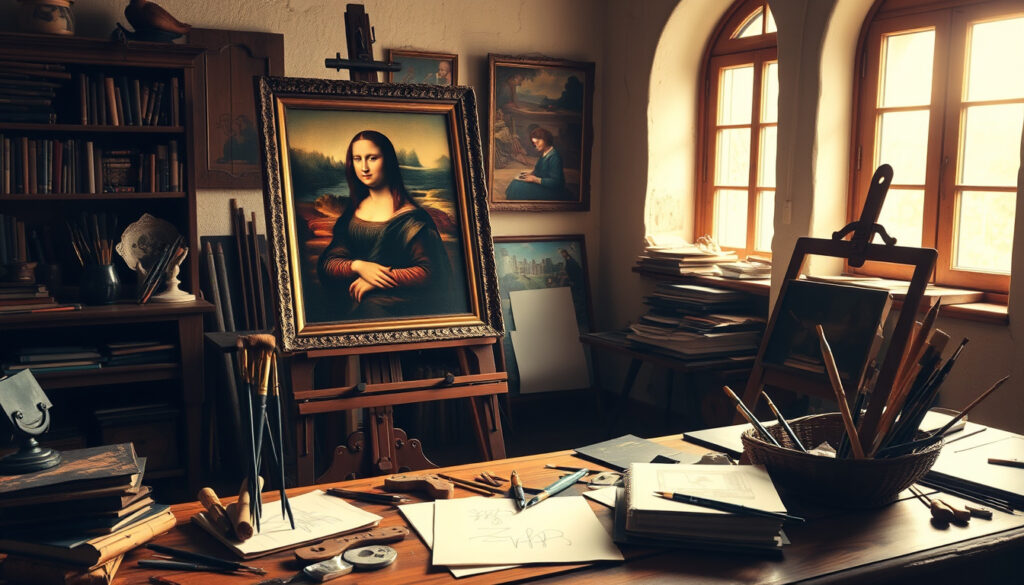
Who Painted the Mona Lisa? Leonardo da Vinci Facts
Few paintings have commanded the world’s attention quite like the Mona Lisa. If you’ve ever found yourself staring at that enigmatic smile in a crowded museum—or on a screen—you’ve probably wondered who on earth created something this iconic. The answer is simpler than the mysteries surrounding her expression: Leonardo da Vinci. But the full story behind this Renaissance masterpiece involves royal acquisitions, a daring theft, and a painting that somehow never reached the family who commissioned it.
Painter: Leonardo da Vinci · Location: Louvre Museum, Paris · Started: 1503 · Completed: 1517 · Owner: French Republic
Quick snapshot
- Exact completion status — Leonardo reportedly worked on it until 1516 or 1517
- Da Vinci’s final intentions for the painting remain uncertain
- Began: October 1503 in Florence
- Major theft: August 21, 1911
- Returned: 1913, recovered in Italy
- Continues drawing millions to the Louvre yearly
- Remains protected as inalienable French national patrimony
Five centuries of scholarship and the same core facts keep surfacing across primary sources and institutional records.
| Field | Value |
|---|---|
| Painter | Leonardo da Vinci |
| Subject | Lisa Gherardini |
| Medium | Oil on poplar panel |
| Dimensions | 77 cm × 53 cm |
| Location | Louvre, Paris |
Who is the real painter of Mona Lisa?
Leonardo da Vinci painted the Mona Lisa. The Wikipedia article on the Mona Lisa (authoritative encyclopedia) describes it as “a half-length portrait painting by Italian Renaissance artist Leonardo da Vinci.” The Louvre itself states the portrait was “doubtless painted between 1503 and 1506.”
Leonardo da Vinci’s role
Leonardo began working on the portrait by October 1503 in Florence, commissioned—according to art historian Giorgio Vasari—by Francesco del Giocondo for his wife Lisa. Yet Leonardo never delivered the painting to the Giocondo family. Instead, he kept it, refining it intermittently until his death in 1519. Britannica (primary reference encyclopedia) confirms this unusual arrangement. When Leonardo moved to France in 1516 to enter King Francis I’s service, he brought the portrait with him.
Evidence from historical records
- Agostino Vespucci witnessed Leonardo painting Lisa del Giocondo in 1503, documented in the Heidelberg Document
- Salai’s 1525 inventory lists “La Gioconda” as a high-value painting
- Royal receipts from 1518 document the painting’s entry into the French Royal Collection
Leonardo treated this portrait as a personal possession, not a commissioned obligation. He continued refining it for over a decade past the expected delivery date.
Where is the original Mona Lisa painting today? Who owns it?
The Mona Lisa hangs in the Louvre Museum in Paris, displayed behind bulletproof glass in Gallery 711. Times of India (editorial feature) reports the painting is owned by the French Republic and managed by the Louvre as national patrimony.
Current location
The painting has been on display at the Louvre since 1797. Under French law, it is inalienable and cannot be sold or transferred—a status it gained after the French Revolution transformed royal property into public assets.
Ownership history
King Francis I of France acquired the Mona Lisa after Leonardo’s death in 1519. According to the Louvre’s official records (primary institutional source), the painting entered the royal collection and was installed in the museum around 1804, with public display commencing in 1797.
France treats the Mona Lisa as sacred national property. Selling it would require dismantling bedrock of French cultural law—something no government has been willing to attempt.
What this means: visitors to Paris can see the world’s most famous painting, but taking it home is not an option, legally speaking.
Why is Mona Lisa so famous?
The Mona Lisa is described as “the best known, the most visited, the most written about, the most sung about, [and] the most parodied work of art in the world.” But fame arrived gradually—and then dramatically accelerated.
Historical significance
The painting showcases psychological depth, sfumato technique creating that unmistakable smoky softness, and a subject whose expression seems to shift depending on the viewer’s angle. Art historian Carmen C. Bambach concludes Leonardo refined it until 1516 or 1517, making it one of the most worked-over pieces in art history.
Cultural impact
The theft in 1911 transformed the Mona Lisa from famous to legendary. Art & Object (art market analysis) notes that the theft “increased public fame of the Mona Lisa” dramatically. Vincenzo Peruggia, a Louvre employee, stole it on August 21, 1911, hiding it in a trunk for two years before police recovered it in Florence.
Before 1911, the Mona Lisa was respected but not ubiquitous. The theft created media frenzy across Europe, and when it returned, the world watched. That moment turned a masterpiece into a global icon.
A masterpiece plus a dramatic crime story equals immortality in popular culture.
Why did Leonardo da Vinci never finish the Mona Lisa?
Leonardo never delivered the painting to the Giocondo family. The traditionally accepted dating places completion between 1503 and 1506, but evidence suggests he kept working on it well past that point.
Work timeline
According to Wikipedia (scholarly compilation), art historian Carmen C. Bambach concludes Leonardo refined the portrait until 1516 or 1517—roughly a decade after the conventional completion window.
Da Vinci’s habits
Leonardo was notorious for leaving works unfinished. The Mona Lisa represents a rare case where he continued refining a piece rather than abandoning it. He reportedly considered it valuable enough to keep close, even bringing it to France when he entered Francis I’s service in 1516.
The implication: Leonardo treated personal projects differently than commissioned works. The Mona Lisa started as a commission but became something he couldn’t part with—perhaps because he saw it as a technical showcase.
How much is the Mona Lisa worth today?
The Mona Lisa is priceless—and not metaphorically. No sale has ever occurred because the French Republic owns it as inalienable national property.
Valuation estimates
Art market analysts consistently rank the Mona Lisa as one of the most valuable paintings ever, though formal valuation is impossible. Some estimates place its insured value at $870 million, though such figures ignore that the painting cannot legally be sold.
Priceless status
The Mona Lisa remains priceless nearly 500 years later—not because no one has tried to price it, but because French law prevents any transaction. Times of India (editorial feature) explains that under French patrimony law, the painting is “inalienable and cannot be sold or transferred.”
The Mona Lisa is simultaneously the world’s most valuable painting and the least sellable. Its worth is measured in tourism revenue, cultural prestige, and scholarly attention—not auction hammer prices.
France owns an irreplaceable cultural asset that generates millions in visitor spending, but cannot leverage it through sale or loan without risking international incident.
The Mona Lisa’s story through time
The painting’s journey from Florence studio to Paris gallery spans over five centuries.
| Period | Event |
|---|---|
| 1503 | Leonardo begins painting |
| 1516 | Leonardo brings painting to France |
| 1519 | Da Vinci dies; Francis I acquires painting |
| 1797 | Painting enters Louvre public display |
| 1911-08-21 | Stolen from Louvre |
| 1913 | Recovered and returned to Louvre |
Three distinct eras stand out: the decades-long creation under Leonardo’s hand, the royal transition after his death, and the international scandal of the 1911 theft that cemented the painting’s fame.
Separating fact from fiction
Despite overwhelming consensus, alternative claims occasionally surface.
Confirmed facts
- Leonardo da Vinci painted the Mona Lisa
- Location at the Louvre
- Ownership by the French state
- Traditional dating: 1503-1506
- Work continued until at least 1516
Unverified claims
- Earlier Mona Lisa / Isleworth Mona Lisa (not accepted by Louvre or mainstream experts)
- Multiple copies as “originals” (rumors from 1911 theft accomplices)
- Precise completion date unknown
- Leonardo’s specific intentions for the painting
Wikipedia (authoritative encyclopedia) explicitly states that claims of an “Earlier Mona Lisa” or “Isleworth Mona Lisa” exist but are “not accepted by Louvre or mainstream experts.” The Mona Lisa Foundation (advocacy organization) promotes the earlier version theory, but this represents a fringe position without institutional backing.
“Theft in 1911 increased public fame of the Mona Lisa dramatically.”
— Art & Object (art market analysis)
“The Mona Lisa is undoubtedly painted between 1503 and 1506.”
— Louvre Museum (official institutional statement)
For tourists visiting Paris, the Mona Lisa demands attention—but so does context. Standing before it takes seconds; understanding why it matters takes a little longer. The Louvre offers that context daily, whether visitors arrive with scholarly interest or casual curiosity.
Related reading: Mona Lisa theft investigation
Leonardo da Vinci captured an enigmatic smile in the Mona Lisa, whose Mona Lisa history and enduring fame continue to captivate millions at the Louvre.
Frequently asked questions
Is Mona Lisa a real person?
Yes. The subject is Lisa Gherardini, born 1479 in Florence, wife of Florentine merchant Francesco del Giocondo. Her family name appears in the painting’s alternate title: La Gioconda.
Who was da Vinci’s lover?
Leonardo never married and had no documented romantic relationships. He lived with his assistant Salai for years, but scholarly debate about the nature of their bond remains inconclusive.
How many children did Leonardo da Vinci have?
None. Leonardo never married and had no children. He was illegitimate and raised by his grandfather; his siblings came from his father’s legitimate marriage to a later wife.
What did Leonardo da Vinci say before he died?
Accounts vary. Vasari reported Leonardo’s last words as a meditation on God’s nature: “I have offended God and mankind by my bad works.” Other sources suggest simpler last utterances focused on physical discomfort.
Why is Leonardo da Vinci buried in Amboise, France?
Leonardo lived at Château du Clos Lucé near Amboise, invited by Francis I. He died there in 1519 and was buried in the Chapel of Saint Florentin at the Church of Saint Florentin. The original grave was destroyed during the French Revolution.
Why was da Vinci’s grave destroyed?
During the French Revolution (1789-1799), religious monuments and royal tombs were systematically destroyed or looted. Leonardo’s grave at the Church of Saint Florentin was among the casualties, though some remains were reportedly recovered and reburied.
More related posts
 Double Chin Removal Singapore: Costs, Methods & What to Expect
 KPop Demon Hunters Songs: Complete Track List & Singers
 Bank of America Singapore – Addresses, Contacts and Services
 How to Password Protect Excel: Workbook, Sheet, Online Guide
 Twelve Cupcakes Closure Singapore: Facts & Impact
 ITE Work-Study Diploma: Recognition, Duration, Salary & Requirements
 Samsung Galaxy Z Fold7 Call Assist: Setup, Live Translate & More
 Slot Gacor Dewakoin99-it: What’s Verified vs. Unverified