Buddhist Funeral Services Singapore: Costs, Customs & Packages
Buddhist funerals are woven into daily life for most Singapore families—Buddhism remains the most practiced religion in the city-state at 31% of the population. What follows when a loved one passes is a structured, ritual-rich process that blends sacred tradition with modern logistics—and knowing what it costs, what to wear, and what happens next can spare families enormous stress. Typical packages range from $4,000 to $15,000 depending on duration, venue, and provider, with most services spanning three to five days. By the time you’re done here, you’ll have a working picture of the entire journey.
Typical wake duration: 3-7 days · Common attire color: White or dark · Mourning period: 49 days · Service providers: Nirvana, Memorial Funeral, Singapore Funeral Solutions
Quick snapshot
- Prayers for rebirth (Buddhism.com)
- White attire standard (Solace)
- No meat offerings (Singapore Funeral Care)
- Basic casket service (Funeral Group)
- Full rites included (Memorial Funeral)
- Cremation options (Nirvana Fugui)
- Day 1: Preparation (Solace)
- Days 2-5: Wake (Singapore Funeral Care)
- Final: Cremation (Mandai Crematorium)
- Starts from $4,988 (Memorial Funeral)
- Factors: Duration, extras (Nirvana Fugui)
- Average range: $4,000-$15,000 (Nirvana Fugui)
This key facts table consolidates the most frequently looked-up details about Buddhist funerals in Singapore.
| Fact | Detail |
|---|---|
| Standard wake | 3-7 days |
| Attire guideline | White clothing |
| Prohibited colors | Black, red |
| Post-death rites | 49-day mourning |
| Wake maximum without permit | 7 days (NEA limit) |
| Dominant tradition | Mahayana Buddhism |
| Cremation venue | Mandai Crematorium or Kong Meng San |
| Post-funeral festivals | Qing Ming (April), Ullambana (7th lunar month) |
How much does a Buddhist funeral cost in Singapore?
Buddhist funeral packages in Singapore typically range from $4,000 to $15,000 for a 3-day service, with costs varying by quality of casket, venue selection, and included extras like monk chanting sessions. Most families land in the $5,000 to $7,000 bracket for a dignified, complete service, though premium packages with elaborate rites and high-end caskets can push toward the higher end. The wide range reflects a genuine choice: basic packages focus on essentials, while fuller options add customization.
Package options
Providers like Funeral Group list 3-day Buddhist packages at $5,888 and 5-day packages at $6,588, with the extra days reflecting additional ceremonial rental time rather than dramatically higher ceremony counts. Memorial Funeral offers a 2-day HDB void deck package from $4,988, scaling up to $6,188 for a 5-day service at the same venue type. Singapore Funeral Solutions, praised for transparent pricing consistent over the past decade, starts Buddhist packages at $5,588 for 3 days. At the budget end, An Fu Funeral Services quotes $5,800 for a Buddhist package, and New Century Funeral Services enters at $5,788. Nirvana Fugui, a major national provider, estimates the average Buddhist funeral package at $4,000 to $15,000 depending on service tier.
Factors affecting price
Venue choice drives much of the cost variation. Holding a wake at an HDB void deck typically costs less than booking a dedicated funeral parlour, where daily rental fees stack on top of package prices. A 3-day HDB package from Funeral Services SG runs $5,500, while the same duration at a parlour requires $4,800 plus daily rental. The casket itself is another major variable—a standard casket keeps costs down, while premium materials and finishes add expense. Monk chanting frequency, floral arrangements, photo enlargements, and vegetarian food for attendees round out the extras that push packages toward the higher end of the range.
We do not advise our clients to spend beyond their budget. This is because we want them to give a dignified send-off for their dearly departed ones, at a comfortable budget.
Budget quotes from funeral providers rarely include NEA permit fees, cremation charges at Mandai or Kong Meng San, or post-funeral niche rental—add-ons that can add $1,000-$2,500 to the final bill beyond the package price.
What do you wear to a Buddhist funeral in Singapore?
White is the standard mourning color for Buddhist funerals in Singapore, worn by close family members and most attendees out of respect for the deceased. The preference for white or subdued dark tones reflects Buddhist teachings about impermanence and simplicity, contrasting sharply with Western funeral norms where black dominates. Visitors who show up in bright or festive colors risk causing distress to the grieving family—a misstep worth avoiding with even a moment’s preparation.
Recommended colors
White clothing signals mourning and purity in the Buddhist tradition practiced by most Singaporeans, who follow Chinese Mahayana rites rather than the more austere Theravada variant. Close family members may wear white entirely, while acquaintances and distant relatives can opt for white shirts, blouses, or simple dark clothing without patterns. For women, plain white or pale tops with dark trousers or skirts work well; for men, white dress shirts or subdued dark formal wear are appropriate. The guiding principle is modesty and absence of flashiness.
What color not to wear
Red is specifically prohibited at Buddhist funerals in Singapore, as the color symbolizes celebration, joy, and vitality—everything the occasion denies. Black, while common in Western funerals, is not traditionally preferred in Buddhist context; some families accept dark clothing from non-family attendees, but white remains the safest choice for those unsure. Bright colors, floral prints, denim, and anything revealing or casual also fall outside acceptable mourning attire. If in doubt, err toward plainness—underdressed is less offensive than overdressed in celebratory colors.
Some younger Singaporeans find white funeral attire impractical if they attend multiple services in quick succession. The tradition prioritizes respect for the deceased over convenience, but wearing a white shirt or blouse that can be washed and reused is generally acceptable for non-immediate family members.
How many days after death is a Buddhist funeral?
Most Buddhist funerals in Singapore occur within three to seven days after death, with odd-numbered durations preferred because they signify the incomplete cycle of life—three, five, or seven days rather than even numbers. The specific timing depends on family preference, monk availability for chanting sessions, and venue booking logistics. Under NEA regulations, wakes exceeding seven days require special permission, making the standard window effectively capped at one week.
Wake timeline
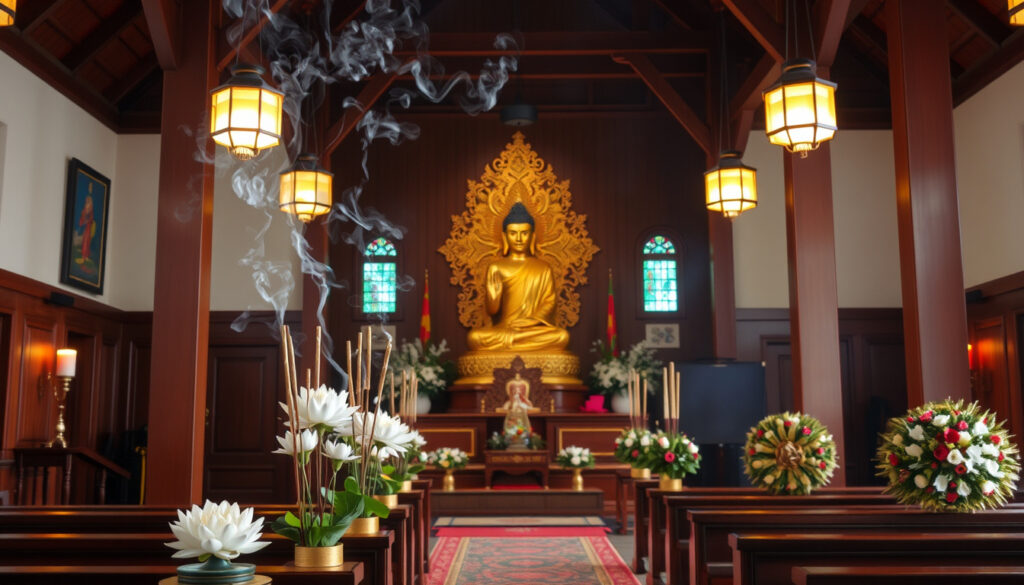
The first day typically involves body preparation, embalming, and setting up the altar with the deceased’s photograph, a Buddha image, candles, incense, fruits, and flowers. The wake formally begins with a gong or bell strike, followed by the first chanting of scriptures such as the Amitabha Sutra or Heart Sutra. Daily monk visits follow, with family members present for prayers and offerings of food, incense, and paper money. The final day of the wake before cremation includes the main funeral ceremony with heightened chanting and ritual.
Preparation period
Families arrange Buddhist funeral services by contacting a provider immediately after death, often within hours. The provider coordinates embalming, transport to the wake venue, and monk scheduling. HDB void decks, funeral parlours, or private homes serve as wake venues, with void decks being the most common and cost-effective choice. Altar setup, photo enlargements, and the procurement of vegetarian food for visitors consume the first 24 hours. Some providers offer 24-hour emergency support for families facing sudden death, a service that can ease the logistical pressure during acute grief.
How long is a typical Buddhist funeral?
A typical Buddhist funeral in Singapore spans five days from start to cremation, with the wake itself lasting three, five, or seven days depending on family choice. The full service includes daily prayers, monk chanting on key days, vegetarian food offerings, and a final ceremony before cremation at Mandai Crematorium or Kong Meng San. Families should budget both time and energy: the process is emotionally and physically demanding, with late-night vigils and multiple ceremonial visits over consecutive days.
Wake length
The wake duration determines the total ceremonial load. A 3-day package covers basic encoffin, one evening ceremony, and the funeral day itself, with monk chanting on two of the three days. A 5-day package allows more unhurried visitation, additional chanting sessions, and a fuller schedule of family prayers. Some families prefer the longer option to accommodate relatives traveling from overseas or to spread out ceremonial obligations. The 7-day maximum without NEA permit covers situations where cremation must be delayed for family logistics or cultural scheduling.
Ceremony duration
Ceremony length varies by tradition within Buddhism. Mahayana funerals, which represent the dominant practice among Chinese Singaporeans, tend toward more elaborate chanting and ritual, with monks reciting the Heart Sutra, Amitabha Sutra, and other scriptures to guide the deceased toward favorable rebirth. Theravada funerals, practiced by some Thai and Sri Lankan Buddhist communities, are typically more subdued, featuring alms-giving to monks and merit-sharing ceremonies. Both traditions share the core Buddhist focus on impermanence, compassion, and karma—principles that shape the ceremony’s pacing and content.
Buddhist funerals focus on the core principles of impermanence, compassion, and karma, with rituals aimed at easing the deceased’s soul toward a favourable rebirth. Families who understand this spiritual framework find the ceremonies less daunting and more meaningful, even if they are not personally devout.
What not to do at a Buddhist funeral
Certain behaviors are specifically inappropriate at Buddhist funerals in Singapore, rooted in both religious teaching and cultural tradition. Avoiding these missteps shows respect for the family and deceased, while violating them—even inadvertently—can cause real offense during an already difficult time. The rules are not complicated, but they differ enough from Western norms that unfamiliar visitors benefit from a brief orientation.
Etiquette rules
Do not touch the casket under any circumstances. The deceased is treated with deep reverence, and physical contact by non-family members is considered disrespectful. Stand at a respectful distance when passing the altar, and bow slightly if you wish to offer incense—do not place incense in the burner without guidance from family or the funeral director. When monks are chanting, maintain silence and stillness; interrupting a prayer session disrupts the spiritual work being performed for the deceased’s rebirth. Offer verbal condolences at the appropriate moment, but avoid overly cheerful conversation in the vicinity of the wake.
Common mistakes
Bringing meat-based food offerings is a common mistake by well-meaning attendees. Buddhist funerals observe vegetarian principles at the altar and for the family’s meals during the wake—meat dishes are considered inappropriate for (offerings). Photography and video recording are generally prohibited during chanting and prayer sessions, even if allowed during visitation. Speaking ill of the deceased, arguing with family members, or treating the wake as a social gathering also violates the occasion’s gravity. Finally, arriving late without apology or leaving early without acknowledgment are considered disrespectful; if your schedule requires early departure, inform the family quietly.
This pricing comparison shows how package duration, venue selection, and service tier drive costs across Singapore’s Buddhist funeral market.
| Package Type | Duration | Venue | Starting Price | Key Inclusions |
|---|---|---|---|---|
| Basic HDB | 2-3 days | HDB void deck | $4,988 | Embalming, casket, basic altar setup |
| Standard Buddhist | 3 days | HDB / parlour | $5,500-$5,888 | + Photo enlargement, monk chanting (1-1-1) |
| Full rites | 5 days | HDB / parlour | $6,188-$6,588 | + Extended chanting, vegetarian food, daily rites |
| Premium suite | 3-5 days | Funeral parlour | $8,000-$12,000 | + Premium casket, multiple monks, full floral |
| Emergency express | 1-2 days | Variable | $5,800+ | + 24-hour support, expedited scheduling |
| Taoist comparison | 3 days | HDB / parlour | $9,388 | Dialect rites, elaborate Taoist customs |
The Buddhist funeral process in Singapore
Seven steps take a family from the moment of death through cremation and into the mourning period, with each stage carrying specific Buddhist meanings and practical requirements. Understanding the sequence helps families coordinate with their chosen provider, arrange leave from work, and prepare emotionally for what lies ahead.
- Contact a funeral provider immediately. Call within hours of death; providers like Memorial Funeral offer 24-hour support. The provider handles transport, embalming, and initial coordination.
- Select venue and package. Choose between HDB void deck, funeral parlour, or private home. Select package duration (3, 5, or 7 days) and preferred inclusions (monk chanting, vegetarian catering, floral arrangements).
- Set up the altar. The provider arranges the deceased’s photograph, Buddha image, candles, incense burner, fruits, and flowers. Family members may assist but providers handle technical setup.
- Conduct daily wake ceremonies. Monks chant scriptures daily; family members attend prayers, offer incense, and receive visitors. Odd-numbered days are traditional for the full ceremony.
- Hold the main funeral ceremony. On the final day before cremation, a heightened chanting session occurs with extended family and community present. The casket is prepared for transport.
- Proceed to cremation. Transport to Mandai Crematorium or Kong Meng San. Cremation typically occurs mid-morning; ashes are collected the following day.
- Observe the mourning period. The 49-day mourning period begins immediately after cremation, with annual observances at Qing Ming (April) and Ullambana (7th lunar month).
Confirmed facts
- Buddhists in Singapore conduct full funeral services with chanting and rites
- White attire is the standard mourning color
- Wake durations are 3, 5, or 7 days using odd numbers
- The mourning period lasts 49 days
- Cremation occurs at Mandai or Kong Meng San
- Buddhism accounts for 31% of Singapore’s population
What’s unclear
- Exact cost breakdowns without contacting providers directly
- Provider-specific variations in chanting schedules
- Theravada-specific package pricing in Singapore
- Precise market share among funeral providers
Odd numbers are used as they signify the ‘incomplete cycle of life.’
— Singapore Funeral Care (funeral tradition guide)
We do not advise our clients to spend beyond their budget. This is because we want them to give a dignified send-off for their dearly departed ones, at a comfortable budget.
— Nirvana Fugui (funeral provider)
For Singapore families facing a Buddhist funeral, the trade-off is clear: budget determines scope, but dignity does not require extravagance. A $4,988 basic package at an HDB void deck covers all essential rites, while families wanting extended chanting, premium caskets, and parlour venues can expect to invest toward the $10,000-$15,000 range. What matters most, providers agree, is that the send-off honors the deceased without breaching the family’s financial comfort—and in Singapore’s Buddhist tradition, that balance is well within reach.
Related reading: Movers and Packers Singapore – Costs Reviews HDB Tips · Best Maid Agency Singapore – 2025 Data-Driven Rankings
funeralgroup.com.sg, solace.sg, nirvanafugui.com, confidencefuneral.com.sg, legitbestreviews.com, singaporefuneralcommittee.sg, memorialfuneral.com.sg, singaporefuneralcare.com, bestreviewsfor.com, alifegrad.com, buddhistfuneralpackage.sg, singaporefuneralservices.sg
Frequently asked questions
Do Buddhists have funeral services?
Yes, Buddhists in Singapore hold formal funeral services with chanting, prayers, and rites performed by monks. Most services follow Mahayana Buddhist traditions blended with Chinese cultural customs, including daily chanting, food offerings, and incense burning. The services aim to guide the deceased toward favorable rebirth through merit-making and spiritual practice.
What are the key Buddhist funeral customs?
Key customs include daily chanting by monks, offerings of food and incense at the altar, pek kim condolence giving from guests, white mourning attire for family, and prayers for the deceased’s soul to achieve a favorable rebirth. The altar typically displays a photograph of the deceased alongside a Buddha image, with candles, flowers, and fruits. Monks recite the Heart Sutra and Amitabha Sutra to emphasize impermanence and compassion.
What is Anantarika-karma in Buddhist funerals?
Anantarika-karma refers to the five grave offenses in Buddhist ethics—killing one’s mother, father, an arhat, splitting the sangha, or causing a Buddha to bleed. At funerals, rituals are partly designed to counteract negative karma and support the deceased’s passage through this evaluation. Families perform merit-making acts such as donating to monks, chanting, and offering vegetarian food to generate positive karma that benefits the deceased.
How do I select casket services in Singapore?
Start by comparing at least three providers for identical package durations. Check whether the quote includes NEA permit fees, cremation charges, and transportation. Ask about monk availability on your preferred dates—some providers coordinate directly with monastic communities while others require families to arrange this separately. Verify whether the casket material is included in the package price or listed as an upgrade. Memorial Funeral, Funeral Group, and Singapore Funeral Solutions are among the better-reviewed providers with transparent pricing.
What follows cremation in Buddhist tradition?
After cremation, families collect the ashes the following day at Mandai Crematorium or Kong Meng San. A bone-picking ceremony may follow in some families, where relatives select meaningful bone fragments for separate keepsake urns. The 49-day mourning period begins, during which families avoid major celebrations and maintain a respectful demeanor. Annual observances include Qing Ming in April (tomb-sweeping) and Ullambana in the 7th lunar month (merit-sharing for ancestors).
How are Buddhist and Taoist funerals different in Singapore?
Buddhist funerals center on chanting and prayers for rebirth, using white attire and vegetarian offerings. Taoist funerals, common among Teochew, Cantonese, and other dialect groups, incorporate elaborate dialect-specific rites, fortune-telling to select auspicious dates, and more ornate altar setups. Taoist packages tend to cost more—a 3-day Taoist package from Funeral Group starts at $9,388 compared to Buddhist packages around $5,588-$5,888 for equivalent duration. The traditions share some elements but differ significantly in ceremonial complexity.
What makes a Buddhist funeral package complete?
A complete Buddhist funeral package includes embalming, casket provision, altar setup with photo and Buddha image, monk chanting on key days (typically three sessions across the wake), vegetarian food for visitors, and coordination of cremation logistics. Extended packages add longer wake durations, additional chanting sessions, premium casket options, floral arrangements, and transportation for family. Providers like Memorial Funeral list their Buddhist package inclusions explicitly, while others bundle services in ways that require item-by-item comparison.
More related posts
 The motel revival: why Britain’s roadside lodgings are splitting from the hotel market
 SIA Share Price SGX: Target, Dividend & Analyst Views
 Ruturaj Gaikwad: IPL Stats, Captaincy Record (2025-26)
 Cloudy Bay Sauvignon Blanc – Price, Vintages, Reviews and Where to Buy
 North London Collegiate School: Rankings, Fees & Admissions
 3988 HK Share Price: Forecast, Dividend Yield & Analyst Targets
 Goh Chok Tong’s Son Jailed: Goh Jin Hian Gets 12 Weeks
 How to Mandi Hadas (Ghusl): Step-by-Step Guide for Men & Women