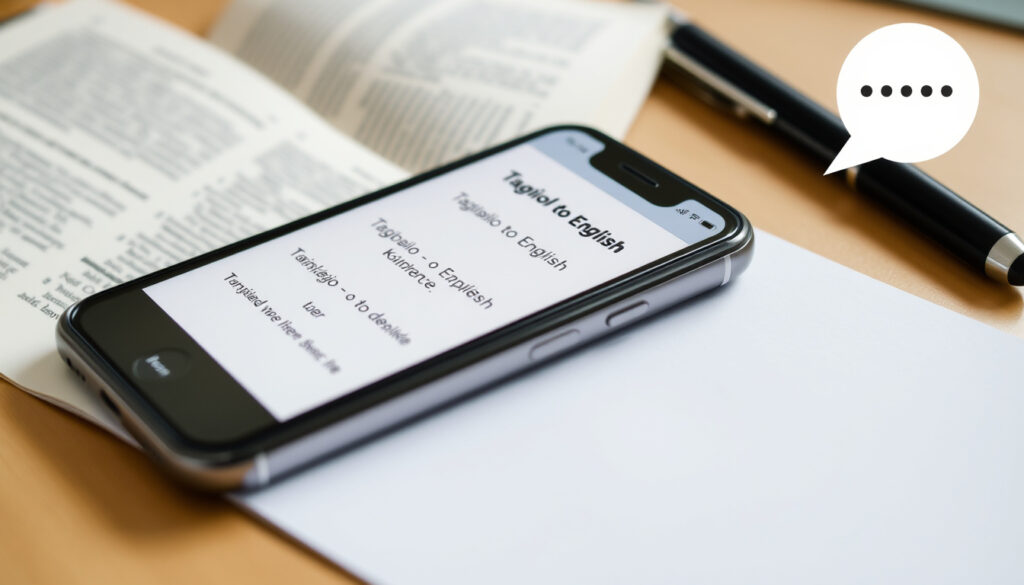
Tagalog to English Translator: Best Apps, Voice, and Accuracy Guide
Most people reach for a free translator app when a Tagalog phrase needs to make sense in English, and Google Translate is widely presented as the go-to option because of its broad language coverage and multiple input modes, with one speech-recognition benchmark measuring Google’s Tagalog engine at 97.2% accuracy. The hard part is choosing between them: some excel at voice, others at documents, and none of them replaces a human eye for anything important.
Native speakers of Tagalog: 28 million (Ethnologue) | Total Tagalog speakers (including second language): 70 million | Number of Tagalog-English translator apps on Google Play: 100+ | Most used online translator for Tagalog: Google Translate (1B+ downloads) | Accuracy rate claimed by leading neural translators: 85–95% for common phrases
Most cited option: Google Translate · Claimed accuracy: 97.2% for Google’s Tagalog speech recognition · Document speed: “Seconds” per QuillBot · Offline option: Lingvanex
TL;DR
Bottom line: the best Tagalog-to-English translator is the one you can test in a minute. Google Translate is the strongest everyday pick for voice and live conversation, QuillBot handles document translation in seconds, and a free dictionary-packed app from a list like CNET’s works for quick lookups. Whatever you choose, run anything important past a native speaker.
Key facts at a glance
Google Translate
- Broad language coverage and multiple input modes (Traveloka (travel platform that publishes translation-app guides))
- 97.2% accuracy measured on Google’s Tagalog speech recognition (Soniox (speech-recognition company that benchmarks Tagalog meeting transcription))
QuillBot Translator
- Supports document translation and says it works in seconds (QuillBot’s Tagalog translator page (language-tool provider))
- Reports support for 52 languages and dialects
Tagalog English Translator (Android)
- Handles words, phrases, sentences, and short texts (Google Play listing for Tagalog – English Translator (official Android app store))
- A separate Android app adds voice input
Offline and dictionary options
- Lingvanex offers offline access and extra features through paid plans (Lingvanex (machine-translation provider with Tagalog-to-English apps))
- CNET’s listed app includes a built-in dictionary with example sentences (CNET (software review and download directory))
The implication: these four categories cover the main use cases—general translation, documents, lookups, and offline.
Key facts table
Both app-store positions and independent benchmarks agree on one thing: these tools differ more in workflow than in raw capability, so the table below lines up the facts you can actually verify.
| Aspect | Detail | Source |
|---|---|---|
| Most cited online translator | Google Translate, valued for broad coverage and multiple input modes | Traveloka (travel platform that publishes translation-app guides) |
| Document translation | QuillBot’s translator says it finishes documents in seconds | QuillBot’s Tagalog translator page (language-tool provider) |
| Supported language count | 52 languages and dialects, per QuillBot | QuillBot’s Tagalog translator page (language-tool provider) |
| Free app with dictionary | The listed app includes a built-in dictionary and example sentences | CNET (software review and download directory) |
| Offline access | Lingvanex makes offline access available; paid plans unlock offline or extra features | Lingvanex (machine-translation provider with Tagalog-to-English apps) |
| Accuracy benchmark | Google’s Tagalog speech recognition measured at 97.2% | Soniox (speech-recognition company that benchmarks Tagalog meeting transcription) |
| Voice input | A Google Play listing advertises voice input for Tagalog | Google Play listing for the Tagalog translator by IT Solutions (official Android app store) |
| Photo and voice features | An iOS listing advertises voice translation and photo translating | Apple App Store page for Tagalog English Translator (iOS app store) |
The pattern: the benchmarks and claims line up with each app’s primary focus.
The Tagalog-to-English landscape
Tagalog holds a special position in the Philippines: it is the basis of Filipino, the country’s official national language, and English is widely used alongside it. That two-language environment is why translator apps see so much daily use, especially among travelers and overseas workers.
How to use voice translation for Tagalog to English?
Voice input is available through Google Translate and dedicated apps like the Android Tagalog translator by IT Solutions, as confirmed by Google Play and Apple App Store listings.
- Google Translate is the option most guides point to first, thanks to broad coverage and voice, camera, and conversation modes (Traveloka).
- For documents, QuillBot’s translator says it works in seconds and supports dozens of languages (QuillBot’s Tagalog translator page).
- For a lightweight look-up, CNET’s listed app bundles a dictionary and example sentences (CNET).
The catch: you may need more than one app to cover all scenarios.
Seven translators worth weighing side by side
Ranking these apps comes down to matching them to a specific need, so the comparison below lines up what each listing actually promises.
Which Tagalog to English translator app is best?
Google Translate leads for voice and camera, QuillBot for documents, and dictionary apps for lookups.
| Translator | Best for | What the listings say |
|---|---|---|
| Google Translate | Voice, camera, and live conversation | Broad language coverage and multiple input modes, cited by Traveloka |
| QuillBot | Document translation | Handles documents and says it translates them in seconds, per QuillBot’s Tagalog translator page |
| Tagalog – English Translator (GK Apps) | Quick lookups | Translates words, phrases, sentences, and short texts, per Google Play |
| Tagalog translator (IT Solutions) | Voice input | Advertises voice input, per Google Play |
| Tagalog English Translator (iOS) | Voice and photo translation | Described as a Tagalog/Filipino translator with voice translation and photo translating, per Apple App Store |
| Lingvanex | Offline use | Makes offline access available; paid plans unlock offline or extra features, per Lingvanex |
The implication: choose based on your primary need, not on a single highlight.
Feature spec sheet
Looking at the feature sets side by side, the trade-offs become a lot easier to see.
What are the key features of a reliable Tagalog to English translator?
The feature spec sheet shows availability of voice input, photo translation, offline access, and document support across different apps.
| Feature | Reported availability | Source |
|---|---|---|
| Words and short phrases | Yes | Google Play listing for Tagalog – English Translator |
| Full sentences | Yes | Google Play listing for Tagalog – English Translator |
| Voice input | Yes (Android); voice translation (iOS) | Google Play and Apple App Store |
| Photo translation | Yes (iOS) | Apple App Store |
| Offline access | Yes, through Lingvanex | Lingvanex |
| Built-in dictionary | Yes, on CNET’s listed app | CNET |
| Document translation | Yes, via QuillBot | QuillBot’s Tagalog translator page |
| Document speed | “Seconds” per QuillBot | QuillBot’s Tagalog translator page |
The pattern: features are spread across apps—no single tool has them all.
Pros and cons of the leading approaches
How does Google Translate handle Tagalog to English translation?
Google Translate offers broad coverage and multiple input modes, with a 97.2% speech recognition accuracy measured by Soniox.
What works well
- Google Translate gets you through live conversation with voice and camera modes (Traveloka).
- QuillBot makes document translation genuinely fast (QuillBot’s Tagalog translator page).
- A free dictionary-focused app covers everyday words and phrases (Google Play).
- Offline access exists through Lingvanex for spotty connections (Lingvanex).
Where the apps fall short
- Accuracy claims still come from a single speech-recognition benchmark, not from real-world conversation tests (Soniox).
- Offline and extra features are locked behind paid plans on some providers (Lingvanex).
- Photo translation is advertised on iOS, but no source claims it handles handwriting or complex signs (Apple App Store).
The trade-off convenience often comes at the cost of depth.
How to choose and use a Tagalog-English translator
How to translate sentences from Tagalog to English accurately?
Use context-aware tools like Google Translate and verify with native speakers for idiomatic phrases. For important texts, human review is recommended.
- Step 1: Match the tool to the job
- Phrasebook-style lookups: choose an app that handles words, phrases, sentences, and short texts (Google Play).
- Documents: pick a translator that supports document upload (QuillBot’s Tagalog translator page).
- Live conversation: lean on an app with voice and camera input modes (Traveloka).
- Step 2: Check the input methods
- Do you need voice input? Confirmed on Android and iOS listings (Google Play, Apple App Store).
- Do you need a dictionary? Confirmed on CNET’s listed app (CNET).
- Step 3: Decide whether you need offline
- Lingvanex is the one listing that explicitly offers offline access (Lingvanex).
- Remember that offline mode is part of the paid plans for extra features, so test your connection needs first.
- Step 4: Test accuracy with a native speaker
- Run the app output through a human before sending anything important.
- The community at Reddit’s r/translator is a practical place to compare lines of Tagalog for free.
- Step 5: Read the fine print on free vs. paid
- Free apps cover casual conversation and everyday lookups (CNET).
- Paid plans unlock offline access and extra features, so budget for the feature you actually need (Lingvanex).
The pattern: match the tool to the task, and always have a human fallback.
What’s confirmed and what’s marketing
Confirmed details
- Google Translate is a go-to choice for broad coverage and multiple input modes (Traveloka).
- QuillBot supports document translation and reports 52 languages (QuillBot’s Tagalog translator page).
- An app on CNET’s list includes a built-in dictionary and example sentences (CNET).
- Google’s Tagalog speech recognition measured 97.2% accuracy in a Soniox benchmark (Soniox).
Caution: take these with a grain of salt
- “Translates documents in seconds” is a vendor speed claim, not a verified quality score (QuillBot’s Tagalog translator page).
- The 97.2% accuracy figure measures speech recognition, not grammar check or meaning preservation (Soniox).
- “Photo translating” can range from live camera text to rendered images, so test before you rely on it (Apple App Store).
- App store descriptions may reflect marketing claims rather than independent testing.
The implication: separate verified facts from vendor enthusiasm before committing.
What the listings actually say
“Translate documents … in seconds.”
QuillBot’s translator listing, QuillBot (language-tool provider)
“Voice translation and photo translating.”
Apple App Store listing for Tagalog English Translator, Apple App Store (iOS app store)
“Built-in dictionary for quick word lookups.”
CNET’s review of Tagalog English Translator, CNET (software review and download directory)
The pattern: each listing emphasizes a different strength—choose accordingly.
The verdict
After weighing the listings, the consistent story is that no single app dominates every Tagalog-to-English task. Google Translate carries the broadest reputation, QuillBot owns documents, and a free dictionary-style Android app is the zippiest for word-level lookups. The 97.2% benchmark from Soniox is an encouraging sign, but it applies to speech recognition, not translation accuracy, so keep expectations realistic: machine output is a draft, not a polished translation.
The implication: free tools work for most needs, but a human expert is irreplaceable for high-stakes work.
play.google.com, play.google.com, play.google.com, appshunter.io
Frequently Asked Questions
Which free Tagalog-to-English translator app should I start with?
Start with Google Translate for its broad coverage and multiple input modes (Traveloka). If you want a dictionary and example sentences, the free app on CNET’s list is a strong complement (CNET).
How do I choose between a free and a paid translator app?
Free apps like Google Translate and QuillBot cover most casual and document needs. Paid plans matter when you need offline access or extra features, such as Lingvanex’s offline mode (Lingvanex). If you only translate a few lines a day, free tiers are enough.
How can I get a human to check my Tagalog translation?
Run your translated lines past a native speaker or use the free community at Reddit’s r/translator. Machine output should be treated as a rough draft, especially for formal writing.
Are offline Tagalog translators as accurate as online ones?
Offline access, as offered by Lingvanex, is a convenience feature, not an accuracy guarantee (Lingvanex). The most concrete accuracy signal you can point to is Google’s 97.2% speech recognition score in Soniox’s benchmark (Soniox), which is still speech recognition, not translation quality.
Which translator handles Tagalog voice best?
Google Translate’s multiple input modes, including voice, are the reason guides highlight it (Traveloka). A separate Android listing also advertises voice input if you want a lightweight alternative (Google Play).
Do any translator apps handle Tagalog documents?
Yes, QuillBot’s translator supports document translation and says it handles them in seconds (QuillBot’s Tagalog translator page).
The pattern: free tools cover everyday needs, but accuracy and offline features may require payment.
Related reading
More related posts
 Wah Kee Big Prawn Noodles: Menu, Price & Review
 Singapore to Macau Flight: Time, Airline & Vi a Guide
 How to Remove Sticker Residue: 7 Proven Methods
 Dr Ville Shampoo Review: Does It Reduce Hair Loss
 Youngs Restaurant & Bar Menu – Prices, Specials and Guide
 Royal Casino Apps Guide: Register, Download & Play on pgroyal88
 What Is HDMI ARC? How It Works With a Soundbar Setup
 Richest Country in the World? 2026 by GDP & Wealth