Body Fat Percentage Female: Healthy Ranges by Age & Visual Guide
You’ve checked the scale, maybe tried a smart scale or calipers, and now you see that number: body fat percentage. But what does it actually mean for your health? This data-driven guide breaks down healthy body fat ranges for women by age, shows you what different percentages look like, and helps you measure yours accurately.
Essential fat range for women: 10–13% ·
Average body fat for women in the US: 25–31% ·
Obese classification (women): ≥32% ·
Athletic female range: 14–20% ·
Ideal body fat for women (general fitness): 21–33%
Quick snapshot
- Essential fat for women is 10–13% (American Council on Exercise)
- Obesity threshold ≥32% for women (ACE)
- Body fat percentage increases with age (InBody USA)
- Exact cutoffs for “attractive” vary across cultures (NIH research)
- Whether 18% body fat is “chubby” is subjective (Medical News Today)
- More personalized body composition metrics (e.g., AI-based imaging) (Harvard Health)
- Shift from BMI to body fat percentage in routine checkups (American Heart Association)
Five key figures sum up the landscape for women’s body fat: the essential minimum, average US levels, athletic range, survey-based attractiveness data, and the age-related increase.
| Label | Value |
|---|---|
| Essential fat minimum (women) | 10% (needed for hormonal function) |
| Average US woman | 25–31% body fat |
| Female athlete average | 14–20% |
| Most attractive (survey data) | 19–22% (varies) |
| Age increase (per decade) | Approximately +1-2% |
What percent body fat should a female be?
Healthy body fat ranges for women
- Essential fat: 10–13% — needed for hormonal and reproductive function (American Council on Exercise (ACE)).
- Athletes: 14–20% — visible muscle definition, still healthy.
- Fitness: 21–24% — good balance of form and function (Medical News Today citing ACE).
- Acceptable: 25–31% — normal for many US women, no immediate health risks.
- Obese: ≥32% — higher health risk (ACE).
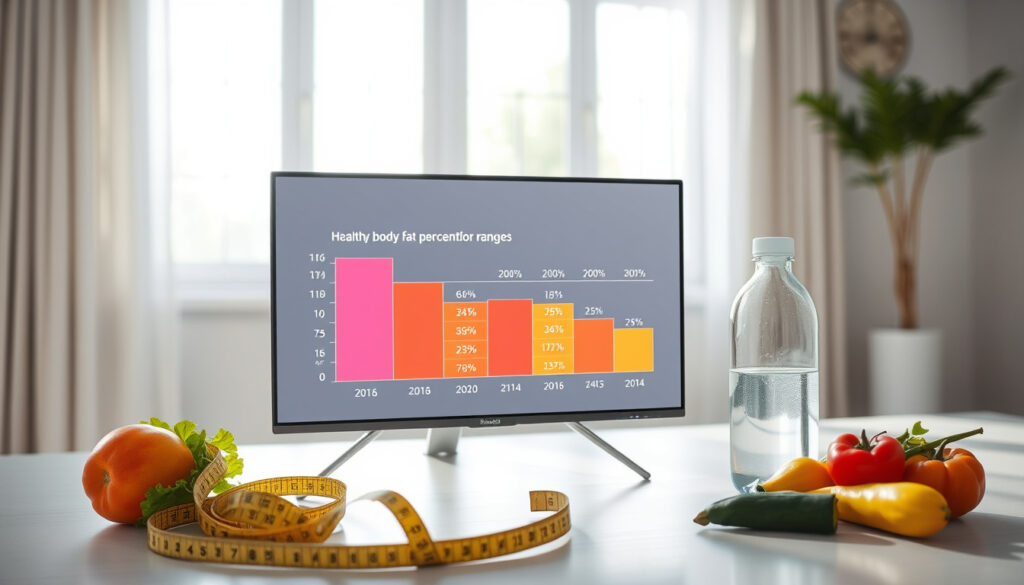
Body fat percentage chart by category
Six categories, one pattern: the lines between “fitness” and “acceptable” blur with age. For a woman in her 20s, 25% body fat lands in the acceptable range; for a woman in her 60s, that same number can be healthy.
The implication: category labels are useful starting points, but your age and activity level matter more than a single number. For a female body fat percentage chart that accounts for these shifts, the age-stratified data provides clearer guidance.
What is considered a healthy body fat percentage as you age?
Body fat changes with age
Body fat naturally increases as women age due to hormonal shifts, muscle loss, and metabolic changes. The chart from InBody USA (body composition technology) shows these decade-based ranges:
- Age 20–29: 21–31% healthy
- Age 30–39: 22–32%
- Age 40–49: 23–33%
- Age 50–59: 24–34%
- Age 60+: 25–35%
WebMD (health publisher) offers slightly tighter ranges: 16–24% for women 20–29, and 22–33% for women 60+. The University of Pennsylvania scale (via Medical News Today) takes a granular approach, grading from “excellent” to “dangerously high” by age.
Women’s Health UK reports that the Royal College of Nursing considers 15–31% healthy for women aged 20 to 40.
The catch: no single authority agrees on exact cutoffs, but the trend is consistent — your healthy range moves up about 1–2% per decade. These healthy body fat ranges for women by age reflect that gradual upward shift.
A woman who stays at 24% body fat from age 30 to 60 will actually be getting healthier relative to her peer group, because the acceptable range rises. The number alone doesn’t tell the story — context of age does.
The pattern: tracking your own trend against age-matched norms gives a more honest picture than chasing a single ideal.
How does 20% body fat look on a woman?
Visual descriptions of 20% body fat
- Visible muscle definition in arms and shoulders
- Defined waist, some curve in hips
- No visible abdominal veins, but a clear shape
- Not “lean” in a competitive sense, but athletic and fit
Research from InBody USA places 20% near the top of the athletic range (14–20%) and the bottom of the fitness range (21–24%). It is considered healthy and often aesthetically preferred in Western surveys (NIH study on attractiveness).
Dr. Weil (integrative medicine specialist) notes that 20% falls within the healthy range for a woman aged 25, which he puts at 16.5% to 24.6%.
20% body fat may require consistent training and careful nutrition. It’s not a set-it-and-forget-it range for most women.
The implication: 20% is attainable but demands lifestyle consistency — it works as a goal only if your routine supports it.
What does a female with 18% body fat look like?
18% body fat visual description
- Lean, well-defined muscles, especially in arms, shoulders, and legs
- Low body fat stores — visible collarbones, some muscle striations
- May see some abdominal muscle outline
- Still soft in areas — not “cut” like a bodybuilder on stage
Is 18% body fat chubby?
No. 18% body fat is solidly within the athletic range for women (14–20%). The University of Pennsylvania chart classifies 16.6–19.4% as “good” for women aged 20–29. Calling it “chubby” would be a misreading — it’s actually on the leaner side.
However, for some women it may be too low. Essential fat functions (menstrual health, hormonal balance) can be disrupted below 14–17%, according to ACE. At 18%, most women are fine, but those prone to amenorrhea should monitor.
“Chubby” is a social label, not a medical one. By every clinical standard, 18% body fat is lean.
What does 25% body fat look like on a female?
25% body fat description
- Softer curves, fuller hips and thighs
- Waist still defined but less sharp
- No visible abdominal muscle separation
- Overall shape: smooth, womanly, not overweight
Is 25% body fat chubby?
Not clinically. 25% body fat falls within the acceptable range (25–31%) per ACE and is actually at the high end of the fitness range (21–24% ends at 24%). For women over 40, 25% is comfortably within healthy territory (InBody USA).
The perception of “chubby” is cultural. In many populations, 25% is normal and healthy. The American Heart Association notes that body fat distribution matters more than the percentage alone.
If you carry most fat around your waist (apple shape), health risks are higher than if it’s on hips and thighs. 25% body fat on a pear-shaped woman is typically lower risk than 25% on an apple-shaped woman.
The implication: where you store fat matters as much as how much you carry.
What is the most attractive body fat percentage for females?
Research on perceived attractiveness
Multiple studies find that waist-to-hip ratio (WHR) is a stronger predictor of perceived attractiveness than body fat percentage alone. A WHR around 0.7 is consistently preferred across cultures (NIH meta-analysis).
That said, Western surveys often cite a body fat range of 19–22% as most attractive. This aligns with the appearance of a toned, athletic-but-not-lean physique.
Cultural variation in preferences
- Some cultures prefer higher body fat (e.g., 24–28%), associated with fertility and prosperity (anthropological studies).
- In fashion and fitness media, lower ranges (14–19%) are overrepresented.
The implication: chasing a universal “attractive” number is a trap. Health markers — regular cycles, energy, strength — should guide your goal.
The body fat range rated most attractive in surveys (19–22%) overlaps heavily with the athletic-to-fitness range that supports good health. When women aim for what looks good, they often land where they feel good too.
The pattern: attractiveness and health converge in the same range — making the goal both practical and sustainable.
Confirmed facts vs. what’s unclear
Confirmed facts
- Essential fat for women is 10–13% (ACE consensus)
- Obesity threshold for women is ≥32% (ACE)
- Body fat percentage increases with age (InBody USA)
- DEXA is the most accurate measurement method (Harvard Health)
What’s unclear
- Exact cutoffs for “attractive” vary across cultures (NIH research)
- Whether 18% body fat is “chubby” is subjective and context-dependent (Medical News Today)
Perspectives from experts
“For women, essential fat is about 10–13% and anything below that can disrupt menstrual cycles and bone health.”
— American Council on Exercise (fitness certification body)
“The Jackson and Pollock formula remains one of the most validated ways to estimate body fat from skinfolds, with age-specific equations that adjust for normal fat gain over time.”
— Jackson & Pollock (research, published in Sports Medicine)
“NHANES data show that the average body fat percentage for US women aged 20–49 is 32% — higher than the ranges many health organizations consider ideal.”
For US women, the gap between what’s clinically healthy and what’s average is significant. The average woman (32% body fat) sits right at the obesity threshold. That doesn’t mean everyone should panic — but it does mean understanding your own number and its context is the first step toward informed decisions.
bodyspec.com, nationalreport.uk, calorique.io, scienceinsights.org, formulaforge.org, inbodyusa.com, vinmec.com
Frequently asked questions
What is the minimum body fat percentage for women to be healthy?
10–13% essential fat is needed for hormonal and reproductive function, according to American Council on Exercise (ACE). Going below 10% for extended periods can cause health issues.
How can I measure my body fat at home?
Smart scales with bioelectrical impedance or skinfold calipers are the most accessible. For best accuracy, measure at the same time each day (morning, before eating) and use the same device.
Does body fat percentage matter more than BMI?
Yes, for individuals. BMI doesn’t distinguish between muscle and fat. Body fat percentage gives a better picture of body composition. The American Heart Association recommends body fat assessment along with BMI.
Can I reduce my body fat percentage without losing weight?
Yes — by building muscle and losing fat (body recomposition). The scale may stay the same while body fat drops. Strength training and adequate protein are key.
What factors affect body fat percentage besides exercise?
Sleep, stress, hormones (menopause, thyroid), genetics, and diet composition all play a role. Harvard Health notes that poor sleep increases cortisol, which can promote fat storage.
Is it safe to have body fat below 10% for a woman?
Generally not. Essential fat functions (menstruation, hormone production, bone health) require at least 10–13%. Below that risk is high for amenorrhea, osteoporosis, and lowered immunity.
More related posts
 OCBC Fixed Deposit Promotion 2026 Rates & Comparison
 Bayern Munich vs Inter Milan Lineups: Confirmed Starting XI
 Civil Servant Bonus 2024 – Amounts, Eligibility, Payments
 Chocolate Finance Withdrawals Delay – Status, Causes, Timeline
 SIMBA Service Centre Near Me: Locations, Hours & Contact
 Honeymoon With My Mother In Law: Webcomic Guide & Reactions
 Accident Today Singapore 2025: Fatalities, History & What to Do