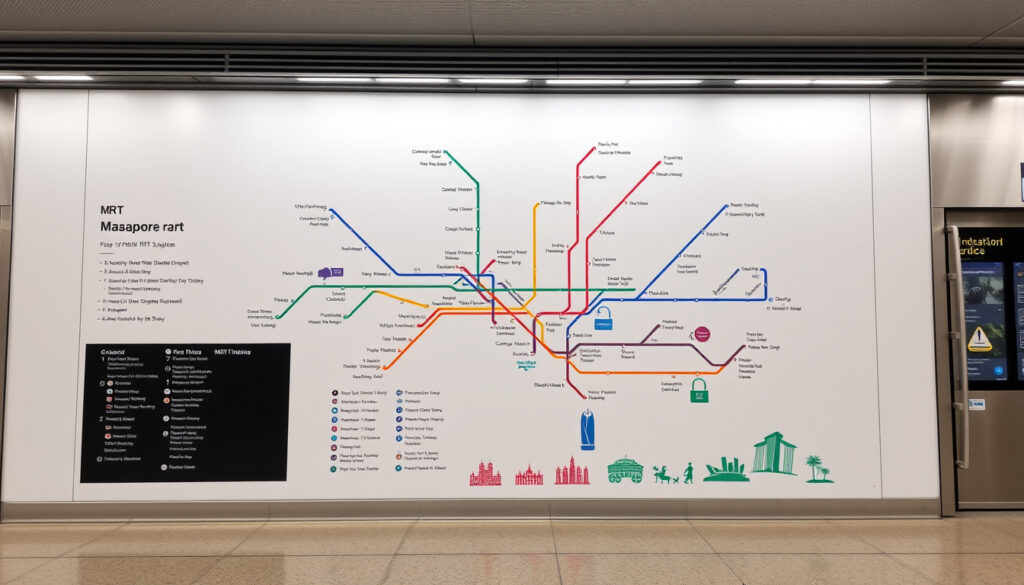
Singapore MRT Map 2024: Tourist Guide, Fares & Station List
Anyone who has unfolded a transit map in a new city knows the mix of promise and confusion it brings. Singapore’s 2024 MRT map tilts hard toward promise: over 140 stations across 6 lines, with peak-hour trains arriving every 2 to 3 minutes, per the Land Transport Authority. The practical bits matter just as much — how tourists pay, when the last train leaves, and which line actually suits a day of sightseeing. Read on for the parts the official map doesn’t spell out.
Total stations (2024): over 140 ·
Lines: 6 ·
Longest line (East-West): about 57 km ·
Daily ridership: over 3.5 million ·
First train: around 5:30 AM ·
Last train: about 11:30 PM to midnight
Quick snapshot
- Six MRT lines and over 140 stations operate on the 2024 map (Land Transport Authority, Singapore’s transport agency)
- Trains generally run from about 5:30 AM to around midnight daily (Trip.com’s Singapore MRT guide)
- The base adult card fare is S$1.28 for trips up to 3.2 km (SBS Transit fares page)
- Which line counts as “slowest” — no official average-speed ranking exists
- Exact per-station exit counts vary by source
- Station counts shift as new stages open, so older guides lag the official map
- 1987: the first MRT line (North-South) opens (Singapore Travel Handbook, 2024 visitor guide)
- 2024: six lines and over 140 stations, now including Thomson-East Coast Line Stage 4 (Singapore Travel Handbook, 2024 visitor guide) (Singapore Travel Handbook, 2024 visitor guide)
- 2026: more Thomson-East Coast stations are expected to open (Ministry of Transport, Singapore’s transport ministry)
- 2030: the future MRT map adds new lines under the long-term master plan (Ministry of Transport, Singapore’s transport ministry) (SMRT, Singapore’s major rail operator)
- Printed maps are available at every station, and the interactive map lives online (Singapore Travel Handbook, 2024 visitor guide) (SMRT, Singapore’s major rail operator)
- For tourists, the fastest move is tapping a contactless bank card instead of queuing at a ticket machine (SMRT, Singapore’s major rail operator)
Six numbers, one pattern: Singapore’s rail network is built for volume — long operating hours, tight peak headways, and fares that scale with distance.
| Metric | Value |
|---|---|
| Total stations | Over 140 (2024) (Singapore Travel Handbook, 2024 visitor guide) |
| Operating lines | 6 (Trip.com’s Singapore MRT guide) |
| Daily ridership (average) | Over 3.5 million (SMRT, Singapore’s major rail operator) |
| Operating hours | About 5:30 AM to about midnight (Trip.com’s Singapore MRT guide) |
| Longest line | East-West Line, about 57 km (SMRT, Singapore’s major rail operator) |
| Fastest line | North-East Line, top speed 100 km/h (Singapore Travel Handbook, 2024 visitor guide) |
How do tourists use the MRT in Singapore?
Step-by-step guide for tourists using MRT
- Quick version: pick a payment card, tap in, follow the signs, tap out.
- Choose your payment: a contactless bank card, the Singapore Tourist Pass, or a single-trip ticket all work (SMRT, Singapore’s major rail operator).
- Tap in at the gantry with the same card you’ll use to exit — the system needs both taps to calculate the ride.
- Follow the line-name signs to the right platform; each platform shows the direction and the next few stations.
- Keep right on escalators, and keep food and drinks out of the system — the rule is enforced.
- Tap out at your destination; the distance-based fare is deducted from your card or pass automatically.
Buying tickets and using the fare card
- Contactless bank cards work directly at the gantries; no top-up or registration is needed for tourists (SMRT, Singapore’s major rail operator).
- The Singapore Tourist Pass caps your transport costs with unlimited rides from S$22 per day, per the official fares published by the Public Transport Council (Public Transport Council, Singapore’s fare regulator).
- Single-trip tickets are sold at station machines — useful for one ride, less convenient for a full day of hopping.
- Tap in and tap out with the same card or pass; mixing payment methods on one journey can leave the system unable to compute your fare.
The trade-off: the system rewards a little planning. Tourists who sort out payment before the gantry — rather than at it — move through Singapore like locals.
Which is the best MRT line in Singapore?
Comparing the North-East Line, Circle Line, and East-West Line
- North-East Line: the fastest line, with a top speed of 100 km/h, according to the Singapore Travel Handbook, 2024 visitor guide
- Circle Line: the sightseeing loop, linking the Botanic Gardens and Marina Bay, per Trip.com’s Singapore MRT guide
- East-West Line: the longest line at about 57 km and the network’s busiest, per SMRT, Singapore’s major rail operator
Three lines, one pattern: each one wins a different prize — speed, sightseeing, and sheer length.
| Line | Best for | Why it wins |
|---|---|---|
| North-East Line | Fast cross-town trips | Highest top speed at 100 km/h; serves Chinatown and Little India |
| Circle Line | Sightseeing loops | Reaches the Botanic Gardens and Marina Bay |
| East-West Line | Long hauls and airport runs | Longest line at about 57 km; connects Changi Airport via its Tanah Merah branch |
Best line for tourists: Circle Line for sights
- First day in Singapore? The Circle Line is the closest thing the MRT has to a sightseeing bus — it rings the city and drops you near the Botanic Gardens and Marina Bay.
- Short stop in Chinatown or Little India? The North-East Line gets you there fastest.
- Airport day at the end of the trip? The East-West Line’s Changi Airport branch is the direct train route.
The pattern: there is no single “best line” — there is the line that matches your itinerary. Speed, sightseeing, and distance each have their own winner, and the map is easiest to read once you know which prize you’re chasing.
How much does it cost to travel by Singapore MRT?
Standard fares and tourist passes
- Adult card fares are distance-based: S$1.28 for trips up to 3.2 km, rising to about S$2.57 for the longest rides (SBS Transit fares page; Trip.com’s Singapore MRT guide).
- The Singapore Tourist Pass unlocks unlimited rides from S$22 per day (Public Transport Council, Singapore’s fare regulator).
- Free travel windows exist on selected North East Line and Sengkang-Punggol LRT rides: tap in before 7:30 AM or between 9:00 and 9:45 AM on weekdays and the first rail trip is free (Ministry of Transport, Singapore’s transport ministry).
- Because fares are distance-based, short tourist hops stay cheap — the cost grows only with longer journeys.
Cost comparison of different payment methods
Tap in before 7:45 AM on a weekday and the same short ride drops from S$1.28 to S$0.78, per SBS Transit’s fare table. That’s a S$0.50 discount for an earlier alarm — the cheapest productivity hack on the network.
- Contactless bank card: best for short stays; no queues, no deposit, and the fare is capped by distance.
- Singapore Tourist Pass: best for heavy sightseeing days — three or four long rides can make the S$22 daily rate worthwhile.
- Single-trip tickets: fine for one ride, but the machine queue makes them the least convenient option for a full day.
What this means: the distance-based system keeps short tourist hops cheap, and the Tourist Pass only pays off on days with many trips. Pick your payment method based on how many rides you actually plan, not on how “official” it looks.
Is the MRT in Singapore 24 hours?
Operating hours and night services
- First trains depart from most stations around 5:30 AM; last trains leave between about 11:30 PM and midnight.
- Peak-hour headways run 2–3 minutes; off-peak waits stretch to about 5–7 minutes.
- Operating hours are extended during festive periods and major events.
The Land Transport Authority says MRT and LRT services generally operate from about 5:30 AM to around midnight daily, with 2–3 minute headways in peak hours and 5–7 minutes off-peak, and later service on selected festive nights (Land Transport Authority, Singapore’s transport agency).
Alternatives after midnight
- No 24-hour MRT service exists — don’t count on sleeping on the last train.
- After the last train, night bus routes and taxis or ride-hailing carry the network’s load until the first train.
- Special event nights (New Year, National Day) bring extended hours and extra services.
Miss the midnight window and the MRT’s convenience disappears. A 2 AM train? There isn’t one. Night buses run slower, ride-hailing costs surge, and a S$2 trip can turn into a S$20 problem.
The catch: the network is generous with hours but unapologetic about closing time. Treat the last train as a hard deadline — or budget for the taxi that follows.
What are all the MRT stations in Singapore?
List of stations on each line
- North-South Line: 27 stations, the original line from 1987 (Singapore Travel Handbook, 2024 visitor guide)
- East-West Line: 35 stations, including the Changi Airport branch (SMRT, Singapore’s major rail operator)
- Circle Line: the loop that rings the city centre, stopping at the Botanic Gardens and Marina Bay
- North-East Line: the fastest line, linking Chinatown and Little India directly
- Downtown Line: roughly 42 km through the central business district and Marina Bay area (Trip.com’s Singapore MRT guide)
- Thomson-East Coast Line: the newest line; Stage 4 joined the map in 2024 (Singapore Travel Handbook, 2024 visitor guide)
Interactive map resources
- The official interactive map is online, and printed maps sit at every station — grab one before you tap in (Singapore Travel Handbook, 2024 visitor guide).
- Looking for the Singapore MRT map 2024 PDF? Official versions come from LTA’s online map; third-party PDFs often lag the latest station openings.
- Map changes land in waves: TEL Stage 4 arrived in 2024, more TEL stations follow in 2026, and the full master plan reshapes the map by 2030.
The map’s evolution is easy to skim:
- 1987 — North-South Line opens as Singapore’s first MRT line (Singapore Travel Handbook, 2024 visitor guide).
- 2024 — six lines, over 140 stations, TEL Stage 4 on the map (Singapore Travel Handbook, 2024 visitor guide).
- 2026 — more Thomson-East Coast Line stations expected (Ministry of Transport, Singapore’s transport ministry).
- 2030 — future map adds new lines under the long-term plan (Ministry of Transport, Singapore’s transport ministry).
The MRT map is a moving target. The version you see today will grow with the Thomson-East Coast Line in 2026 and the master plan’s new lines by 2030, so treat any “2024 map” as a snapshot, not a promise.
The implication: today’s map is a snapshot, not a final answer. Visitors who check the official interactive map before travel will have the most up-to-date view of the network.
Confirmed facts
- MRT services operate from about 5:30 AM to around midnight daily (Trip.com’s Singapore MRT guide).
- Six MRT lines are operational on the 2024 map (Trip.com’s Singapore MRT guide).
- City Hall and Orchard consistently rank among the most crowded stations, according to the Singapore Travel Handbook, 2024 visitor guide.
What’s unclear
- Which line is “slowest”: no official average-speed ranking exists.
- Exact per-station exit counts vary by source and update unevenly.
- Railway maps from third-party PDFs sometimes miss newly opened stations.
- Opening dates for future stations have shifted before and can shift again.
Operators and guides agree on the essentials — the rest is detail.
MRT and LRT services generally operate from about 5:30 AM to around midnight daily, with later hours on selected festive occasions.
— Land Transport Authority, Singapore’s transport agency
Adult MRT and LRT card fares currently range from S$1.28 to S$2.57, and the fare structure is distance-based.
— Trip.com’s Singapore MRT guide
The latest MRT map as of late 2024 reflects the opening of the Thomson-East Coast Line’s fourth stage.
— Singapore Travel Handbook, 2024 visitor guide
For a first-time visitor, the 2024 MRT map is less a diagram and more a cheat sheet: six lines, over 140 stations, first trains around 5:30 AM, last trains near midnight, and fares that top out around S$2.57 for card users. The system’s real power is friction — a contactless card turns the whole network into one tap-and-go ride. The weakness is the clock: when the last train leaves, the MRT’s convenience vanishes with it. For tourists, the decision is clear: plan around the train during its operating hours, or budget for the night-bus and taxi premium that waits after midnight.
Related reading: How to Take the MRT in Singapore – 2024 Travel Guide · Singapore MRT Map Guide – Fares, Lines & Tips
mrt.sg, singaporemrt.org, lta.gov.sg, lta.gov.sg, mapa-metro.com
Frequently asked questions
What is the fastest MRT line in Singapore?
The North-East Line, with a top speed of 100 km/h, according to the Singapore Travel Handbook, 2024 visitor guide. It is the line to pick for quick cross-town hops, especially between Chinatown and Little India.
Can I use my foreign credit card on MRT?
Yes — contactless bank cards work directly at the gantries, and the same card must be used to tap in and tap out. SMRT’s getting-around guidance covers contactless payment and the SimplyGo system (SMRT, Singapore’s major rail operator).
Are there toilets at MRT stations?
Facilities vary by station. Larger interchange stations such as City Hall and Orchard are the safest bets; when in doubt, use the toilet before tapping into the paid area.
Is the MRT wheelchair accessible?
Yes — the network is built with barrier-free access, lifts, and tactile guidance as standard, and station staff can assist with boarding. All six lines in the 2024 map are served by accessible stations.
How do I get from Changi Airport to city by MRT?
Take the East-West Line from Changi Airport station to Tanah Merah, then switch to a city-bound train. The route is clearly marked on the official interactive map and on station platform signs (Trip.com’s Singapore MRT guide).
What is the penalty for eating on MRT?
Eating and drinking are banned on trains and in stations, and enforcement is strict. Treat the gantry as the snack cutoff line — finish before you tap in.
Are pets allowed on MRT?
No — only guide dogs are allowed on trains and in stations. Pet owners should plan on taxis or private-hire cars instead.
Do I need to tap out if I stay on same line?
You tap only at entry and exit, not at intermediate stations. But you must tap out when you leave the paid area, or the system cannot calculate your distance-based fare (SBS Transit fares page).
Related reading
- How to Take the MRT in Singapore – 2024 Travel Guide (Singapore Travel Handbook)
- Singapore MRT Map Guide – Fares, Lines & Tips (Trip.com)
More related posts
 Taylor Swift Net Worth 2026: $2.1 Billion – Richest Female Musician
 Arknights: Endfield Release Date – January 22, 2026
 70-Inch QLED TV: Best Models, Pros vs OLED & Buyer’s Guide (2024)
 Gold Chain for Men: Sizes, Styles & Prices in Ireland
 Best Maid Agency Singapore – 2025 Data-Driven Rankings
 Aston Villa vs Fulham F.C. Stats: Head-to-Head Record
 Typhoon Cafe Plaza Singapura: Menu, Buffet, Reviews & Hours
 Singapore Muslim Prayer Time Today: Official MUIS Schedule