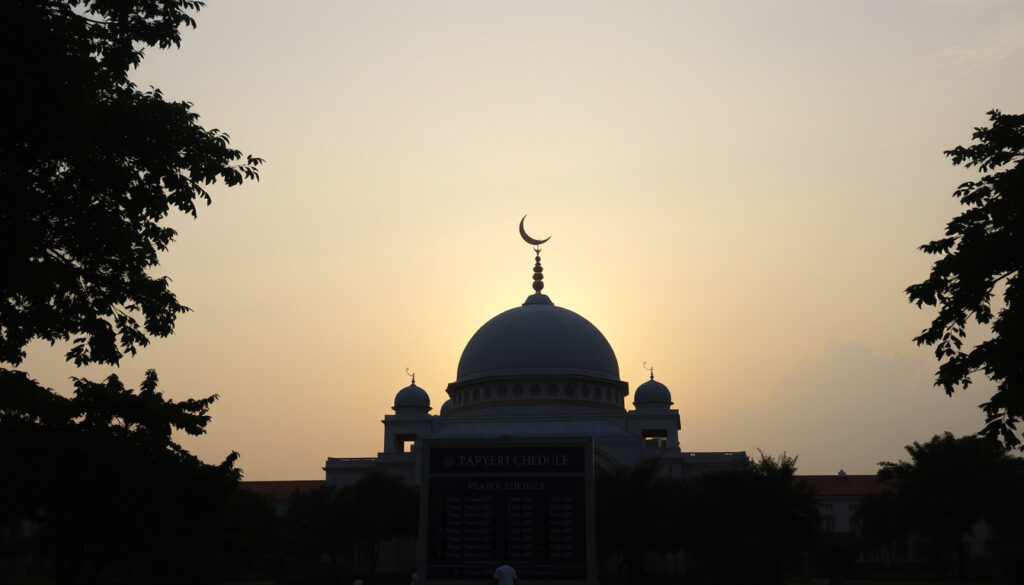
Mu lim Prayer Time Singapore: 2025 Schedule & Guide
Most people in Singapore who pray five times daily don’t realize how much their schedule shifts day to day — and why. A quick glance at the Majlis Ugama Islam Singapura (MUIS) homepage shows today’s times: Fajr at 5:34 AM, Maghrib at 7:08 PM.
Fajr (Subuh): 5:34 AM · Syuruk: 6:57 AM · Dhuhr (Zohor): 1:03 PM · Asr (Asar): 4:27 PM · Maghrib: 7:08 PM · Isha (Isyak): 8:17 PM
Quick snapshot
- MUIS publishes the official 2025 prayer timetable as a PDF (MUIS Islamic Calendar page)
- Singapore’s Muslim population is predominantly Sunni (Shafi’i school) (MUIS homepage)
- Exact calculation method (degree-based or time-based) used by MUIS
- Whether different apps use identical or varying calculation methods
- Prayer times shift daily due to solar position; the difference can be several minutes between adjacent days (MUIS 2025 dataset)
- Download the official MUIS 2026 timetable when released (MUIS Islamic Calendar page)
MUIS determines prayer times using hisab (astronomical calculations) and rukyah (sighting) — a combination that ensures the official timetable aligns with observable solar phenomena. — MUIS official methodology notice
Five facts about Singapore prayer times, one pattern: MUIS holds exclusive authority over the official schedule.
| Label | Value |
|---|---|
| Official Authority | Majlis Ugama Islam Singapura (MUIS) |
| Calculation Method | Hisab (astronomical calculations) and Rukyah (sighting) |
| Next Prayer (Example) | Maghrib 7:08 PM |
| Number of Daily Prayers | 5 |
| Sect Majority | Sunni (Shafi’i school) |
What time is the prayer in Singapore today?
Today’s prayer times for Singapore
- Fajr (Subuh): 5:34 AM – start of the day’s first prayer (MUIS homepage)
- Syuruk: 6:57 AM – the moment sunrise ends Fajr
- Dhuhr (Zohor): 1:03 PM
- Asr (Asar): 4:27 PM
- Maghrib: 7:08 PM
- Isha (Isyak): 8:17 PM
The times above come directly from MUIS, the official Islamic council of Singapore. They change daily because prayer times are calculated from the sun’s position (MUIS Islamic Calendar page).
How to read the MUIS timetable
MUIS publishes a single PDF each year covering all 365 days. The 2025 timetable is available on their site (MUIS Islamic Calendar page). A preview on data.gov.sg open data portal shows the first few days of 2025: January 2 lists 5:44, 7:07, 1:10, 4:34, 7:10, and 8:25 (data.gov.sg Muslim Prayer Timetable 2025).
The implication: relying on any other source risks praying outside the valid window.
What are the 5 times a day Muslims pray?
Fajr (Subuh)
- Starts at dawn, ends at sunrise (Syuruk)
- Today: 5:34 AM
- Two rak’ah sunnah before the obligatory prayer
Fajr is the only prayer that can be prayed between the start of true dawn and before the sun’s disk appears. Once Syuruk hits (6:57 AM today), Fajr time ends (MUIS homepage).
Dhuhr (Zohor)
- After the sun passes its zenith until any object’s shadow equals its height
- Today: 1:03 PM
- Four rak’ah obligatory
In Singapore, Dhuhr typically starts shortly after midday. The exact moment depends on the solar meridian crossing (MUIS Islamic Calendar).
Asr (Asar)
- Begins when an object’s shadow equals its height, lasts until sunset
- Today: 4:27 PM
- One of the two prayers mentioned together in the Quran
Maghrib
- Immediately after sunset, ends when twilight disappears
- Today: 7:08 PM
- Three rak’ah obligatory
The Maghrib window is the shortest of all five prayers — about 12-20 minutes in Singapore depending on the season.
Isha (Isyak)
- After twilight (red glow) vanishes until dawn
- Today: 8:17 PM
- Four rak’ah obligatory
What this means: The five prayers cover the full day from dawn to night, each with a precise opening and closing time based on solar geometry. MUIS’s timetable captures these boundaries exactly.
What is the forbidden time for Salah?
Three prohibited times
Islamic tradition identifies three moments when voluntary prayer is forbidden: at sunrise, when the sun is at its zenith (midday), and at sunset.
Do not pray after Fajr until sunrise, nor after Asr until sunset. — Prophet Muhammad (peace be upon him), Sahih Bukhari, Book of Prayer Times
- From Fajr until the sun has fully risen (Syuruk period)
- When the sun is at its zenith (around 12:45-1:15 PM, before Dhuhr)
- From Asr until sunset
Why these times are forbidden
The prohibition is tied to the sun’s association with pagan worship practices. Scholars explain that these are moments when the sun is either rising, setting, or at its peak — acts of prostration during these times could resemble sun worship. The ruling comes from multiple authentic hadith collections (Sahih Bukhari, Book of Prayer Times).
Exceptions
Catching up on missed obligatory prayers (qada) is allowed even during forbidden times. The prohibition applies only to nafl (voluntary) prayers. Similarly, praying Janazah (funeral) and sujud al-tilawah are permitted.
The three forbidden windows are very short — typically less than 15 minutes each in Singapore. Knowing them prevents a prayer from being unintentionally invalid.
Is Singapore Sunni or Shia?
Majority Sunni in Singapore
Singapore’s Muslim community is overwhelmingly Sunni, following the Shafi’i school of jurisprudence. MUIS itself operates under Shafi’i methodology (MUIS homepage).
Influence on prayer times
In practice, the sect makes little difference to the prayer time schedule used in Singapore. Both Sunni and Shia communities consult the same MUIS timetable. Shia Muslims in Singapore typically follow the same clock times because the MUIS calculation aligns with the observable solar phenomena.
No practical difference in timetable
The one potential variation is the start of Fajr — some Shia schools use a different angle for dawn. But in Singapore, the MUIS timetable is accepted across mosques regardless of sect. The open-data dataset from data.gov.sg open data portal does not specify sect adjustments.
How can I get Singapore prayer times for 2025 or 2026?
MUIS official PDFs
The most reliable source is MUIS’s Islamic Calendar page, where PDFs for 2024, 2025, and 2026 are listed (MUIS Islamic Calendar page). The 2025 PDF is available now; 2026 will appear later in 2025.
Mobile apps
- Muslim Pro – pulls from multiple calculation methods but allows users to select MUIS data
- AlAdhan – provides a Singapore calendar for future months with generic calculations (AlAdhan Singapore calendar)
Note that most apps use their own calculation engines. For guaranteed accuracy, cross-check with MUIS’s official times.
Websites
MUIS’s homepage (muis.gov.sg) shows current day’s times. The data.gov.sg dataset provides a machine-readable CSV (data.gov.sg Muslim Prayer Timetable 2025). For long-term planning, download the MUIS PDF.
Apps that use Umm al-Qura or ISNA calculations can differ from MUIS by several minutes. Singapore residents who rely solely on aggregator apps risk praying outside the valid window.
The pattern: MUIS controls the data — any shortcut introduces error.
For those specifically tracking the night prayer, the official Isyak time today provides the MUIS-verified schedule for Isha in Singapore.
Frequently asked questions
What time does Fajr start in Singapore?
Fajr (Subuh) today starts at 5:34 AM. This is the beginning of dawn. The time changes daily; check the MUIS timetable for the exact date.
How long after Maghrib can I pray Isha?
Isha begins when the red twilight disappears after sunset, which is about 1 hour and 10 minutes after Maghrib in Singapore. Today Isha is at 8:17 PM, about 69 minutes after Maghrib.
Can I pray Dhuhr at any time after noon?
No – Dhuhr ends when an object’s shadow equals its height plus the shadow at noon. That’s around 4:27 PM today (Asr start). After that, Dhuhr time is invalid.
What is the meaning of Syuruk?
Syuruk is the moment the sun’s disk appears above the horizon. It marks the end of Fajr prayer time and the beginning of the first forbidden period for voluntary prayer.
Why are prayer times different in June vs December?
Because Singapore is near the equator, the day length varies slightly (about 12 minutes difference between solstices), but the Sun’s daily path changes enough to shift Fajr and Isha noticeably – up to 20 minutes across the year.
Does Singapore use daylight saving time?
No, Singapore observes UTC+8 year-round. Prayer times do not shift for DST.
What is the best app for prayer times in Singapore?
Muslim Pro with the Singapore (MUIS) preset or the official MUIS website. For advanced users, Athan Pro also offers a MUIS option.
Is it permissible to combine prayers in Singapore?
Yes, for legitimate reasons (travel, illness) under the Shafi’i school you may combine Dhuhr with Asr or Maghrib with Isha. This is a standard allowance.
More related posts
 Real Madrid vs Atlético Madrid Lineups: March 2026 Derby
 Slot Gacor Dewakoin99-it: What’s Verified vs. Unverified
 Who Cannot Vote in Singapore? Eligibility & Disqualification
 Lee Joon-hyuk: Biography, Height, Marriage & Royal Ancestry
 Flight to Ipoh from Singapore: Airlines, Prices & Flight Time
 Popeye the Sailor Man: Origin, Characters & Legacy