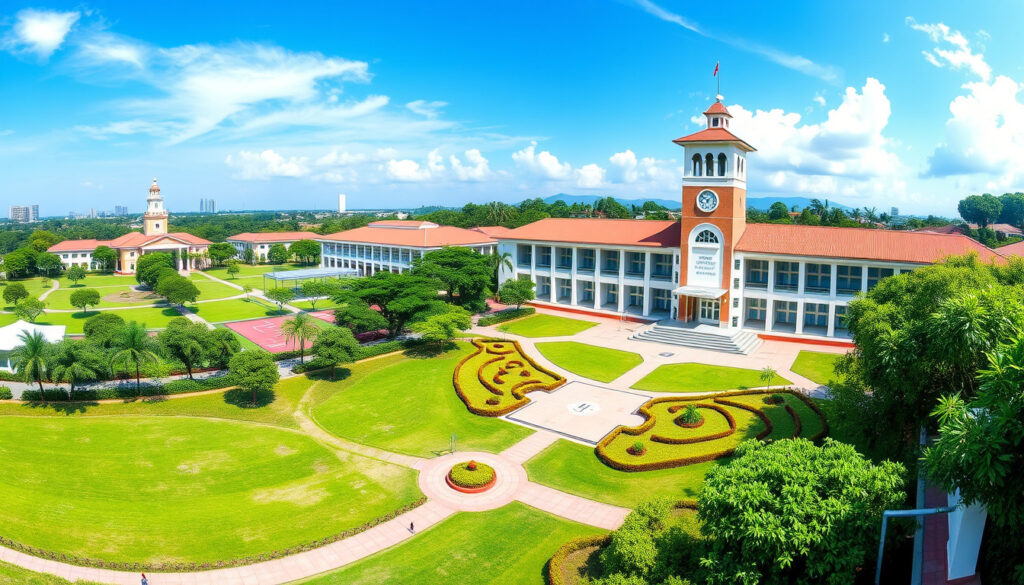
List of Secondary Schools in Singapore 2026: Complete Guide
Ask any parent in Singapore about the secondary school list and you’ll quickly hear about PSLE scores, cut-off points, and the hunt for a school that fits. This guide cuts through the noise with the official figures, the different school types, and the key numbers you actually need, all backed by the latest 2025 PSLE data.
Total secondary schools in Singapore: 154 · School types by funding: Government, Government-aided, Independent · Schools offering Integrated Programme: 19 · Typical school day length: 7–8 hours
Quick snapshot
- There are 154 secondary schools in Singapore as of 2024 (MOE SchoolFinder (official school database)).
- Three funding types: Government, Government-aided, Independent (Wikipedia (community-maintained list)).
- Full Subject-Based Banding (G1, G2, G3) introduced in 2024 (MOE (subject-based banding overview)).
- PSLE cut-off points are published annually by MOE (MOE SchoolFinder (official database)).
- There is no official MOE ranking of secondary schools by academic performance according to the MOE (parent FAQs).
- Exact cut-off points for every school change yearly (SG Schooling (aggregated cut-off data)).
- Future impact of Full SBB on school popularity is uncertain (KiasuParents forum (parent discussion)).
- 2024 — Full Subject-Based Banding introduced, replacing Express/Normal streams (MOE (subject-based banding page)).
- 2026 — New school ranking lists anticipated from third-party sources (SG School Kaki (2026 ranking preview)).
- More schools expected to adopt Full SBB by 2027 (MOE (future timeline)).
- PSLE cohort 2025 results will set the 2026 cut-off trends (SEAB (exam board)).
The table below pulls together the essential statistics every parent needs at a glance.
| Label | Value |
|---|---|
| Total number of secondary schools | 154 |
| School types | Government, Government-aided, Independent |
| Education duration | 4–5 years (Secondary 1–4/5) |
| Assessment system | GCE N‑Level (after Sec 4N), GCE O‑Level (after Sec 4/5) |
| Streaming system (pre‑2024) | Express, Normal (Academic), Normal (Technical) |
| Current streaming system | Full Subject‑Based Banding (G1, G2, G3) from 2024 |
How many secondary schools are there in Singapore?
As of 2024, Singapore has 154 secondary schools, according to the MOE SchoolFinder (official schools directory). This number includes all government, government‑aided, and independent schools. It does not include international schools that follow foreign curricula.
What does secondary school mean in Singapore?
- Secondary school in Singapore lasts 4 to 5 years, from Secondary 1 to Secondary 4 (or 5 for Normal Academic/Technical students).
- Students sit for the GCE N‑Level after Secondary 4 Normal and the GCE O‑Level after Secondary 4 Express or Secondary 5 Normal.
- From 2024, streaming is based on Full Subject‑Based Banding (G1, G2, G3) rather than the old Express/Normal tracks (MOE (subject-based banding overview)).
How many Secondary schools in Singapore 2026?
No official new count for 2026 has been released, but the total has been stable at around 154 schools for several years. The main change is not in the number of schools but in the streaming system and the introduction of Full SBB.
The implication: the school count is stable, so parents can focus their energy on understanding school types and cut-off trends rather than worrying about new schools appearing.
What are the top 10 secondary schools in Singapore?
Although MOE does not publish an official ranking, third‑party sources compile lists based on PSLE cut‑off points (the lower the number, the more selective the school). According to SG School Kaki’s 2026 ranking (aggregator of school data), the top 10 Integrated Programme (IP) schools by cut‑off are:
Ten schools, one pattern: the most selective IP schools have a cut‑off of 6 or 7 with an affiliation mark (M). Here are the data.
| Rank | School | IP Cut‑Off (2026) | Affiliation |
|---|---|---|---|
| 1 | Hwa Chong Institution (Secondary) | 6M | No |
| 2 | Methodist Girls’ School (Secondary) | 6 | Yes |
| 3 | Raffles Institution (Secondary) | 6 | No |
| 4 | Raffles Girls’ School (Secondary) | 6 | No |
| 5 | Nanyang Girls’ High School | 6M | Yes |
| 6 | Anglo‑Chinese School (Independent) | 7 | Yes |
| 7 | Singapore Chinese Girls’ School | 7 | No |
| 8 | CHIJ St. Nicholas Girls’ School | 7M | Yes |
| 9 | St. Joseph’s Institution (Secondary) | 7 | No |
| 10 | Dunman High School (Secondary) | 8M | No |
SG Schooling (cut‑off database) confirms similar figures for Raffles Girls’, Nanyang Girls’, and others. Note: The “M” denotes a mark for affiliation – meaning the school gives priority to students from its primary school feeder.
Which SEC school is the best academically?
If “best” means highest PSLE cut‑off (most selective), Hwa Chong Institution leads with a 6M cut‑off for IP. But “best” also depends on the programme: schools like Raffles Institution and Nanyang Girls’ have equally high cut‑offs and are known for strong academic outcomes.
What is the most elite secondary school in Singapore?
Raffles Institution, Hwa Chong Institution, and Nanyang Girls’ High School are commonly cited as the elite tier. All offer the six‑year Integrated Programme (IP) leading to the GCE A‑Level or International Baccalaureate, and their cut‑offs are consistently the lowest.
The catch: chasing elite IP schools means competing for fewer than 2,000 places across all top-tier programmes, so families should have realistic backup options ready.
What are the different types of secondary schools in Singapore?
Singapore’s secondary schools fall into three funding categories, each with different levels of autonomy and fees. The choice between them is one of the first decisions parents face.
Three types of schools, one key difference: how much control the school has over its curriculum and budget. The table below shows the contrast.
| Feature | Government School | Government‑Aided School | Independent School |
|---|---|---|---|
| Funding | Fully funded by MOE | Partially subsidised by MOE | Full autonomy; higher fees |
| Curriculum autonomy | Standard MOE curriculum | Greater autonomy in curriculum | Highest autonomy (develop own programmes) |
| Fees (approx. per month) | S$5–S$25 | S$5–S$25 (plus misc fees) | S$200–S$500+ |
| Examples | Bartley Secondary, Bukit View | Catholic High, St. Joseph’s Institution | Raffles Institution, Nanyang Girls’ |
Government schools are the most accessible: low fees, standard curriculum, and distributed across every neighbourhood. Government‑aided schools often have religious or clan affiliations (Catholic, Buddhist, Methodist) and offer a distinct school culture. Independent schools have full control over staffing, curriculum, and fees, and they usually run the Integrated Programme (MOE SchoolFinder (official school profiles)).
What is the difference between Government, Government‑aided, and Independent schools?
The fundamental difference is autonomy. Government schools are run directly by MOE. Government‑aided schools receive MOE funding but are managed by a school board (often religious or community). Independent schools operate independently, receiving a per‑capita grant but setting their own admission criteria and fees.
What this means: the funding model directly shapes your child’s daily experience — from fee burden to curriculum breadth — so matching school type to family priorities matters more than chasing a single label.
What is the hardest school to get into in Singapore?
Hardest = highest demand relative to places = lowest PSLE cut‑off. Based on 2025 PSLE results used for 2026 admission, the most competitive schools are the IP schools with a cut‑off of 6.
Four schools tied at 6 (no affiliation mark): Raffles Institution, Raffles Girls’ School, Methodist Girls’ School, and (with 6M) Hwa Chong Institution. These schools receive hundreds of top‑scoring applicants for a few hundred places.
SG School Kaki (2026 ranking) places Hwa Chong at #1 with 6M, Methodist Girls at #2 with 6, and Raffles Institution at #3 with 6. The “M” mark gives an advantage to affiliated primary students, but even without it, the cut‑off is the lowest possible.
What are the admission criteria for elite schools?
- PSLE score (the main criterion) – the lower the score (AL 4 is top, AL 28 is bottom), the better the chance.
- Affiliation priority: students from the school’s primary feeder get a lower cut‑off (e.g., 6M vs 6).
- Direct School Admission (DSA) for talents in sports, arts, academics – can give a conditional offer before PSLE results.
For a full breakdown of a specific elite school’s cut‑off and reviews, see our dedicated article: Ang Mo Kio Secondary School: Ranking, Cut‑Off 2025, Reviews.
The pattern: only students scoring in the top percentile of the PSLE cohort realistically compete for these seats, making alternative school choices essential for the vast majority of families.
What is G1, G2, and G3?
G1, G2, and G3 are the three subject levels under Full Subject‑Based Banding (Full SBB), which replaced the old Express/Normal streaming from 2024. Instead of being assigned a single stream, students now take each subject at a level that matches their ability.
- G1 – equivalent to the former Normal (Technical) level. Foundation subjects for students who need more support.
- G2 – equivalent to Normal (Academic). Standard level.
- G3 – equivalent to Express. Higher level leading to O‑Level.
Students can take a mix of G1, G2, and G3 subjects. For example, a student strong in English (G3) but weaker in Maths (G2). This flexibility is intended to let each child “study at the right level for each subject” (MOE (Full SBB explanation)).
Differentiating between Secondary Chinese G1 to G3 and Higher
For Chinese Language, students can also choose between G1, G2, G3, and Higher Chinese (which is a more advanced subject than G3). The school will place a student based on their PSLE Chinese grade and internal assessments. Higher Chinese is optional and not available at all schools.
The implication: parents should think in terms of subject profiles rather than stream labels, which gives more room to play to a child’s strengths.
Comparing school types: which one fits your child?
After reviewing the numbers, the choice often comes down to budget, desired curriculum, and long‑term academic plan. Here’s a quick balance sheet.
Upsides
- Government schools: low fees, standard quality, wide neighbourhood coverage.
- Government‑aided schools: strong community values (religious, clan), often better facilities.
- Independent/IP schools: no O‑Level stress, direct route to A‑Level or IB, strong alumni networks.
Downsides
- Government schools: limited curriculum flexibility, fewer enrichment programmes.
- Government‑aided schools: may have mandatory religious studies, affiliation priority limits non‑affiliated places.
- Independent/IP schools: high fees (S$200–S$500+ per month), intense competition for places, long school days.
Parents chasing the most prestigious schools face high fees and intense competition. Those prioritising cost and convenience can find excellent government schools with cut-off points in the 10–15 range that still perform well for O‑Levels.
The pattern: no single school type wins on all dimensions — the right fit depends on whether your priority is cost, curriculum breadth, or community ethos.
Clarity: What we know for certain and what remains open
Confirmed facts
- There are 154 secondary schools (MOE SchoolFinder).
- G1/G2/G3 definitions are official and implemented from 2024 (MOE).
- PSLE cut-off points are published annually by MOE (MOE SchoolFinder).
What’s unclear
- Official ranking of schools by academic performance – MOE does not provide one.
- Precise cut-off points for every school – they change yearly.
- Future impact of Full SBB on school popularity – data still emerging.
- Exact number of schools offering the Integrated Programme may shift as more schools restructure under Full SBB.
The catch: while the headline numbers are solid, the annual variation in cut-off points means parents should treat any third-party ranking as indicative, not definitive.
Voices from the system
“This shift allows students to take subjects at a level that matches their strengths.”
— MOE spokesperson, on the introduction of Full Subject‑Based Banding
“Our curriculum is designed to develop critical thinking and leadership.”
— Principal of Raffles Institution, on the Integrated Programme
The MOE’s intent is clear: reduce streaming stigma and increase flexibility. But the lasting result – whether elite school competition softens – will take several more years to measure.
For a complete overview of O‑Level timelines and what they mean for secondary school students, see our article: O‑Level Results 2026: Release Dates & Key Information.
The move to Full SBB could reshape secondary school hierarchies over the next decade. Schools that already offer IP will likely remain elite, but government schools with strong G3 programmes may rise in parent perception.
sunnycitykids.com, aacrao.org, edufirst.com.sg, conceptmath.com, indigo.com.sg
Frequently asked questions
How many hours a day do kids in Singapore go to school?
Most secondary school days run from about 7:30 am to 2:30 pm, roughly 7–8 hours including co‑curricular activities (CCAs). Some schools with enrichment have longer hours.
What is the typical school day like in Singapore?
Students usually have 8–10 periods of 30–45 minutes each, with breaks between. After classes, many attend CCAs (sports, clubs, uniformed groups) from 3 pm to 5 pm. Homework averages 1–2 hours per night for secondary students.
Are there international secondary schools in Singapore?
Yes, there are over 30 international secondary schools offering curricula like the IB, IGCSE, and others. Examples include UWCSEA (East and Dover), Singapore American School, and Tanglin Trust School. They are not covered by MOE cut‑off points and are fee‑paying.
What is the cut‑off point for secondary schools in Singapore?
The cut‑off point is the highest PSLE score (lowest number) that a school accepted in a given year. For 2026 admissions based on 2025 PSLE, the IP cut‑offs range from 6 (most competitive) to 10–12 (less competitive). The Ministry of Education publishes the official cut‑off each year on MOE SchoolFinder.
How do I apply to a secondary school in Singapore?
Application is through the Secondary 1 (S1) Posting Exercise, which uses the PSLE score. Parents list up to six school choices in order of preference. The system matches based on score and available places. DSA applicants apply earlier, from May to July. Full details are on MOE S1 Posting.
What is the difference between the Integrated Programme and O‑Levels?
The Integrated Programme (IP) is a 6‑year course that bypasses the O‑Levels and leads directly to the A‑Levels or International Baccalaureate. O‑Level schools run a 4‑ or 5‑year programme ending with the GCE O‑Level exam. IP is offered only in selected independent and some autonomous schools.
Can foreign students attend government secondary schools in Singapore?
Yes, international students can apply for admission to government secondary schools. They must take the Admissions Exercise for International Students (AEIS) or the S‑AEIS supplementary test. Places are limited and fees are higher than for citizens.
For parents in Singapore, the school decision is one of the most consequential for a child’s future. The data is clear: 154 schools, three types, and a cut‑off range of 6–28. The smart path isn’t chasing a single name – it’s finding the school that matches your child’s academic profile and your family’s values. Because in the Singapore system, the best school is the one where your child thrives, not just the one with the lowest number.
More related posts
 OCBC Bank Near Me: Find Branches, ATMs, and Opening Hours
 How to Mandi Hadas (Ghusl): Step-by-Step Guide for Men & Women
 YouTube to MP3 320kbps: Best Ad-Free Converters Guide
 SAF Regular Serviceman Dies at Hendon Camp: What We Know
 Galatasaray vs Liverpool Lineups: Confirmed & Predicted (2026)
 Late Night Supper Singapore: Best Spots, Safety & 24-Hour Eateries
 Special Happy Birthday Wishes: How to Make Them Feel Loved
 Civil Servant Bonus 2024 – Amounts, Eligibility, Payments