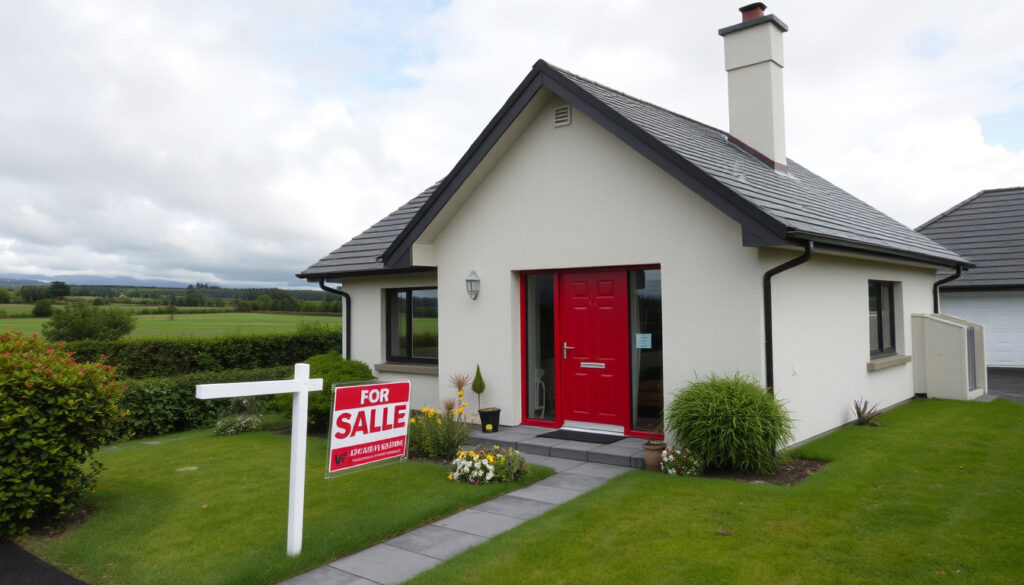
How to Buy a House in Ireland: Step-by-Step Guide 2025
Buying your first home in Ireland is one of the biggest financial leaps you’ll ever take — and the rules here make it different from almost anywhere else. With an average house price of €315,000 and a first-time buyer minimum deposit of just 10%, the path from saver to homeowner is more structured than you might think.
Average house price in Ireland (2024): €315,000 ·
Minimum deposit for first-time buyers: 10% of purchase price ·
Average mortgage interest rate: 4.5% ·
Typical home buying process duration: 4–6 months ·
Help to Buy maximum grant: €30,000
Quick snapshot
- First-time buyers need at least 10% deposit (Central Bank of Ireland)
- Help to Buy scheme provides up to €30,000 (Revenue (tax authority))
- Mortgage lenders use 3.5–4 times income multiples (CCPC (consumer protection authority))
- Standard process includes solicitor, survey, and conveyancing (Central Bank of Ireland)
- Future interest rate movements (Central Bank of Ireland)
- Exact processing time varies by lender and property (Carrick Credit Union)
- Whether Help to Buy will be extended beyond 2025 (Revenue)
- Whether First Home Scheme will remain available after its current pilot phase (Central Bank of Ireland)
- Process typically takes 4–6 months from deposit savings to key handover (gov.ie (official government guide))
- Mortgage approval in principle takes 1–2 weeks (Wise (currency & finance))
- Closing and conveyancing takes 6–8 weeks after sale agreed (gov.ie (official government guide))
- Complete conveyancing and sign contracts (Carrick Credit Union)
- Arrange building insurance before closing (Carrick Credit Union)
- Register property with the Property Registration Authority (Property Registration Authority (state body))
The snapshot clarifies that while deposit rules are set, timelines and future schemes carry uncertainty.
Key facts at a glance
Six numbers that define the Irish home-buying landscape for 2025.
| Metric | Value |
|---|---|
| Average house price in Ireland | €315,000 |
| First-time buyer minimum deposit | 10% |
| Average mortgage rate | 4.5% |
| Typical process duration | 4–6 months |
| Help to Buy maximum grant | €30,000 |
| Stamp duty rate | 1% up to €1 million |
These figures set the baseline for any first-time buyer’s budget calculation.
What salary do you need to buy a house in Ireland?
Your income determines how much a lender will offer. The Central Bank of Ireland sets a limit of 4 times your gross annual income for first-time buyer mortgages. That means if you earn €50,000, you could borrow up to €200,000. Combined with a 10% deposit, that gives you a maximum purchase price of about €222,000 — short of the national average of €315,000. Most first-time buyers need dual incomes or a larger deposit to bridge the gap.
Can I get a mortgage if I earn 30k?
- With a €30,000 salary, maximum borrowing at 4x income is €120,000.
- At 10% deposit, the maximum property price would be roughly €133,000.
- That amount may be enough for an apartment or a home in lower-cost regions — but not in Dublin or Cork without additional support.
The First Home Scheme can provide up to 30% of the purchase price, effectively raising your buying power. Even so, a €60,000 combined household income is more realistic for most markets.
A single earner on €30k may be priced out of Dublin without the First Home Scheme. The catch: the scheme reduces your equity stake, so you share future appreciation with the state.
The implication: a single income may need supplementation from state schemes or a partner’s earnings to reach national average prices.
How much can I borrow for a mortgage?
- Borrowing limit: 3.5–4 times gross annual income for first-time buyers.
- LTV cap: 90% of property value — you must provide the remaining 10% as deposit.
- Affordability test: Lenders also check net income after living expenses, typically demanding mortgage payments not exceed 30–35% of net monthly income.
How much deposit do I need for a 300k house?
For a €300,000 home, the standard first-time buyer deposit is 10% — that’s €30,000. But the real cost of entry is lower if you qualify for the Help to Buy scheme, which gives up to €30,000 or 10% of the purchase price (whichever is less) for new builds.
How much of a deposit do I need to buy a house in Ireland?
- New build (with Help to Buy): effective deposit as low as 0% — the grant can cover the full 10% if the purchase price is ≤€300,000 and you satisfy all conditions.
- Second-hand home: minimum 10% deposit from your own savings. No Help to Buy available.
- Lower deposit options: some lenders offer 90–95% LTV mortgages with mortgage insurance, but these are rare and come with higher interest rates.
A first-time buyer purchasing a €300,000 new build could walk in with zero cash deposit thanks to Help to Buy — but only if they have sufficient income to secure a €270,000 mortgage and meet the scheme’s tax-repayment conditions.
The takeaway: deposit size is not the only barrier. Without Help to Buy, saving €30,000 takes the average Irish earner about 2–3 years of dedicated saving.
What do I need to do to buy a house in Ireland?
The process breaks into five clear stages. Here is the step-by-step sequence used by most Irish first-time buyers, based on the CCPC (consumer protection commission) official guide.
- Step 1: Save for a deposit
- Aim for at least 10% of the property price.
- Consider the Help to Buy scheme for up to €30,000 on new builds.
- Carrick Credit Union advises using a dedicated deposit savings account to show lenders a consistent saving pattern.
- Step 2: Get mortgage approval in principle
- Check your credit record with the Irish Credit Bureau.
- Gather payslips, bank statements, and tax returns.
- Apply for a mortgage in principle from multiple lenders — this shows sellers you’re a serious buyer.
- Step 3: Find a property
- Work with a licensed auctioneer or estate agent.
- Attend viewings and compare properties.
- Get a professional survey (structural, BER, and pest inspection) before making an offer.
- Step 4: Make an offer and go sale agreed
- Submit a written offer through your solicitor.
- Negotiate price and accept a sale agreed status.
- Your solicitor handles due diligence: property searches, contract review, and title checks.
- Step 5: Finalize mortgage and complete purchase
- Send the loan offer to your solicitor.
- Arrange building insurance — lenders require it from exchange of contracts.
- Complete closing paperwork, pay stamp duty (1% up to €1 million), and register the property.
How long is the process of buying a house in Ireland?
- Deposit saving phase: 1–3 years (depending on income and help from schemes).
- Mortgage approval: 2–4 weeks for in-principle, 4–6 weeks for full approval.
- Property search to offer: 2–6 months typical.
- Conveyancing to completion: 6–8 weeks after sale agreed.
- Total average: 4–6 months from mortgage approval to keys.
What are the biggest first time home buyer mistakes?
Even well-prepared buyers trip up. Here are the most common pitfalls from Housing Agency and consumer experience.
Not getting mortgage approval before viewing
- Without approval in principle, sellers may not take your offer seriously.
- You risk falling in love with a home you can’t afford.
- Wise recommends lining up approval before even starting viewings.
Underestimating closing costs
- Stamp duty (1%), solicitor fees (€1,500–€2,500), survey (€300–€600), moving costs.
- Total added costs: 2–3% of the purchase price.
- First-time buyers often forget to budget for these.
Skipping the survey
- A professional survey can uncover structural issues, damp, or wiring problems.
- Without it, you could inherit €10,000+ in repairs.
What’s the best age to buy a house?
- The Housing Agency says financial readiness matters more than age.
- Common range: 28–35 for first-time buyers in Ireland.
- Older buyers (70+) can still get mortgages, but terms may be shorter (10–15 years).
Can a 70 year old woman get a 30 year mortgage?
- Lenders typically require the mortgage to end by retirement age (usually 70).
- A 30-year term at age 70 is very unlikely — most Irish lenders cap the term so that the loan is repaid by age 75–80.
- Some lenders offer shorter terms (10–15 years) for older borrowers.
The pattern: financial readiness and professional advice matter more than age or loan term length.
What is the 20/30/40 rule?
This informal rule helps Irish buyers gauge affordability. It has three parts:
- 20% deposit: traditionally recommended (now 10% minimum for first-time buyers).
- 30% of gross income on housing costs: monthly mortgage payment plus insurance should not exceed 30% of gross salary.
- 40% of gross income on total debt: including car loans, credit cards, and student loans.
The CCPC notes that lenders apply their own stress tests, but this rule remains a useful personal benchmark. For Irish first-time buyers, the 20% deposit is no longer standard — but the 30% and 40% limits are still widely used by lenders.
What this means: the rule is a useful stress test even if the deposit part has softened.
Certainties and uncertainties
Confirmed facts
- First-time buyers need at least 10% deposit
- Help to Buy provides up to €30,000 on new builds
- Standard process includes solicitor, survey, conveyancing
What’s unclear
- Future interest rate trajectory
- Exact processing times vary by lender and property type
- Whether Help to Buy will remain available after 2025
- Whether First Home Scheme will continue beyond its current pilot phase
These lists help buyers focus on what they can rely on and what they need to monitor.
What the experts say
“Start saving early and keep a consistent record — lenders want to see that you can manage monthly payments even when life gets expensive.”
CCPC (Ireland’s consumer protection authority)
“The Help to Buy scheme has been a game-changer for first-time buyers of new homes. It effectively reduces the deposit barrier to zero for many.”
Citizens Information (government advisory service)
“Our advice is always: get your mortgage approval in principle before you start viewing. It puts you in a much stronger negotiating position.”
Housing Agency (national housing authority)
For Irish first-time buyers, the decision to buy now or wait hinges on a single reality: house prices are rising faster than deposits can be saved. With Help to Buy and the First Home Scheme still available in 2025, the window to get into the market with state support is open — but it won’t stay open forever. The choice is clear: start the process this year, or risk needing an even bigger deposit next year.
Frequently asked questions
Do I need a solicitor to buy a house in Ireland?
Yes. A solicitor is essential to handle contracts, property searches, and the legal transfer of ownership. The CCPC states you should hire a solicitor early in the process.
What is the Help to Buy scheme and how does it work?
It’s a tax refund for first-time buyers of new homes. You can claim up to 10% of the purchase price (max €30,000). The Revenue website explains eligibility and application steps.
What is the Local Authority Home Loan?
A government-backed mortgage for first-time buyers who cannot get a loan from a bank. It offers fixed rates and requires a 10% deposit. The Housing Agency administers it through local authorities.
How does the bidding process work in Ireland?
Estate agents run informal bidding. You make an oral or written offer, and the agent may reveal competing bids. Once your offer is accepted, the property goes “sale agreed.” The CCPC advises getting legal advice before bidding.
What are the typical closing costs?
Expect stamp duty (1%), solicitor fees (€1,500–€2,500), survey (€300–€600), and moving costs. Total: 2–3% of the purchase price, according to the CCPC.
What is stamp duty and how much do I pay?
Stamp duty is a tax on property transfers. For residential property up to €1 million, the rate is 1%. For amounts above €1 million, the rate on the excess is 2%. Revenue collects it at closing.
Can I buy a house with no deposit in Ireland?
Not usually. First-time buyers must provide at least 10% deposit. The Help to Buy scheme can cover that 10% for new builds, effectively allowing zero cash deposit — but you still need enough income to qualify for the mortgage. The Central Bank rules require a minimum 10% equity from your own resources (which the grant can count as).
Related reading
- HDB Deferred Income Assessment 2025: Eligibility & Rules
- Pasir Ris Street 11: HDB Blocks, Rentals & Location Guide
These guides offer additional context for related housing decisions.
More related posts
 Translate English to Myanmar Zawgyi – Tools, Tips, and Guide
 Singapore Prayer Times Today | MUIS Schedule
 Lincoln City vs Chelsea: Carabao Cup Result and Stats
 Movers and Packers Singapore – Costs Reviews HDB Tips 2025
 Aston Villa vs Crystal Palace: Prediction, H2H, Highlights & Live
 Singapore Birth Rate 2025: TFR Hits Record Low of 0.87
 HDB Deferred Income Assessment 2025: Eligibility & Rules
 Best Maid Agency Singapore – 2025 Data-Driven Rankings