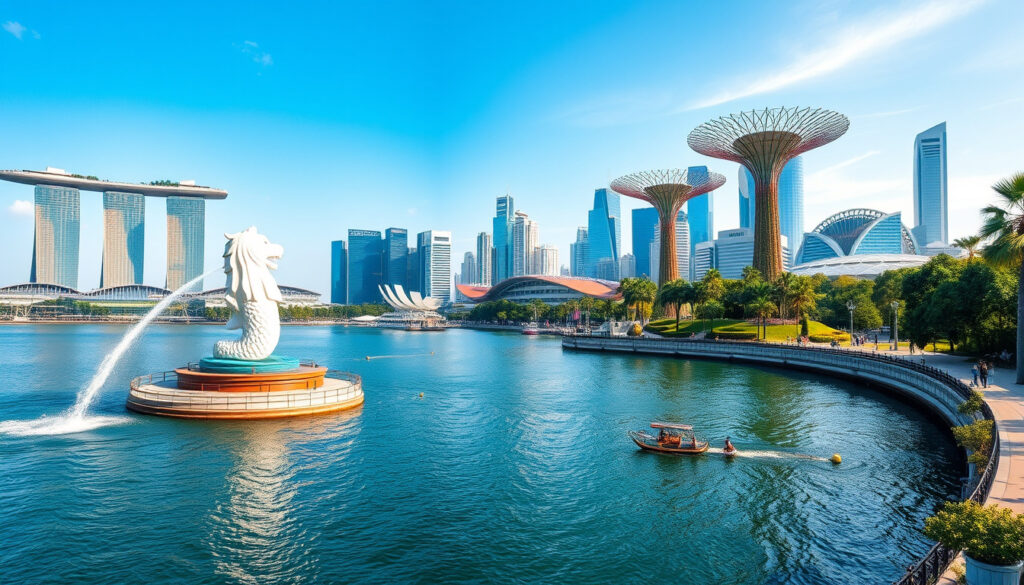
Where to Go in Singapore: Free Attractions & Family Itinerary
If you’re mapping out a trip to this tropical city-state, the sheer number of “must-sees” can feel overwhelming. Singapore packs a lot into a tiny footprint — soaring skyscrapers, UNESCO-listed gardens, and hawker centres serving world-class food for under five dollars. This guide cuts through the noise, focusing on where to go in Singapore whether you’re travelling with family, on a shoestring, or planning a quick 3-day itinerary.
Annual tourist arrivals (2019): ~13.6 million · Total land area: 733.1 km² · Population: 5.45 million · Number of islands: 63 · Official languages: English, Malay, Mandarin, Tamil
Quick snapshot
- Gardens by the Bay is a signature family-friendly attraction (Gardens by the Bay official attraction website)
- Singapore Botanic Gardens is a free-entry UNESCO World Heritage Site (National Parks Board Singapore Botanic Gardens)
- East Coast Park is a free outdoor recreation area (National Parks Board)
- Whether three days is enough for all traveler types — families may need more time (Singapore Tourism Board)
- Best neighbourhood depends on personal preference, not a universal ranking (Singapore Tourism Board)
- Exact timing of monsoon can vary year to year (Travjoy travel blog) (Singapore Tourism Board)
- February to April is commonly described as the driest window, but confidence is moderate (Travjoy travel blog) (Singapore Tourism Board)
- June is a major family-travel period due to school holidays (Travjoy travel blog)
- November to January is wettest, but rain comes in short bursts (Travjoy travel blog)
- Great Singapore Sale typically runs June–August
- Check visa requirements at Singapore Tourism Board
- Book popular attractions in advance to avoid queues
- Pack light layers — Singapore is hot and humid year-round
Six essential facts at a glance, from language to top attraction.
| Fact | Value |
|---|---|
| Official language | English |
| Currency | Singapore Dollar (SGD) |
| Best time to visit | February to April |
| Top attraction | Gardens by the Bay |
| Population | 5.45 million |
| Country area | 733.1 km² |
Where Do Most Tourists Go in Singapore?
Marina Bay Sands and Gardens by the Bay
- Marina Bay area is the top tourist hub, known for its iconic skyline and integrated resort (Marina Bay Sands (premium observation deck))
- Gardens by the Bay is a core family-friendly stop with Supertrees and conservatories (Gardens by the Bay official attraction website)
- The Merlion Park area is one of the most photographed landmarks (Visit Singapore (official tourism portal))
The Marina Bay cluster alone can fill a full day — plan for at least four hours to see Gardens by the Bay, the SkyPark, and the surrounding boardwalks without rushing.
Sentosa Island
- Sentosa attracts families with beaches, Universal Studios, S.E.A. Aquarium, and Adventure Cove (Resorts World Sentosa (major attraction operator))
- Sentosa Sensoryscape is a free family-friendly attraction connecting the resort to the beach (Sentosa (official island website))
Orchard Road shopping belt
- Orchard Road is the main shopping street, with malls and department stores along a two-kilometre stretch (Visit Singapore (official tourism portal))
Chinatown and Little India
- Chinatown is a common cultural stop for food, heritage, and walkable street exploration (Visit Singapore (official tourism portal))
- Little India is a heritage district widely recommended for food, temples, and street life (Visit Singapore (official tourism portal))
The pattern: most visitors cluster around Marina Bay, Sentosa, and Orchard Road. But the city’s real texture — hawker food, temple streets, neighbourhood parks — lies in districts like Chinatown, Little India, and Kampong Glam.
Is 3 Days in Singapore Enough?
Three days is enough for major highlights if you plan efficiently. Spread across three full days, you can cover the Marina Bay area, Sentosa, and the key cultural districts without feeling like a checklist runner.
Sample 3-day itinerary
- Day 1: Marina Bay, Gardens by the Bay, Merlion Park, and evening at Clarke Quay (Visit Singapore (official tourism portal))
- Day 2: Sentosa Island – Universal Studios or S.E.A. Aquarium, then relax at Palawan Beach (Resorts World Sentosa (major attraction operator))
- Day 3: Little India, Kampong Glam, Singapore Botanic Gardens, then free time for shopping or a rooftop bar at Marina Bay (National Parks Board Singapore Botanic Gardens)
What to prioritize
- First-time visitor? Focus on Marina Bay, Gardens by the Bay, and Sentosa for the “wow” factor
- Foodie? Swap a morning at Sentosa for a food tour through Chinatown and Little India
- Nature lover? Include the Singapore Botanic Gardens and MacRitchie Reservoir (National Parks Board (park management authority))
Transportation tips
- Singapore’s MRT (Mass Rapid Transit) is efficient and covers most tourist spots
- A Singapore Tourist Pass (1, 2, or 3 days) offers unlimited rides on public buses and trains (Singapore Tourism Board)
- Walking is pleasant in Marina Bay and the heritage districts, but consider taxis or ride-hailing for Sentosa to save time
For more detailed suggestions on activities, check out our guide on Things to Do in Singapore: Top Attractions & Budget Tips.
The implication: three days works well for a tight itinerary, but families with young kids will want four days to avoid burnout. Consider skipping Sentosa if you only have 48 hours — the Botanic Gardens and East Coast Park offer free, relaxing alternatives.
What Is the Best Part of Singapore?
Kampong Glam for culture
- Kampong Glam is a heritage district known for Sultan Mosque, Arab Street, and culture-rich strolls (Visit Singapore (official tourism portal))
Tiong Bahru for hipster vibes
- This neighbourhood is filled with indie cafes, bookstores, and 1930s architecture
Little India for food
- Little India is a heritage district widely recommended for food, temples, and street life (Visit Singapore (official tourism portal))
East Coast for beaches
- East Coast Park is a free outdoor recreation area with cycling, beaches, and family activities (National Parks Board (park management authority))
The “best part” depends entirely on your travel style. Foodies will find more satisfaction in Little India than in Marina Bay. Families should lean into Sentosa and the Botanic Gardens. Young adults: head to Haji Lane for boutiques and rooftop bars.
The trade-off: choosing one district over another means missing out, but Singapore is small enough that you can combine two or three in a single day. For example, start at Kampong Glam (morning), walk to Little India (lunch), and end at the Botanic Gardens (afternoon).
What Are 10 Must-See Places in Singapore?
Ten picks that span iconic landmarks, natural escapes, and cultural sites — plus five free alternatives that won’t cost a cent.
Iconic landmarks
- 1. Marina Bay Sands SkyPark Observation Deck – premium city views (Marina Bay Sands (premium observation deck))
- 2. Gardens by the Bay – Supertree Grove and Cloud Forest (Gardens by the Bay official attraction website)
- 3. Sentosa Island – Universal Studios, beaches, and S.E.A. Aquarium (Sentosa (official island website))
- 4. Singapore Zoo – award-winning open-concept zoo (Mandai Wildlife Reserve (official wildlife park operator))
Natural escapes
- 5. Singapore Botanic Gardens – free-entry UNESCO World Heritage Site (National Parks Board Singapore Botanic Gardens)
- 6. MacRitchie Reservoir – free hiking trails and canopy walk (National Parks Board (park management authority))
Cultural sites
- 7. Little India – heritage district for food and temples (Visit Singapore (official tourism portal))
- 8. Chinatown – street food and shophouses (Visit Singapore (official tourism portal))
- 9. Merlion Park – photo spot with harbour views (Visit Singapore (official tourism portal))
Free attractions
- 10. Jewel Changi Airport Rain Vortex – indoor waterfall, free to view (Jewel Changi Airport (transit attraction operator))
- Free bonus: East Coast Park, Fort Canning Park, and Bukit Timah Nature Reserve
You can also explore the National Museum of Singapore with our photo guide: National Museum of Singapore Photos: Worth It, Cost & Hours.
What this means: you can tick off seven of these ten without spending a dollar on entry fees — the Botanic Gardens, MacRitchie, Little India, Chinatown, Merlion Park, Jewel Rain Vortex, and East Coast Park are all free. That’s a full itinerary for budget-conscious travelers.
What’s the Best Time of Year to Visit Singapore?
Dry season (February–April)
- February to April is commonly described as the driest window (Travjoy travel blog)
- Ideal for outdoor activities like hiking MacRitchie and beach time on Sentosa
Monsoon season (November–January)
- November to January is typically the wettest period, but rainfall often comes in short bursts (Travjoy travel blog)
- Still possible to enjoy indoor attractions like Gardens by the Bay’s Cloud Forest and the National Gallery
Festivals and events
- Chinese New Year (January/February) – Chinatown light-ups and street bazaar
- Great Singapore Sale (June–August) – shopping discounts across Orchard Road and malls (Singapore Tourism Board)
- June school holidays bring families, increasing crowds at major attractions
The pattern: the best time balances your tolerance for rain with your budget — February-April offers the least rainfall but higher hotel rates on weekends. November-January is cheapest for flights and accommodation, but you’ll need an umbrella.
The takeaway: your choice of season directly affects both experience and wallet.
Pros and Cons of Visiting Singapore
Upsides
- Extremely safe and clean for solo and family travelers (Singapore Tourism Board)
- English widely spoken, so navigation is easy
- World-class food at hawker centres for under 5 SGD
- Free attractions like Botanic Gardens, East Coast Park, and MacRitchie
- Efficient public transport system (MRT)
Downsides
- High cost of accommodation and alcohol compared to neighbouring countries
- Hot and humid year-round — no real cool season (Singapore Tourism Board)
- Limited beach space; Sentosa’s beaches are man-made
- Crowds at top attractions can feel overwhelming
- Some entry fees (Universal Studios, Aquarium) are expensive
What Travelers Say
Gardens by the Bay is a must-see, but don’t skip the Botanic Gardens. It’s free, beautifully maintained, and the Jacob Ballas Children’s Garden is a hit with younger kids.
— National Parks Board, official site
Sentosa Sensoryscape offers a complimentary walk from the resort to the beach, perfect for families wanting a no-cost activity with a bit of art and nature.
— Sentosa, official island website
Summary
Singapore rewards travelers who step off the beaten tourist trail. While Marina Bay Sands and Sentosa are box-office draws, the city’s real heart beats in its hawker centres (try Maxwell Food Centre in Chinatown), free green spaces like the Botanic Gardens, and heritage districts such as Kampong Glam. For the budget-conscious family or the short-stay traveller, the decision is clear: front-load your itinerary with one or two paid icons, then spend the rest of your time exploring the free, authentic corners that make Singapore one of Southeast Asia’s most accessible gateways.
travjoy.com, machupicchu.org, playtime.sg, traveloka.com, honeykidsasia.com, busykidd.com, thesmartlocal.com, airasia.com, sassymamasg.com, lajollamom.com, bigworldsmallpockets.com, misslobang.com
Frequently Asked Questions
What is the cheapest way to get around Singapore?
The MRT and public buses are the most affordable. A single trip costs around 1–2 SGD, and a Singapore Tourist Pass offers unlimited rides for 1–3 days (Singapore Tourism Board).
Is Singapore safe for solo travelers?
Yes, Singapore consistently ranks among the safest cities globally, with low crime rates and a reliable police presence (Singapore Tourism Board).
Do I need a visa to visit Singapore?
Many nationalities (including US, UK, EU, Australia, New Zealand) get visa-free entry for up to 90 days. Check your country’s status at the Singapore Tourism Board.
What local food must I try in Singapore?
Iconic dishes include Hainanese chicken rice, laksa, chili crab, and satay. Hawker centres like Maxwell Food Centre and Lau Pa Sat are perfect for sampling.
How do I get from Changi Airport to the city center?
The MRT (train) takes about 30–45 minutes to City Hall or Raffles Place. A taxi costs around 25–35 SGD, and ride-hailing apps like Grab are widely used.
Can I use credit cards everywhere in Singapore?
Most shops, hotels, and restaurants accept major credit cards. Hawker centres and small stalls may prefer cash (SGD).
What is the dress code for temples in Singapore?
Cover shoulders and knees when visiting Buddhist or Hindu temples. Shoes are often removed before entering.
More related posts
 YouTube to MP3 320kbps: Best Ad-Free Converters Guide
 Crystal Palace vs Wolves: Match Result, Highlights & H2H Record
 Top Free Online C++ Compilers: Debugging, Dark Mode & More
 iPhone 17 Release Date, Irish Price & Specs Guide
 500 HKD to SGD: Live Rate & Best Conversion Options
 Royal Casino Apps Guide: Register, Download & Play on pgroyal88
 Thunder vs Nuggets: Prediction, Picks & Head-to-Head
 Samsung Galaxy Z Fold7 Call Assist: Setup, Live Translate & More