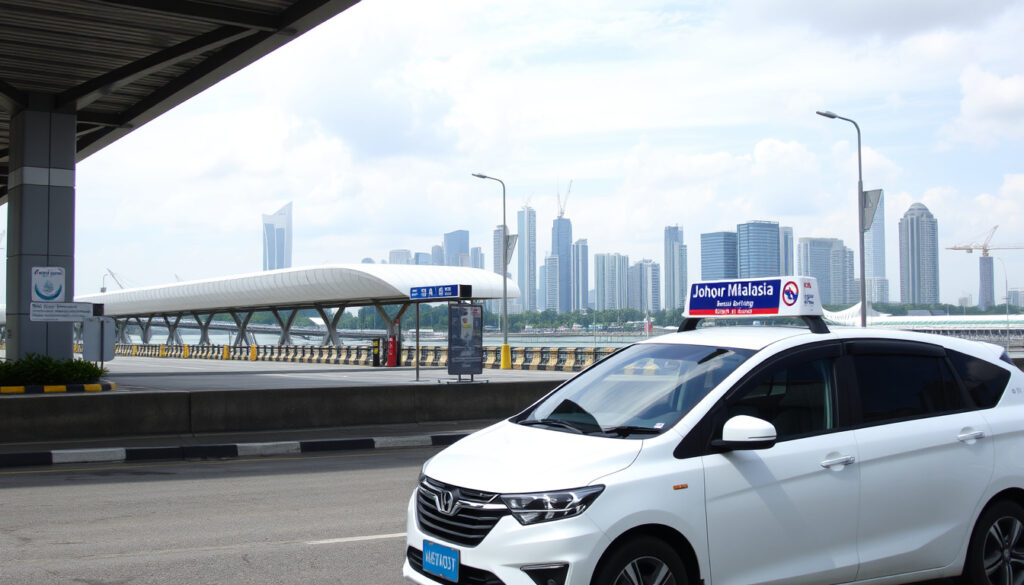
SG to JB Taxi 2025: Prices, Pick-up & Alternatives
Every Causeway first-timer knows the moment: the taxi to Johor Bahru seems easy, then everyone quotes a different price and a different rule. The official system is simpler — Ban San Street Terminal is the pick-up point for licensed cross-border taxis (STRIDES Premier (licensed cross-border taxi operator)), with regulated fares from S$60 for a four-seater (The Straits Times (Singapore national daily)). From 4 May 2026 the drop-off zone widens, and from 1 July 2026 the standard fare steps up to S$80 (STRIDES Premier (licensed cross-border taxi operator)). The trick is telling the regulated service from the ad-hoc one.
Official fare (4-seater, no booking): S$60 (The Straits Times) ·
Official fare (4-seater, advance booking): S$70 (Channel NewsAsia) ·
Official fare (larger taxi): S$120 (The Straits Times) ·
Typical cross-border taxi range: S$80 – S$210 (The Straits Times)
Quick snapshot
- Ban San Street Terminal is the official pick-up point for licensed cross-border taxis (STRIDES Premier).
- Street-hail fare to Larkin Sentral is S$60 for a four-seater under the current schedule (The Straits Times).
- From 1 July 2026 the standard four-seater fare moves to S$80 (STRIDES Premier).
- Whether every taxi waiting near Queen Street is officially licensed.
- Whether Grab will resume cross-border trips in the future.
- How many licensed operators actually run the route.
- 2022: Ban San Street–Larkin fare rose from S$48 to S$60 (Channel NewsAsia).
- 4 May 2026: cross-border taxis may drop off anywhere in Singapore and parts of Johor (The Straits Times).
- 1 July 2026: revised fares — S$80 standard four-seater to Larkin (STRIDES Premier).
- More pre-booked cross-border taxis after Strides Premier’s online booking launch (The Straits Times).
- Budget for the S$80–S$210 range once the revised scheme is in force (STRIDES Premier).
- Ban San Street remains the cheapest legal starting point (The Straits Times). (The Straits Times)
Official fare structure
One pattern runs through the fare table: the regulated price depends on where you board, how far you’re going, and how many seats you need.
| Item | Official value | Source |
|---|---|---|
| Official pick-up point | Ban San Street, Singapore | STRIDES Premier |
| 4-seater fare (no booking) | S$60 | The Straits Times |
| 4-seater fare (advance booking) | S$70 | Channel NewsAsia |
| Larger taxi (6+ seats) | From S$120 | The Straits Times |
| Price range (all operators) | S$80 – S$210 | The Straits Times |
| Cross-border Grab | Not available as of writing | — |
The takeaway: the regulated fare is per taxi, not per person. Split a four-seater four ways and the S$60 trip costs about S$15 a head — cheaper than most shared vans and far more predictable.
How much is a taxi from Singapore to JB?
Under the current published schedule, a street-hail taxi from Ban San Street Terminal to Larkin Sentral costs S$60 for a standard four-seater, and S$70 if you book in advance (The Straits Times; Channel NewsAsia). From 1 July 2026 the revised cross-border fare list lifts the standard four-seater trip to S$80, with an extra S$20 for Johor destinations beyond 35 km from Larkin (STRIDES Premier; The Straits Times). Six-seaters such as the Toyota Sienta or Noah are priced at S$120 in the revised list, premium six-seaters like the Toyota Alphard at S$180, and six-seaters carry an extra S$30 beyond 35 km (The Straits Times). In practice, quotes across licensed operators run from roughly S$80 to S$210 per taxi.
The cross-border taxi is priced per taxi, not per seat. That is what makes it a group deal: four riders splitting a S$80 fare pay about S$20 each for a door-to-door crossing.
What is the cheapest taxi option from Singapore to JB?
- S$60 street-hail from Ban San Street to Larkin Sentral today (The Straits Times)
- S$70 for the same trip with advance booking (Channel NewsAsia)
- S$80 from 1 July 2026 under the revised fare list (STRIDES Premier)
The cheapest legitimate option is the official stand itself. Because the fare is set per taxi, a full four-seater works out to S$15 a head under the current schedule — S$20 a head once the revised S$80 fare lands. Six-seaters and premium vehicles cost more, but a six-seater split six ways at S$120 remains competitive for larger groups.
What is the price of a taxi from Larkin to Singapore?
- Larkin Sentral to any Singapore destination (excluding the Ban San Street terminal): S$60 (Channel NewsAsia)
- The same trip with advance booking: S$70 (Channel NewsAsia)
- Ban San Street–Larkin fare history: S$48 until 2022, then S$60 after the revision (Channel NewsAsia)
The fare runs in both directions. The 2022 revision raised the Ban San Street to Larkin Sentral route from S$48 to S$60, and the same S$60 became the benchmark that now applies in reverse under the current schedule.
The implication: the published fare is a ceiling, not a negotiation starting point. Any driver quoting double the regulated rate is betting you haven’t read the schedule.
The pattern: the regulated price is the only reliable number. Anything above it should be questioned.
Can I take a taxi from SG to JB?
Yes, as long as you board at a licensed pick-up point. Ban San Street Terminal is the designated stand for cross-border taxis from Singapore (STRIDES Premier (licensed cross-border taxi operator)), and the service operates under the official fare scheme (The Straits Times (Singapore national daily)). Boarding an unlicensed taxi leaves you outside that system, which is where most of the bad stories start.
Where is the official taxi pick-up point for cross-border taxis from Singapore?
- Ban San Street Terminal — the official street-hail stand (STRIDES Premier)
- Pre-booked pick-ups at other Singapore locations via Strides Premier or ComfortDelGro services (The Straits Times)
- Changi and Seletar airports are excluded from the standard cross-border street-hail arrangement (The Straits Times)
Ban San Street is the only place where you can walk up, queue, and hail a licensed cross-border taxi to Johor. The alternative is pre-booking: under the earlier scheme announced in September 2025, Strides Premier quoted about S$80 for most cross-border trips, with Ban San Street pick-ups at S$60 (The Straits Times).
Can I use ComfortDelGo taxi from JB to Singapore?
- Yes — ComfortDelGro runs licensed cross-border taxi services on the Singapore–Johor route (The Straits Times)
- From Larkin Sentral, licensed taxis take passengers to Singapore destinations at the regulated S$60 fare (Channel NewsAsia)
- Advance booking from the JB side moves the fare to S$70 (Channel NewsAsia)
The ComfortDelGro brand appears on both sides of the Causeway. From the Johor side, Larkin Sentral is the hub for licensed taxis heading back to Singapore, and the fare schedule mirrors the one used out of Ban San Street.
Does Strides taxi offer cross-border service to JB?
- Yes — Strides Premier operates the licensed cross-border taxi service at Ban San Street (STRIDES Premier)
- Online booking for SG–JB cross-border rides was announced in September 2025 (The Straits Times)
- Its published revised fare from Ban San Street to Larkin is S$80 from 1 July 2026 (STRIDES Premier)
Strides Premier is the operator behind the Ban San Street terminal’s cross-border taxi stand. The September 2025 announcement positioned online booking as the way to secure a taxi in advance, rather than waiting in the queue.
Unofficial taxis around the terminal and the Causeway are the one real hazard: they may quote multiples of the regulated fare, and you lose the protections of the official scheme the moment you step in.
What this means: legality is about where you board. At the licensed stand you get the published fare; outside it, you are negotiating with no ceiling and no recourse.
The pattern: the official stand is the safe zone; everything else is a gamble.
Can I take Grab from Singapore to JB?
No — at least not as of writing. Grab does not currently support cross-border trips that start in Singapore and end in Johor Bahru. The app works within each country, not across the Causeway: Grab Singapore covers the island, and Grab Malaysia covers Johor once you’re there.
How much is Grab Malaysia?
- No fixed fare — prices are computed by distance and time, with surge pricing at peak hours
- Booking is cashless by default through the app
- Grab is not an option for the JB–SG border crossing today
Grab Malaysia’s pricing is dynamic, so quoting a single number would be misleading. In practice, the fare you see in the app is the fare you pay, which is the main reason so many travellers default to Grab inside Johor.
What is the alternative to Grab in Malaysia?
- MyCar — Malaysian ride-hailing app with strong coverage outside the main cities
- AirAsia Ride — available in select cities, convenient for airport-linked trips
- Bolt — operates in some Malaysian cities, often undercutting Grab on price
- Licensed taxi stand at Larkin Sentral — the direct option for crossing back to Singapore
For the return crossing, the licensed taxi stand at Larkin Sentral is the direct alternative to Grab — it runs under the same regulated fare structure as the Singapore side (The Straits Times). Inside Johor, the apps above cover what Grab doesn’t reach.
The real alternative to Grab for the JB crossing is not another app — it is the licensed taxi stand at Ban San Street, the only Singapore-side pick-up that pairs a legal crossing with a fixed price.
Is Grab cheaper than taxi in Singapore?
For domestic Singapore trips, the answer flips by the hour. Grab is often cheaper when demand is flat and drivers are plentiful. Metered taxis become the better deal during surge pricing, when Grab’s multiplier can push a fare above the meter. For the JB crossing, the comparison is moot: the cross-border route is not a ride-hailing route.
Do I need cash for a taxi in Singapore?
- Cash is accepted but not required on most Singapore taxis
- Cards and mobile wallets are widely accepted
- Grab is designed to be fully cashless
For cross-border street-hail taxis, the safest habit is to confirm the payment method before boarding. The fare is regulated — S$60 to Larkin today, S$80 from 1 July 2026 (The Straits Times; STRIDES Premier) — but card acceptance at the stand is something to settle up front.
Is Bolt cheaper than Grab in Malaysia?
- Bolt has launched in several Malaysian cities with aggressive pricing
- Its coverage is thinner than Grab’s, so availability is the limiting factor
- Where both operate, Bolt frequently quotes the lower fare
In Malaysian cities where Bolt is live, it has been the cheaper quote more often than not. The trade-off is a smaller fleet and longer wait times at peak hours, which is why most travellers still open Grab first.
The pattern: within Singapore, the cheapest option flips between Grab and metered taxis depending on the hour. For the Causeway crossing, that contest does not exist — the regulated taxi fare wins by default.
Which taxi app works best in Malaysia?
Once you are in Johor, the ranking changes. Grab has the deepest coverage, Bolt can be cheaper in the cities it serves, and MyCar and AirAsia Ride fill the gaps that the bigger apps miss.
Which cab is best in Malaysia?
- Grab — best coverage and reliability, not always the cheapest
- Bolt — lower fares in supported areas, smaller fleet
- MyCar — homegrown alternative with strong regional coverage
- AirAsia Ride — useful around airports and select cities
- Licensed taxis at Larkin Sentral — the only app-free option for crossing back to Singapore
For most travellers in Johor, Grab is the default because it works everywhere. If you are watching the fare, a quick Bolt comparison can pay off where it operates. For the border crossing itself, the licensed taxi stand beats every app.
Why this matters: the best app in Malaysia gets you around Johor, not across the border. The return trip to Singapore is still a licensed-taxi or bus decision.
SG to JB taxi options compared
Five ways to cross, one pattern: the licensed taxi is the only option with a fixed fare and a designated pick-up point; the apps cover everything except the border.
| Option | Where it works | Typical cost | Best for |
|---|---|---|---|
| Licensed taxi at Ban San Street | Singapore → Johor, door-to-door | S$60 – S$210 per taxi (The Straits Times) | Groups needing a guaranteed legal crossing |
| Pre-booked cross-border taxi (Strides Premier / ComfortDelGro) | Pick-up across Singapore, airports excluded | About S$80 per taxi under the earlier scheme (The Straits Times) | Planned trips and peak hours |
| Grab | Within Singapore or within Malaysia only | App fare; no SG → JB cross-border option as of writing | Local rides on either side |
| Bolt | Select Malaysian cities | Often cheaper than Grab where available | Budget riders in KL and Johor |
| MyCar / AirAsia Ride | Malaysian cities | Varies by city and demand | Alternatives when Grab surges |
| Private car services | Pre-booked, door-to-door | Above regulated taxi rates | Premium comfort and group trips |
The catch: app convenience and border legality rarely overlap. The one service that does both is the licensed cross-border taxi — and it starts at a documented pick-up point, not a phone screen.
Pros and cons of taking a licensed taxi to JB
Upsides
- Regulated fare: S$60 street-hail today, S$80 from 1 July 2026, no surge surprises (STRIDES Premier)
- Door-to-door to Larkin Sentral and other Johor points — no bus transfer at the Causeway
- Per-taxi pricing: split four ways, the S$60 trip costs about S$15 a head
- A legal crossing with a published fare and a designated stand
Downsides
- Expensive solo: S$60 – S$210 for one passenger who could take the bus for a fraction of the price
- Street-hail means going to Ban San Street; there is no waving down a cross-border taxi elsewhere
- Causeway traffic and both customs checks add unpredictability to the total time
- Unlicensed taxis near the terminal can look identical to the official ones — check the stand
The trade-off is sharp: a fixed fare and a legal crossing versus a higher per-person cost and a fixed pick-up point. For two or more travellers, the math usually tips towards the taxi.
How to book a cross-border taxi from Singapore to JB
The official process is deliberately simple. Here is the route that keeps you inside the regulated system from start to finish.
- Head to Ban San Street Terminal, the official street-hail pick-up point for licensed cross-border taxis (STRIDES Premier).
- Check the published fare before you queue — S$60 to Larkin Sentral for a four-seater under the current schedule, S$80 from 1 July 2026 (The Straits Times; STRIDES Premier).
- Tell the driver your destination. Larkin Sentral is the standard run; destinations within 35 km use the base fare, and longer Johor trips carry the published surcharge (The Straits Times).
- Confirm the total fare and payment method before boarding — cross-border street-hail fares are per taxi, not per person.
- Keep your passport ready. The taxi goes through Singapore exit and Malaysian entry checks, and both queues move at the Causeway’s pace.
- For the return, use the licensed taxi stand at Larkin Sentral back to Singapore at the same S$60 base fare (Channel NewsAsia).
If you are timing the trip, check the live bridge cameras first — the queue can change faster than the fare (Singapore Signal (travel guide site)).
Peak-hour queues at Ban San Street are the real cost of the official route. The S$70 advance-booking fare buys a reserved taxi and a skip-the-wait plan under the current schedule (Channel NewsAsia).
The pattern: every step is boring and official, which is exactly why it works. The trouble starts when someone skips the queue.
What’s confirmed and what’s still unclear
Confirmed facts
- Ban San Street Terminal is the official pick-up point for licensed cross-border taxis (STRIDES Premier)
- Official fares are regulated: S$60 street-hail today, S$80 from 1 July 2026 (The Straits Times; STRIDES Premier)
- Grab does not offer SG → JB cross-border rides as of writing
What’s unclear
- Whether every taxi waiting near Queen Street is officially licensed — unofficial operations near the terminal are a known risk (The Straits Times)
- Whether Grab will resume cross-border service if the regulatory picture changes
- How many licensed operators actually run the route
- How the wider drop-off zone from 4 May 2026 will affect street-hail availability in practice
The pattern: the regulated system is transparent, and the unregulated market is not. The gap between them is where most of the confusion lives.
What travellers and operators are saying
Cross-border taxis can drop off passengers anywhere in Singapore and in parts of Johor from 4 May 2026.
— The Straits Times (Singapore national daily), on the expanded drop-off zone
The 2022 fare revision increased the Ban San Street Terminal to Larkin Sentral fare from S$48 to S$60.
— Channel NewsAsia (Singapore news broadcaster), on the regulated fare history
There is so much mixed information about licensed taxis to JB that most people just want to know one thing: what should the fare actually be?
— A r/askSingapore user, describing the confusion after the latest rule changes
The common thread: operators publish, travellers double-check. The practical fix is to treat the published fare as the ceiling and refuse anything above it.
The takeaway
The regulated fare structure is the whole game: every legal taxi out of Singapore starts at a published price, and the stand at Ban San Street is where that price becomes real. Grab will not cross the border, so the licensed taxi is the only door-to-door option that pairs a legal crossing with a fixed fare. For the solo traveller on a budget, the calculation is clear: split the S$60 four-seater with other passengers at the stand, or take the bus from Queen Street and save the difference.
Related reading
Before you cross, check the live traffic picture and the ringgit exchange rate — both change the real cost of the trip.
- Singapore to JB Traffic: Live Cameras & Best Crossing Times (Singapore Signal, travel guide site)
- Convert Ringgit to SGD: Current Rate & How To Convert (Singapore Signal, travel guide site)
straitstimes.com, wahdah.sg, themoneybees.co, stomp.sg, channelnewsasia.com, shopee.sg, straitstimes.com, stridespremier.com.sg
Frequently asked questions
How long does a taxi ride from Singapore to JB take?
The driving distance is short, but the Causeway queue and two customs checks set the real timing. Budget at least an hour from pick-up, and more during peak crossing times.
Do I need a passport for a cross-border taxi?
Yes. Every taxi crossing from Singapore to Johor Bahru passes through immigration at the Causeway, so you need a passport valid for travel into Malaysia.
Are there luggage limits on cross-border taxis?
A standard four-seater has a normal car boot. For bulky luggage or larger groups, book a six-seater such as the Toyota Sienta or Noah, priced at S$120 in the revised schedule (The Straits Times).
Can I book a cross-border taxi online?
Yes. Strides Premier announced online booking for Singapore–Johor Bahru cross-border taxi rides in September 2025 (The Straits Times), and its revised fare from 1 July 2026 sets the standard Larkin run at S$80 (STRIDES Premier).
What happens during customs check for a taxi ride?
The taxi stays in the vehicle queue through the Causeway checkpoints. Passengers pass through immigration with their documents while the driver handles the vehicle, so keep your passport in hand.
Is it safe to take an unofficial taxi from Singapore to JB?
Not recommended. Unofficial taxis operate outside the regulated fare and licensing system, which carries a risk of overcharging or legal issues, with none of the protections of the official scheme.
More related posts
 Jang Keun-suk: Career, Marriage, and Why Japan Loves Him
 Pasir Ris Street 11: HDB Blocks, Rentals & Location Guide
 The Boy in the Striped Pajamas: Ending, Facts & FAQs
 What to Do in Busan: Top Attractions, Itineraries & Tips
 List of Secondary Schools in Singapore 2026: Complete Guide
 Africa Cup of Nations: Senegal Stripped of Title? Controversy
 Popeye the Sailor Man: Origin, Characters & Legacy
 Civil Servant Bonus 2024 – Amounts, Eligibility, Payments