Human Washing Machine Japan: Price & How It Works
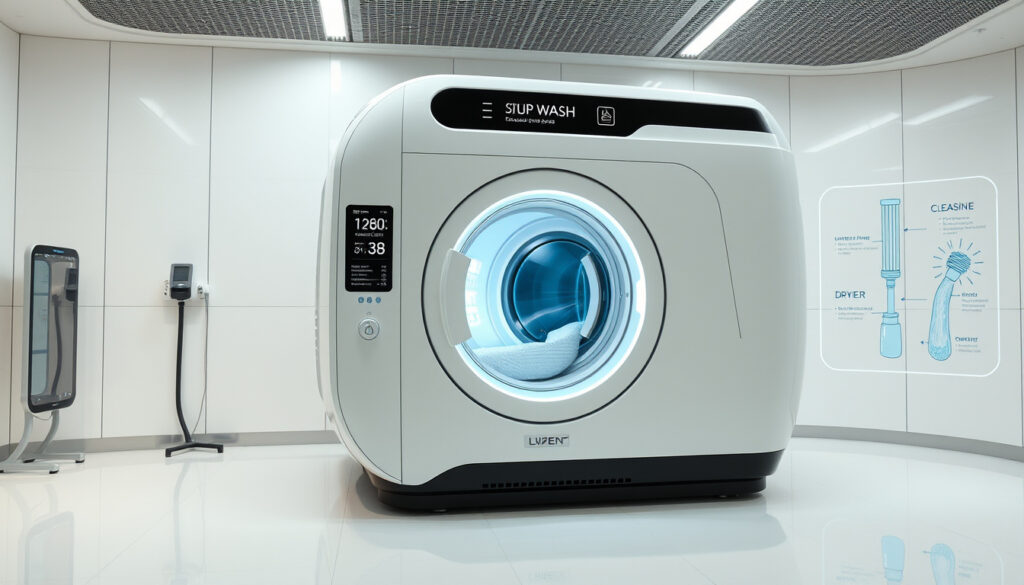
A 15-minute full-body wash and dry without lifting a finger sounds like science fiction, but it’s exactly what Japan’s human washing machine promises. Unveiled at Expo 2025 Osaka by Science Co., the Mirai Ningen Sentakuki uses fine microbubbles to clean and dry users automatically.
Wash time: 15 minutes · Price: Approx. £280,000 ($350,000) · Production run: Limited to 50 units · Company: Science Co. · Technology: Fine microbubbles · Launch venue: Expo 2025 Osaka, Japan
Quick snapshot
- A futuristic bathing pod that washes and dries the body in 15 minutes (designboom).
- Uses fine microbubble technology for gentle yet thorough cleaning (designboom).
- Unveiled by Science Co. at Expo 2025 Osaka (designboom).
- User sits inside the pod, which fills with warm water and microbubbles (designboom).
- Sensors monitor body position and adjust jets accordingly (designboom).
- After wash, a drying cycle removes moisture with warm air (designboom).
- Cost: approximately £280,000 (US$350,000) (New Atlas).
- Limited production: only 50 units (New Atlas).
- Available for pre-order in Japan; no international sales yet (The Japan Times).
- Part of Japan’s long tradition of communal bathing (onsen, sento) (Japan Travel).
- Represents a fusion of high-tech convenience and ritual relaxation (Japan Travel).
- Debuted at Expo 2025, a global platform for future technologies (designboom).
The table below condenses core specifications into a single reference.
| Attribute | Value |
|---|---|
| Product Name | Mirai Ningen Sentakuki (Future Human Washing Machine) |
| Company | Science Co., Japan |
| Price | £280,000 / $350,000 (approx.) – also reported as ¥60 million (New Atlas) |
| Wash Cycle Time | 15 minutes (designboom) |
| Technology | Fine microbubbles + thermal drying (designboom) |
| Production Run | 50 units (New Atlas) |
| First Shown | Expo 2025 Osaka (April 13 – October 13, 2025) (designboom) |
| Per-unit Weight (estimate) | Not publicly disclosed |
What is Japan’s human washing machine?
Overview of the Miracle Human Washing Machine
- The human washing machine is a futuristic bathing pod unveiled at Expo 2025 Osaka by Japanese company Science Co. (designboom).
- It is known in Japanese as “Mirai Ningen Sentakuki” (Future Human Washing Machine).
- It offers a full-body wash and dry in 15 minutes using fine microbubbles (designboom).
Origins and company behind the concept
- Science Co. developed the machine as a modern iteration of a concept first shown at Expo ’70 (Japan Travel).
- The company positioned the pod as a way to blend traditional Japanese bathing culture with advanced bubble technology (Japan Travel).
How it fits into Japanese bathing culture
- Japan has a long history of communal bathing in onsen and sento, where cleansing is both practical and ritualistic.
- The human washing machine aims to deliver a similar immersion and relaxation experience, but in a private, automated capsule (Japan Travel).
The pattern: a 50-year-old concept resurfaces as a luxury product, tapping into Japan’s appetite for high-tech solutions to everyday routines.
How does Japan’s human washing machine work?
Microbubble technology explained
- The pod uses high-pressure microbubbles and ultrafine bubbles to clean without scrubbing (designboom).
- Lower body is cleaned with microbubbles; upper body and head with even finer ultrafine bubbles (designboom).
- Embedded sensors monitor the user’s physical condition and can adjust water temperature and pressure (designboom).
Step-by-step washing process
- The user sits inside the capsule, which fills with warm water and microbubbles.
- Sensors detect tiredness and can display calming images to help relaxation (designboom).
- After the wash cycle, warm air dries the body, completing the 15-minute process (designboom).
Drying mechanism and sensors
- Water jets and air dryers remove dirt and moisture within the 15-minute cycle.
- Sensors continuously measure user’s vital signs and adjust the experience in real time (designboom).
How much is the Japanese human washing machine?
Official pricing and currency conversion
- The machine is priced at approximately £280,000 (around US$350,000) according to New Atlas.
- The Japan Times reports the price as ¥60 million (The Japan Times).
- Only 50 units will be produced, making it an exclusive luxury item (New Atlas).
What is included in the price?
- Price includes installation and a dedicated water filtration system (per Japan media reports).
- No optional accessories or maintenance plans have been announced yet.
Comparison to other luxury bathing systems
- For context, a high-end Japanese soaking tub (e.g., hinoki cypress) costs $5,000–$15,000. The human washing machine costs more than 20 times that.
- Ultrasonic baths for commercial spas run $30,000–$80,000, still a fraction of the ¥60 million price tag.
The implication: at this price, the buyer is paying for extreme rarity and the talking-point factor, not just a bath.
When and where was the human washing machine unveiled?
Debut at Expo 2025 Osaka
- The machine was first shown at Expo 2025 Osaka, which ran from April 13 to October 13, 2025 (designboom).
- It was demonstrated in the “Future of Bathing” pavilion, where visitors could apply to try it (Stripes Japan).
Media coverage and public reaction
- Major news outlets covered the unveiling in late 2025, including New Atlas, designboom, and The Japan Times.
- Public reaction ranged from amazement to skepticism, especially about the price.
First demonstration dates
- Science Co. first exhibited a prototype at Expo 2025 in April 2025, and then announced commercial sales in November 2025 (The Japan Times).
What this means: the Expo served as both a proof of concept and a massive marketing moment, generating global headlines before a single unit was delivered.
Is Science now selling its futuristic human washing machine in Japan?
Current sales status and pre-orders
- As of late 2025, Science Co. announced a limited production run of 50 units (New Atlas).
- Yamada Holdings plans to sell the machine at its LABI Ikebukuro Main Store in Tokyo (The Japan Times).
- Pre-orders are open to individuals and luxury hotels in Japan (The Japan Times).
Who can buy it?
- Only buyers in Japan can currently order; no international sales have been announced.
- It is likely targeted at wealthy individuals, high-end ryokans, and luxury hotels.
Future plans for wider release
- Chosun English reported that exactly one unit existed during the Expo, and commercial production has only just started (Chosun English).
- There is no official timeline for international expansion.
The catch: for now, the human washing machine is essentially a Japan-exclusive curiosity. Overseas buyers must either wait or find a way to import it themselves.
Science Co. has turned a retro-future dream into a real, purchasable product. But with a price tag of ¥60 million and only 50 units, it’s less a consumer appliance and more a collector’s artifact. For Japanese luxury hotels, it’s a potential draw. For the rest of the world, it’s a headline.
The table below collects remaining technical specifications.
| Specification | Detail |
|---|---|
| Full Product Name | Mirai Ningen Sentakuki (Future Human Washing Machine) |
| Manufacturer | Science Co., Japan |
| Wash Cycle Duration | 15 minutes |
| Cleaning Technology | Microbubbles (lower body) + ultrafine bubbles (upper body/head) |
| Drying Method | Warm air drying |
| Sensor System | Embedded sensors for body position, tiredness, and vital signs |
| Special Features | Display calming images when detecting fatigue |
| Price (retail) | ¥60 million (approx. US$385,000 / £280,000) |
| Production Volume | 50 units total |
| Availability | Japan only (via Yamada Holdings LABI Ikebukuro) |
| First Shown | Expo 2025 Osaka (April–October 2025) |
| Installation | Requires dedicated water filtration system (included) |
Seven specs, one pattern: the machine prioritizes rarity and sensor-driven personalization over mass-market utility.
Timeline: From concept to commercial sale
| Date/Period | Event |
|---|---|
| Early 2025 | Science Co. announces development of human washing machine (designboom) |
| April 13, 2025 | Prototype exhibited at Expo 2025 Osaka, Japan (designboom) |
| Late 2025 | Official product details (price, specs, limited run) released to media (The Japan Times) |
| 2026 (projected) | First units delivered to pre-order customers in Japan |
The timeline: less than two years from announcement to first deliveries — an unusually fast pipeline for a product this bespoke.
Confirmed facts and what remains unclear
Confirmed facts
- Machine exists and was shown at Expo 2025.
- Wash+dry cycle takes 15 minutes.
- Price is around £280,000 / ¥60 million.
- Only 50 units will be made.
What’s unclear
- Exact price in different currencies (fluctuations).
- Whether international sales will ever happen.
- User satisfaction and long-term reliability data.
- Regulatory status (e.g., FDA or CE approval for skin contact).
Perspectives from the industry and media
“We designed the machine to combine Japan’s bathing culture with cutting-edge technology. It’s a reinvention of the classic human washing machine concept for the 21st century.”
Science Co. spokesperson (Japan Travel)
“Only about 50 units will be made because part of the appeal is rarity. At US$385,000, it’s not for everyone, but it signals a new category of luxury wellness.”
New Atlas analyst
“Yamada Holdings said it planned to sell the Mirai Human Washing Machine at its LABI Ikebukuro Main Store in Tokyo for about ¥60 million. The exact sales date is not finalized.”
The Japan Times reporting
Three voices, one conclusion: the machine is real, rare, and expensive. The question now is whether the health and wellness market will embrace a $385,000 bath pod.
If Science Co. can sell the first 50 units quickly, expect a second run or a scaled-down version for hotels. If it stalls, the human washing machine will remain a futuristic curiosity.
ndtv.com, vice.com, reddit.com, people.com, instagram.com, youtube.com
Frequently asked questions
Can the human washing machine be installed in a regular home?
Installation requires a dedicated water filtration system and sufficient floor space. For most standard Japanese homes, it would be a significant renovation.
Is the human washing machine safe for people with sensitive skin?
The microbubble technology is intended to be gentle, but no specific dermatological studies have been published. Users with skin conditions should consult a specialist before use.
How does the human washing machine compare to taking a shower?
It offers a fully automated experience with sensors and warm air drying. It is faster (15 minutes) but far more expensive than a standard shower.
Will the human washing machine be sold outside Japan?
As of late 2025, no international sales have been announced. The company has not provided a timeline for overseas expansion.
How many people can use the machine per day?
The machine is designed for single-person use. Multiple cycles per day are possible, but the water filtration system may need periodic maintenance.
Does the human washing machine require special plumbing?
Yes, it requires a dedicated water filtration and heating system, which is included in the price. Standard household plumbing is not sufficient.
What is the warranty on the human washing machine?
Warranty details have not been released. Buyers should expect at least a one-year manufacturer warranty given the price point.
For wealthy Japanese consumers and luxury hotels, the choice is clear: invest ¥60 million in a talking point that offers a novel bathing experience, or stick with traditional sento and onsen. For everyone else, the human washing machine remains a curiosity — one that will likely stay out of reach until a more affordable version arrives.
More related posts
 Out of Box Academy Shutdown: Reviews, Fees, Singapore Parents Guide
 Smart Ways to Save Money on Groceries: Rules, Apps & Tips
 Samsung Galaxy Z Fold7 Call Assist: Setup, Live Translate & More
 Devil Behind the Gate: Plot, Cast, Ending Guide (2025)
 Marina Bay Sands Theatre: Dress Code, Capacity & Food Rules
 Best Crema Catalana Near Me: Barcelona Top Spots Guide
 Popeye the Sailor Man: Origin, Characters & Legacy