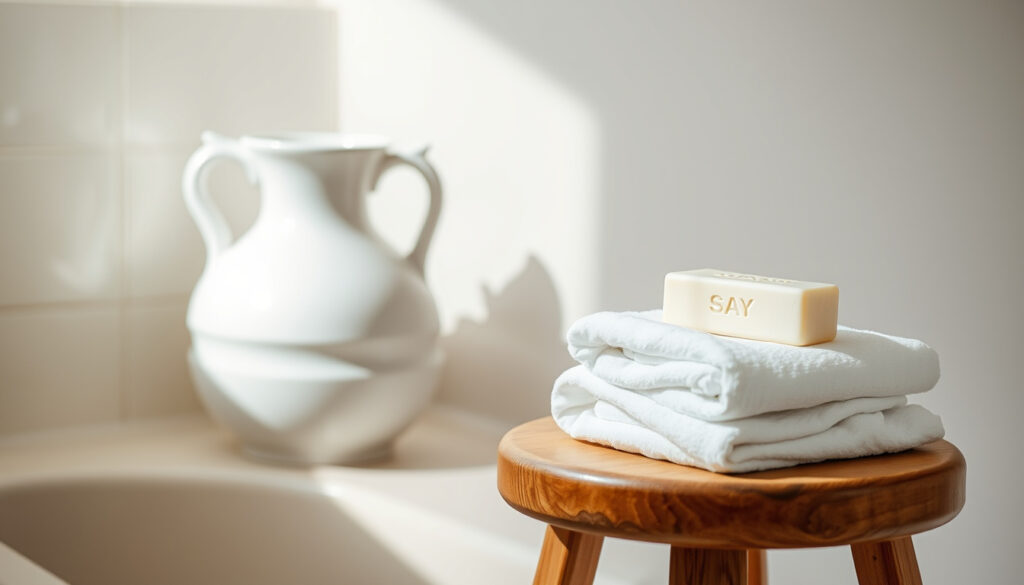
How to Mandi Hadas (Ghusl): Step-by-Step Guide for Men & Women
Few religious practices balance clarity and flexibility like the ritual bath of ghusl (mandi hadas). The Quran commands it after major impurity (Quran 5:6), yet the details — how much water, which parts to wash, and what about braids — leave many people uncertain, so this guide breaks down the essential steps for men and women, drawing directly from Islamic jurisprudence to answer the most common questions.
Muslims worldwide: 1.9 billion ·
Ghusl required after: menstruation, postpartum, sexual activity, ejaculation, conversion ·
Ghusl ruling: obligatory (fard) in Sunni and Shia schools ·
Sources: Quran 5:6, hadith (Bukhari, Muslim)
Quick snapshot
- Ghusl is obligatory after sexual intercourse, ejaculation, menstruation, and postpartum bleeding (Islam Q&A (fatwa reference)).
- Water must reach every part of the body, including mouth and nose (IslamWeb (jurisprudence portal)).
- Intention (niyyah) in the heart is required by all schools (Islam Q&A).
- Whether women must undo braids if water cannot penetrate the scalp (tight vs. loose braids). (Islam Q&A (fatwa reference))
- Exact number of times to pour water over the head: once obligatory, three times sunnah (Islam Q&A (fatwa reference)).
- 7th century CE: Revelation of Quran 5:6 — foundation of ritual purity rules.
- 9th century CE: Compilation of Sahih al-Bukhari — detailed hadith on ghusl.
- Focus on step-by-step instructions for both men and women.
- Address common questions about hair washing and braids.
The following table provides a quick reference for key ghusl facts.
| Label | Value |
|---|---|
| Arabic term for full wash | ghusl |
| Primary source | Quran 5:6, Sahih al‑Bukhari 248 |
| Number of obligatory acts (fard) in Hanafi school | 3 (rinsing mouth, nose, washing entire body) |
| Number of obligatory acts in Shafi’i school | 2 (intention and removing all impurities, then water over all) |
| Time limit for ghusl after menstruation | As soon as bleeding stops, before next prayer |
How to mandi hadas properly?
What are the obligatory steps of ghusl?
- Form the intention (niyyah) in the heart — no verbal utterance required (Islam Q&A (fatwa reference)).
- Wash the entire body, ensuring water reaches every part, including the scalp and hair roots (IslamWeb (jurisprudence portal)).
- Rinse the mouth and nose — obligatory in the Hanafi school (Islam Q&A).
What is the sunnah method?
- Say bismillah before starting.
- Wash hands three times, then private parts.
- Perform wudu as for prayer (optional but recommended).
- Pour water over the head three times, then wash the right side of the body three times, followed by the left side three times (YouTube lecture by Belal Assaad (Islamic speaker)).
What is the niyyah for ghusl?
The intention is made silently in the heart: “I intend to perform ghusl to remove major impurity.” No specific Arabic phrase is required, though many say “Nawaytu ghusl al-janabah” (Islam Q&A).
The minimum obligation is astonishingly simple: water everywhere. The sunnah adds blessings, but missing the sunnah does not invalidate the ghusl.
The implication: most people overcomplicate ghusl. The core requirement — wet the entire body — is straightforward. The extras are gravy.
How to mandi hadas haid?
What is the ghusl after menstruation?
- Same as regular ghusl, but with emphasis on removing any traces of blood from the body.
- Wait for complete cessation of bleeding before performing ghusl (Islam Q&A).
- Use a cloth or pad during ghusl if needed for modesty.
How is it different for women after postpartum?
- Postpartum bleeding (nifas) has a maximum of 40 days, after which ghusl must be performed (IslamWeb (jurisprudence portal)).
- If bleeding stops before 40 days, ghusl is required immediately.
- Women with braids: water must reach the base of the hair (Islam Q&A (fatwa on braids)).
For women after menstruation, the wait for complete cessation is critical. Performing ghusl too early may require repetition if bleeding resumes.
The pattern: the haid ghusl mirrors janabah ghusl, but adds the practical step of ensuring blood traces are removed. Postpartum brings a longer timeline but same core rules.
Can I mandi hadas without washing hair?
Can you do ghusl without washing hair?
- Hair washing is obligatory if water cannot reach the scalp (SeekersGuidance (Shafi’i fiqh resource)).
- If hair is not water‑permeable (e.g., tight braids or synthetic extensions), it must be undone or loosened so water reaches the roots (SeekersGuidance).
- Scholars differ: Maliki and Hanafi schools allow women to keep braids if water reaches the base; Hanbali and Shafi’i “require undoing if water cannot penetrate” (Marifah Institute (Hanafi fiqh)).
Can water not penetrate braids?
- If braids are so tight that water cannot reach the roots, they must be undone (IslamWeb (jurisprudence portal)).
- General rule: water must reach every part of the body, including the scalp (Hidayah Quran (Quran learning platform)).
- Women should test by pouring water — if water drips from the scalp, the braids are fine (AboutIslam (da’wah site)).
Women with braids: the dispensation is generous in the Hanafi school, but if you suspect water does not reach your scalp, the safe course is to undo. Men, however, must wash their braids thoroughly — no exemption.
Why this matters: the hair question is the most common source of anxiety. The short answer — water must reach the roots — is simple, but the application depends on hair type and school of thought.
What is the correct way to perform ghusl?
How to perform ghusl for male?
- Begin with intention (niyyah).
- Say bismillah.
- Wash hands three times, then private parts.
- Perform wudu as for prayer.
- Pour water over the head three times, ensuring water reaches the scalp.
- Wash the entire body, starting with the right side, then the left (YouTube lecture by Belal Assaad (Islamic speaker)).
How to perform ghusl janabat?
- Same as above, but the intention is specifically for janabah (major impurity).
- It is recommended to wash the right side three times and the left side three times.
- Ensure no dry spot remains — use a mirror or ask someone to check if needed.
Men often forget to wash the navel, behind the ears, and between the toes. These are common spots where water may not reach.
The trade-off: the sunnah method adds extra actions but no extra obligation. The minimal valid ghusl is just water everywhere once.
Can I do ghusl without showering?
What is the simplest ghusl?
- Ghusl does not require a shower; a bucket and jug suffice (Islam Q&A).
- Simplest form: pour water over the entire body three times, ensuring every part is wet.
- Standing under a shower is acceptable but not necessary.
- Using a bathtub: you must pour water over yourself, not just soak (IslamWeb (jurisprudence portal)).
Can I use a bucket or jug?
- Yes, this is the traditional method used by the Prophet (peace be upon him).
- Recovery from illness: you can do ghusl without full shower if water reaches all parts — a jug is fine.
- Ensure the place is clean and private.
The simplest ghusl is also the most authentic: a jug of water, poured three times. No shower, no special equipment. The only requirement is water reaching every part.
The implication: for the sick, the elderly, or the traveller, ghusl remains accessible. The barrier is not the method but the intention.
Step-by-step guide to ghusl
- Make the intention (niyyah) in your heart.
- Say bismillah.
- Wash your hands three times.
- Wash your private parts thoroughly.
- Perform wudu as for prayer (optional, but recommended).
- Pour water over your head three times, ensuring water reaches the scalp.
- Wash your right side (shoulder to foot) three times.
- Wash your left side three times.
- Rinse your mouth and nose (obligatory in Hanafi school).
- Ensure no dry spot remains — check behind ears, navel, between toes.
The step-by-step method ensures no part is missed, but the minimum obligation is water over every part once.
Confirmed facts
- Ghusl is obligatory after sexual intercourse, ejaculation, menstruation, and postpartum bleeding.
- Water must cover the entire body including mouth and nose.
- Intention (niyyah) in the heart is required by all schools.
- Women with braids do not need to undo them if water reaches the hair base (Hanafi opinion).
What’s unclear
- Whether a woman must undo braids if water cannot penetrate the scalp (tight vs. loose braids).
- Exact number of times to pour water over the head: once obligatory, three times sunnah.
Quotes from Islamic sources
“The Prophet (peace be upon him) used to pour water on his head three times when performing ghusl.”
Sahih al-Bukhari (as cited by Islam Q&A)
“If a woman has braded hair, she does not have to undo the braids if water can reach the roots of the hair. This is the view of the majority of scholars.”
Imam al-Nawawi (as referenced by Islam Q&A on braids)
“The one who is in a state of janabah and the one whose period has ended must make water reach every part of the body and hair.”
Sheikh Muhammad Salih al-Munajjid (Islam Q&A, fatwa 163830)
For the Muslim following the Hanafi school, the choice is clear: keep your braids, pour water over them, and ensure the roots are wet. For the Shafi’i follower, if there is any doubt about water penetration, loosen or remove the braids. The trade-off is between convenience and certainty — and the safest path is to undo what blocks water.
islamqa.info, thesunniway.com, hadithoftheday.com, muslimconverts.com, seekersguidance.org
For a more comprehensive breakdown of the purification process, you can refer to this detailed guide on ghusl that covers additional rulings and variations.
Frequently asked questions
Do I need to make wudu before ghusl?
Wudu before ghusl is sunnah, not obligatory. You can perform ghusl without wudu, but it is recommended (Islam Q&A).
What should I do if I cannot get water into my nose due to a medical condition?
If you have a medical condition, you may omit rinsing the nose. The obligation is to wash what is possible. Consult a scholar for your specific case (IslamWeb).
Is ghusl valid if I shower but do not rinse my mouth?
In the Hanafi school, rinsing the mouth and nose is obligatory. In the Shafi’i school, it is sunnah. If you miss it, your ghusl may be incomplete depending on your school (Islam Q&A).
Does touching a sexual organ without penetration require ghusl?
No, ghusl is only required after actual intercourse or ejaculation. Touching alone does not invalidate purity (Islam Q&A).
Can I perform ghusl in the bath without pouring water?
No, you must pour water over your body. Simply lying in a bath does not count as ghusl (IslamWeb).
How do I know if my ghusl is accepted?
If you have fulfilled the obligations (intention, water over entire body), your ghusl is valid. Acceptance is between you and Allah. Focus on sincerity and thoroughness.
Understanding these nuances helps avoid common mistakes in ghusl.
More related posts
 Singapore to JB Traffic: Live Cameras & Best Crossing Times
 Eintracht Frankfurt vs Tottenham lineups: confirmed starting XI
 Punjab Kings vs Gujarat Titans – PBKS Wins Thriller by 3 Wickets
 Flight to Chengdu from Singapore: Direct Airlines & Tips
 A Star Is Born: True Story, Jack’s Death, and Singing Facts
 100 SGD to VND Today: Rate, Black Market & What It Buys
 Shilin Night Market Singapore 2019: Dates & Food Guide
 How to Train Your Dragon: Franchise Watch Order Guide