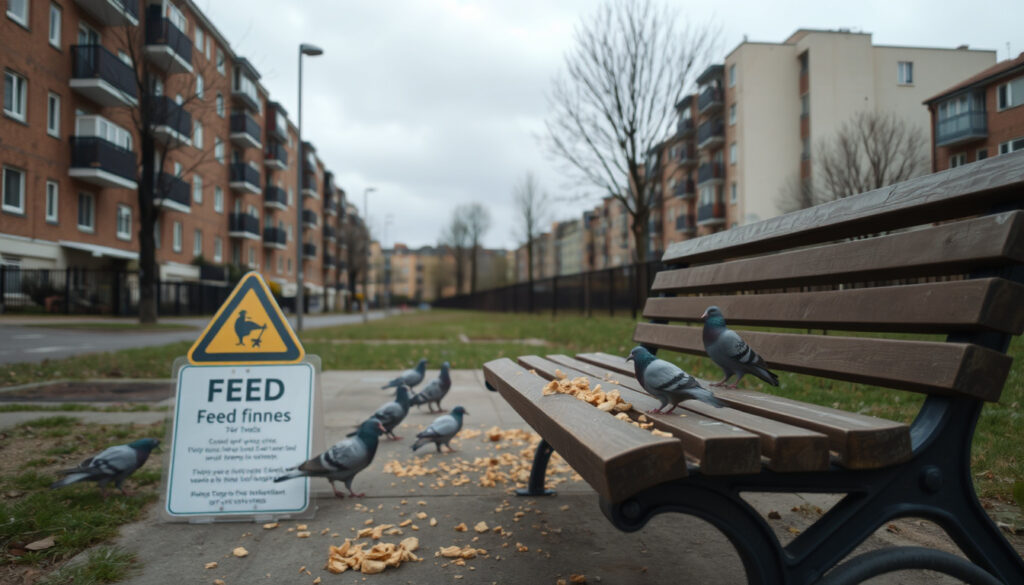
Chai Chee Pigeon Feeding Charges: Fines, Law & Case Details
A 74-year-old woman who fed pigeons from her HDB flat in Chai Chee now faces a S$9,000 fine after being charged under Singapore’s Wildlife Act. Her case highlights the growing tension between compassion for animals and strict enforcement of laws designed to keep urban wildlife in check.
Maximum fine per charge: S$5,000 ·
Highest fine imposed in related case: S$9,000 ·
Number of charges against 74-year-old: 5 ·
Location of incidents: Chai Chee, Singapore ·
Law violated: Wildlife Act (Chapter 351)
Quick snapshot
- Woman was charged on 23 Jan 2026 and fined S$9,000 on 19 Mar 2026 (Channel NewsAsia)
- Feeding pigeons violates Singapore’s Wildlife Act (Chapter 351) (Singapore Statutes Online)
- Fines range up to S$5,000 for first offence, S$10,000 for repeat (Channel NewsAsia)
- The feeding occurred at a HDB block in Chai Chee (Malay Mail)
- Exact number of feeding incidents beyond the 17 counts mentioned in court
- Whether the woman has paid the fine or will appeal
- The specific reasoning behind the judge’s final fine amount (below maximum)
- Whether the reported feeding start date of 2024-09-01 is precisely accurate across all charges
- 2024-09-01: First alleged feeding incident at Block 2 Chai Chee Road (Malay Mail)
- 23 Jan 2026: Woman charged in court (Malay Mail)
- 19 Mar 2026: Sentenced to S$9,000 fine (Mothership)
- Possible appeal or installment payment plan for the fine
- Increased enforcement in Chai Chee area
- Public debate on compassion vs. regulation may intensify
The penalty structure reveals a sharp escalation: repeat offenders face double the fines, and the Wildlife Act allows little discretion once charges are filed.
| Label | Value |
|---|---|
| Accused | 74-year-old Singaporean woman (name not public) |
| Location | Block 48 Chai Chee, Singapore |
| Number of charges | 5 |
| Date of charges | 23 January 2026 |
| Date of sentencing | 19 March 2026 |
| Total fine imposed | S$9,000 |
| Maximum possible fine | S$25,000 (5 × S$5,000) |
Why are you not supposed to feed pigeons?
What is the penalty for feeding pigeons in Singapore?
- Under the Wildlife Act (Chapter 351), first-time offenders face a fine of up to S$5,000 per charge (Singapore Statutes Online (official legislation database)).
- Repeat offenders can be fined up to S$10,000 per charge (Channel NewsAsia (Singapore’s leading news broadcaster)).
- In the Chai Chee case, the 74-year-old was charged with five counts, meaning she could theoretically have faced up to S$25,000 in fines. The court imposed S$9,000 (Mothership (Singapore news site)).
The implication: even a single pigeon feeding incident can land you in court, and the law treats each feeding as a separate offence.
How does feeding pigeons affect the ecosystem?
- Pigeon feeding leads to overpopulation, which in turn increases disease transmission (e.g., psittacosis) and property damage from droppings (NEA (Singapore’s National Environment Agency)).
- Uneaten food attracts rats and other pests, creating a cascade of urban wildlife problems.
- The National Environment Agency (NEA) emphasizes that a collective effort is needed to manage pest birds (NEA).
The Chai Chee resident’s repeated feeding didn’t just break a rule — it directly contributed to the very conditions that make pigeon control necessary. The fine is a blunt instrument, but the ecosystem impact is real.
The pattern: Singapore’s enforcement relies on deterrence, and this case shows the courts are willing to impose significant fines even on first-time offenders who continue after warnings.
How much to feed a pigeon per day?
Can you overfeed a pigeon?
- Pigeons typically eat 30–50 grams of seed per day per bird. Overfeeding can cause obesity, liver disease, and dependence on handouts (NParks (Singapore’s national parks board)).
- Experts discourage any deliberate feeding of urban pigeons because it disrupts their natural foraging behaviour.
The pattern: well-meaning feeding often leads to health problems for the birds themselves, ironically worsening their welfare.
What is the healthiest food for pigeons?
- If you must feed, a balanced mix of grains (corn, wheat, millet) and legumes is best. Bread, rice, and processed human food lack essential nutrients (NParks).
- However, in Singapore, any feeding is illegal under the Wildlife Act, so there is no sanctioned “healthy” option.
Even the best-intentioned feeding is illegal. The law doesn’t distinguish between bread and quality grain — it’s the act of feeding itself that carries the fine.
The irony: the healthier the food, the more likely pigeons will return, strengthening the habit that the law aims to break.
Will pigeons remember you if you feed them?
How long do pigeons remember humans?
- Pigeons have excellent long-term memory and can recognize individual humans, even after months or years apart (Channel NewsAsia).
- Studies show they associate specific people with food sources, making regular feeders an easy target for enforcement.
The implication: the Chai Chee woman’s repeated visits to the same HDB block made her a predictable presence, which likely led to complaints and eventual charges.
Do pigeons form bonds with people who feed them?
- While pigeons do not form emotional bonds like pets, they learn to trust individuals who provide food reliably (Malay Mail).
- This trust can lead to dependence, where the birds wait at the same spot daily for a handout.
The catch: that very trust made the woman’s behaviour visible to neighbours and authorities, turning compassion into evidence.
Will pigeons starve if I stop feeding them?
Are pigeons capable of finding food on their own?
- Pigeons are skilled foragers and do not rely solely on human handouts. They can find seeds, insects, and leftover food in urban environments (NEA).
- In Singapore, pigeons thrive on a mix of natural and human-derived food sources even without direct feeding.
The trade-off: sudden cessation of feeding may cause temporary stress, but it does not lead to starvation as long as natural food sources are available.
What happens to urban pigeons when feeding stops?
- The birds will eventually disperse to other areas where food is available (NParks).
- This is why enforcement agencies encourage residents to stop feeding entirely — it’s the most effective way to reduce pigeon populations humanely.
If the Chai Chee neighborhood stops feeding, the pigeon population there will likely drop within weeks. But enforcement alone won’t work without community cooperation.
The upshot: the woman’s repeated feeding may have created a dependency that her prosecution alone will not undo — neighbours must collectively stop as well.
What is a sad fact about pigeons?
What health problems do urban pigeons face?
- Urban pigeons often suffer from diseases (e.g., salmonella, avian pox), malnutrition, and injuries caused by human activities (Channel NewsAsia).
- Many die from poisoning or trapping in pest control operations, a grim reality of urban wildlife management.
The paradox: the very act of feeding, intended to rescue pigeons, can ironically lead to greater harm when authorities intervene with culling or fines.
How do pigeon control methods affect them?
- In Singapore, pest control methods include netting, spikes, and sometimes culling. These measures are triggered by overpopulation caused by feeding (NEA).
- The repeated feeding by individuals can create a cycle: more feeding leads to more pigeons, which leads to more aggressive control measures.
The 74-year-old said she wanted to “rescue” pigeons from hunger. But by feeding them repeatedly, she likely contributed to the very conditions that led to pest control interventions — the opposite of rescue.
The pattern: compassion without understanding the ecosystem can backfire, and the legal system offers no middle ground.
Timeline of the Chai Chee pigeon feeding case
- 2024-09-01: First alleged feeding incident at Block 2 Chai Chee Road, from a sixth-floor kitchen ledge (Malay Mail).
- October 2024: Three additional feeding incidents on the charge sheet (Malay Mail).
- 2025-02-20: Final alleged feeding incident before charges (Malay Mail).
- 23 Jan 2026: Woman charged in court with five counts under the Wildlife Act (Malay Mail).
- 19 Mar 2026: Sentenced to S$9,000 fine; she admitted to feeding pigeons 17 times (Mothership).
- Prior cases: In 2025, another woman fined S$6,500 for similar offenses in Yishun (Channel NewsAsia).
What we know and what remains unclear
Confirmed facts
- Woman was charged on 23 Jan 2026 and fined S$9,000 on 19 Mar 2026 (Channel NewsAsia).
- Feeding pigeons violates Singapore’s Wildlife Act (Singapore Statutes Online).
- Fines range up to S$5,000 for first offence, S$10,000 for repeat.
- The feeding occurred at an HDB block in Chai Chee.
What’s unclear
- Exact number of feeding incidents beyond the 17 counts mentioned in court.
- Whether the woman has paid the fine or will appeal.
- The specific reasoning behind the judge’s final fine amount (below maximum).
- Whether other residents in the same block have been warned or charged.
Voices in the case
“I only wanted to rescue the pigeons from hunger.”
— 74-year-old woman, as quoted in Channel NewsAsia
“The prosecution highlighted that the accused continued feeding despite prior warnings from authorities.”
— Mothership citing prosecution statements
“Feeding wildlife attracts pests and spreads disease. We urge the public to refrain from feeding pigeons and other birds.”
— National Environment Agency (NEA), as reported in NEA reader’s letter
For the Chai Chee resident, the fine is a concrete consequence of a clash between personal compassion and public health regulation. The law is clear: feeding pigeons is illegal, and the penalties are designed to deter repeat behaviour. Whether this case changes anyone’s mind is uncertain, but the message from Singapore’s enforcement agencies is unambiguous: stop feeding, or face the fine.
mothership.sg, tamilmurasu.com.sg, mothership.sg, asiaone.com, mothership.sg, sgbulletin.com
Frequently asked questions
Is feeding pigeons illegal in Singapore?
Yes, feeding pigeons is illegal under the Wildlife Act (Chapter 351). Offenders can be fined up to S$5,000 for a first offence and up to S$10,000 for repeat offences (Singapore Statutes Online).
What is the Wildlife Act and how does it apply to feeding pigeons?
The Wildlife Act prohibits intentionally feeding any wildlife, including pigeons, without written approval from the director-general of wildlife management. It applies everywhere in Singapore, including public housing estates (Channel NewsAsia).
Can I feed pigeons in my own garden or balcony?
No, the Wildlife Act applies to all premises, including private property. Feeding pigeons from a balcony or garden is still illegal (NParks).
How do I report someone feeding pigeons in my estate?
You can report pigeon feeding to the National Environment Agency (NEA) via their hotline or online feedback form. You can also approach your town council (NEA).
Are there any exemptions for religious or cultural feeding?
No, there are no general exemptions. Any feeding of wildlife requires written approval from the director-general of wildlife management, which is rarely granted for pigeons (Singapore Statutes Online).
What should I do if I see a sick pigeon?
Contact the Animal & Veterinary Service (AVS) or NEA. Do not attempt to feed or handle the bird. Report the location so authorities can assess and manage the situation (NParks).
Why are pigeon feeding fines so high in Singapore?
Fines are set high to deter behaviour that leads to public health issues, property damage, and ecological imbalance. Singapore’s strict enforcement reflects the government’s priority on urban cleanliness and disease control (NEA).
More related posts
 New Music Releases 2026: Full Calendar & Genre Guide
 Choi Seung-yeon: CrossFit Athlete, Physical: Asia, & Instagram
 Buddhist Funeral Services Singapore: Costs, Customs & Packages
 Arknights: Endfield Release Date – January 22, 2026
 iPhone 17 Release Date, Irish Price & Specs Guide
 Bao Er Cafe Fortune Centre: Menu, Hours, Reviews & Photos
 La Roche-Posay Sunscreen Review: Worth the Hype
 Network Attached Storage: What It Is, Benefits, and Downsides