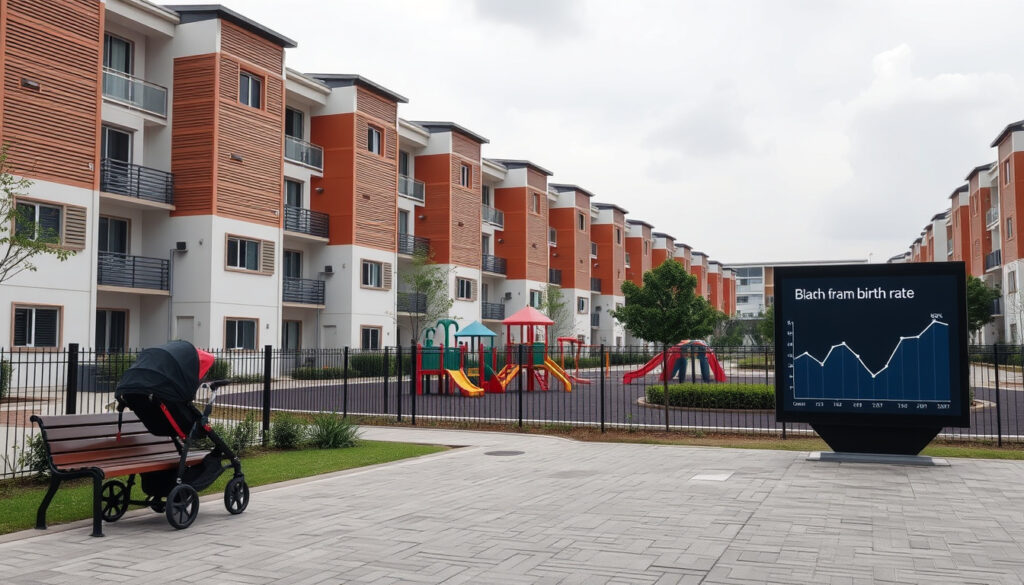
Singapore Birth Rate 2025: TFR Hits Record Low of 0.87
When a city-state reports fewer than 30,000 newborn residents for the first time, you know something fundamental has shifted. Singapore’s total fertility rate (TFR) hit a record low of 0.87 in 2025, extending a decline that touches every community differently.
Total Fertility Rate (TFR) 2025: 0.87 · Live Births 2025: 29,864 · TFR Decline from 2024: -0.10 (from 0.97) · Crude Birth Rate 2025: 6.5 per 1,000 residents · TFR by Ethnicity (Chinese/Malay/Indian): 0.71 / 1.58 / 0.92
Quick snapshot
- TFR fell to 0.87 in 2025 (SingStat – official statistics agency)
- Live births dropped 11.4% to 29,864 (Channel NewsAsia – Singapore news outlet)
- Chinese TFR 0.71, Malay 1.58, Indian 0.92 (SingStat Population Trends 2025)
- Why the TFR dropped so sharply in 2025
- Whether government policies can reverse the decline
- The exact reasons behind falling Malay and Indian TFRs
- Whether economic pressures or cultural shifts are the main driver
- 2024 TFR: 0.97 (Macrotrends – demographic data aggregator)
- 2025 TFR: 0.87 (record low) (Macrotrends – demographic data aggregator)
- 2026 projection: crude birth rate ~7.99 per 1,000 (Macrotrends – demographic data aggregator)
- Further TFR decline expected in 2026 (Father’s Day Singapore 2025 guide)
- Increased pressure on workforce and healthcare (Father’s Day Singapore 2025 guide)
- Possible expansion of marriage and parenthood incentives – see also our Father’s Day Singapore 2025 guide
Here is a summary of key fertility metrics for 2025.
| Metric | Value |
|---|---|
| Total Fertility Rate 2025 | 0.87 |
| Change from 2024 | -0.10 |
| Live Births 2025 | 29,864 |
| Crude Birth Rate 2025 | 6.5 per 1,000 |
| Chinese TFR | 0.71 |
| Malay TFR | 1.58 |
| Indian TFR | 0.92 |
| Replacement Rate | 2.1 |
Is Singapore’s birth rate declining?
What is the total fertility rate in 2025?
Singapore’s resident total fertility rate (TFR) in 2025 was 0.87, down from 0.97 in 2024 (SingStat, Singapore’s national statistical office). This is the lowest TFR on record. The number of live births fell 11.4% to 29,864 (Channel NewsAsia), while the crude birth rate dropped to 6.5 per 1,000 residents from 7.4 in 2024 (ICA (Immigration & Checkpoints Authority) Report).
How does the 2025 TFR compare to previous years?
- 2024 TFR: 0.97 (SingStat)
- 2023 TFR: 0.97 (same as 2024) (SingStat Population Trends 2025)
- 2025 TFR: 0.87 – a decline of 0.10, the largest single-year drop in recent history.
The decline from 0.97 to 0.87 in one year erased a decade of modest stability. For policymakers, the speed of the drop is as alarming as the level itself.
The implication: without a quick policy response, the decline may accelerate further.
What is Singapore’s birth rate per woman in 2025?
What is the difference between total fertility rate and crude birth rate?
The total fertility rate (TFR) measures the average number of children a woman would have in her lifetime if she experienced the current age-specific fertility rates. The crude birth rate (CBR) is the number of live births per 1,000 residents in a given year. Singapore’s TFR of 0.87 is far below the replacement rate of 2.1, meaning the population is not reproducing itself (SingStat).
What is the crude birth rate in 2025?
The crude birth rate stood at 6.5 per 1,000 residents, down from 7.4 in 2024 (ICA Report). That is a 12.2% decrease, reflecting both fewer births and a slightly growing resident population.
A TFR of 0.87 means an entire generation is replaced by less than half. Without migration, Singapore’s citizen population would shrink sharply within two decades.
The pattern: even with immigration, the workforce faces steady contraction.
How did Singapore’s birth rate vary by ethnicity in 2025?
What is the TFR for Chinese, Malay, and Indian residents?
- Chinese TFR: 0.71 (SingStat Population Trends 2025)
- Malay TFR: 1.58 (SingStat)
- Indian TFR: 0.92 (SingStat)
Malays had the highest crude birth rate among ethnic groups at 11.8 per 1,000 residents, while Chinese had the lowest at 5.3 per 1,000 (ICA Report). Indians had a crude birth rate of 7.3 per 1,000.
How do these numbers compare to 2024?
All ethnic groups experienced declines from 2024. The Chinese TFR rose slightly to 0.83 in 2024 from 0.81 in 2023, but then fell to 0.71 in 2025. The Malay TFR dropped from 1.65 in 2023 to 1.58 in 2024, and further to 1.58 in 2025 (statistically unchanged but still a decline from 2023). Indian TFR fell from 1.00 in 2024 to 0.92 in 2025 (SingStat Population Trends 2025).
| Ethnicity | TFR (2025) | Crude Birth Rate (per 1,000) | Population Share |
|---|---|---|---|
| Chinese | 0.71 | 5.3 | 73.9% |
| Malay | 1.58 | 11.8 | 13.5% |
| Indian | 0.92 | 7.3 | 9.0% |
Three ethnic groups, three very different fertility trajectories. The Chinese TFR of 0.71 is among the lowest recorded for any major ethnic group worldwide.
What has been the historical trend of Singapore’s birth rate?
What was Singapore’s birth rate in 2024?
In 2024, the TFR was 0.97, with live births totaling approximately 33,700 (SingStat). The 2025 figure of 29,864 represents a sharp acceleration of the long-term decline.
How has the TFR changed over the past 20 years?
- 2005: 1.26 (Wikipedia demographics data)
- 2010: 1.15
- 2015: 1.24
- 2020: 1.10
- 2023: 0.97
- 2025: 0.87
The TFR has been below replacement since the late 1970s. The decline accelerated after 2020, coinciding with the pandemic and rising cost of living.
The historical trend is not a gentle slope — it’s a staircase descending faster with each step. The 2025 drop is the largest single-year decline since records began.
The catch: each successive low becomes harder to reverse.
What is the forecast for Singapore’s birth rate in 2026?
What do demographic projections say?
Macrotrends projects a crude birth rate of 7.99 per 1,000 for 2026, which would be a slight improvement from the 2025 rate of 6.5 per 1,000 (Macrotrends). However, the TFR is expected to continue its downward trajectory, possibly falling below 0.85.
Can government policies reverse the trend?
Singapore has spent billions on Marriage and Parenthood packages — cash gifts, baby bonuses, extended parental leave, and subsidised childcare (Ministry of Social and Family Development (MSF)). Despite these efforts, the TFR has not risen above 1.3 since 2001. The 2025 plunge suggests that current incentives are insufficient to counteract structural headwinds: high housing costs, career pressures, and shifting social norms. For additional data context, see our Women in STEM facts page.
More money for parents, but no reversal. The implication: future policies may need to target not just financial support but cultural and workplace changes.
The bottom line: government spending alone has not changed the trajectory.
Timeline: Singapore’s Birth Rate Decline
- 2024: TFR 0.97 — already a record low at the time (SingStat)
- 2025: TFR drops to 0.87, live births 29,864 — steepest single-year decline (Channel NewsAsia)
- 2026 (forecast): Crude birth rate projected at 7.99 per 1,000, but TFR expected to fall further (Macrotrends)
What We Know and What We Don’t
Confirmed facts
- TFR in 2025 is 0.87 (SingStat)
- Live births 29,864 (ICA)
- TFR in 2024 was 0.97 (SingStat)
- Ethnic TFRs: Chinese 0.71, Malay 1.58, Indian 0.92 (SingStat Population Trends 2025)
- Crude birth rates by ethnicity: Chinese 5.3, Malay 11.8, Indian 7.3 (ICA Report)
What’s unclear
- Why the TFR dropped so sharply in 2025
- Whether the Malay TFR decline (1.65→1.58) will accelerate
- If new government policies can break the trend
- The exact role of housing costs vs. career choices
- Whether economic pressures or cultural shifts are the main driver
What this means: the data tells a clear story of decline, but the causes remain debated.
Voices on the Crisis
Singapore is going extinct.
— Elon Musk, via X (formerly Twitter), as reported by Channel NewsAsia
The sharp decline in births is deeply concerning. We are studying the data closely to see what more can be done.
— Minister for Social and Family Development Masagos Zulkifli, as quoted in the same CNA report
Singapore’s birth rate has hit a record low that demands more than routine policy adjustments. For the government, the choice is clear: either accelerate and deepen parenthood incentives — from housing grants to workplace flexibility — or accept a shrinking citizen workforce and the social costs that follow. The data from 2025 is not just a number; it is a demographic signal that, left unaddressed, will reshape Singapore’s economy and society for decades.
More related posts
 Wah Kee Big Prawn Noodles: Menu, Price & Review
 Singapore to Myanmar Flight: Time, Cost & Tips
 Marina Bay Sands Theatre: Dress Code, Capacity & Food Rules
 Charles & Keith Jem: Is It Luxury? Controversy & Store Guide
 XRP Price USD Today Live: Chart, News & Prediction
 Bengawan Solo Terminal 4: Store Info, Hours, Menu & Comparison
 Catherine Zeta-Jones: Biography, Diagnosis & Marriage Timeline
 TV Shows with Park Bo-young: Complete List and Upcoming Dramas