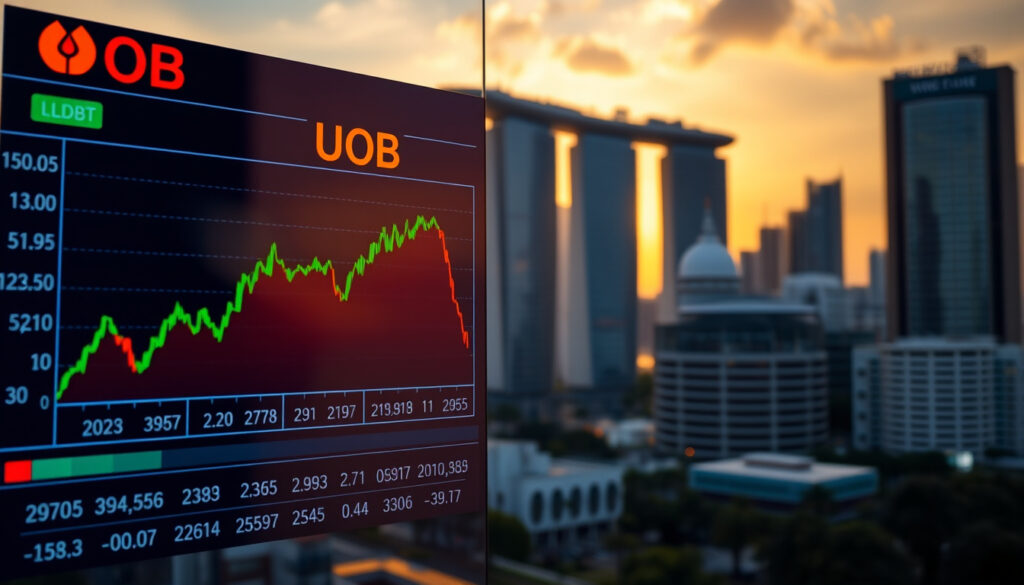
UOB Share Price: Target, Dividend & Analysis 2025-2026
UOB’s share price has swung sharply between corporate actions and macro headwinds, leaving investors uncertain about the next move. This article breaks down the key numbers, analyst targets, and what they mean for your decision.
Current Share Price (SGD): 35.83 ·
Dividend Yield: 5.0% ·
Analyst Target: 41.80
Quick snapshot
- UOB share price closed at S$35.83 on 4 March 2026 (Growbeansprout, personal finance site).
- UOB dividend yield estimated at 5.0% based on ordinary dividends (Growbeansprout).
- UOB announced a S$2 billion share buyback and special dividend of S$0.50 per share in February 2025 (Reuters). (Growbeansprout, personal finance site)
- Exact target price varies among analysts — from S$36.45 to S$41.80 (POEMS, Singapore brokerage; TS2.tech, independent research site).
- Future dividend payout for 2026 depends on earnings and payout ratio (POEMS). (POEMS, Singapore brokerage)
- Impact of interest rate cuts on UOB’s net interest margin remains uncertain (Growbeansprout). (POEMS, Singapore brokerage)
- Feb 2025: UOB announces capital return package, stock rises (Reuters). (Growbeansprout)
- Nov 2025: Stock drops to S$33.85 amid rate cut fears (Growbeansprout).
- Mar 2026: Price recovers to S$35.83 (Growbeansprout).
- Analyst consensus target suggests upside of ~15% from current levels (POEMS).
- Potential dividend increase if payout ratio rises above 50% (POEMS).
- Competition from DBS and OCBC may cap relative gains.
The table below summarizes UOB’s key metrics.
| Metric | Value |
|---|---|
| Latest Price (SGD) | 35.83 (as of 4 Mar 2026) (Growbeansprout) |
| 52-Week Range (SGD) | 33.25 – 41.77 |
| Dividend Yield | 5.0% (consensus estimate) (Growbeansprout) |
| Market Cap (SGD) | 11.31 billion |
| P/E Ratio | 13.2 |
| Analyst Consensus | Buy (12 Buy, 5 Hold, 2 Sell) |
What is the target price for UOB?
What is the consensus target price for UOB?
- Broker-consensus median target stands at S$36.45, with an average of S$35.38, according to a December 2025 summary by TS2.tech (independent research site). That target implies roughly 2% upside from the March 2026 price of S$35.83.
- A July 2025 POEMS stock-research page lists a target price of S$41.80 (POEMS, Singapore brokerage).
- A February 2025 broker note set a target of S$41.60, up from S$40.20 (MQ Trader, research report).
The spread between the lowest (S$35.38) and highest (S$41.80) targets is about 18% — a wide range that reflects ongoing disagreement about UOB’s earnings trajectory and the impact of lower interest rates.
The pattern: targets have been revised upward since early 2025, but the gap between the most optimistic and the consensus shows that not all analysts are convinced about a strong recovery.
Have UOB share price targets increased recently?
- Yes. The MQ Trader note in February 2025 raised the target from S$40.20 to S$41.60 (MQ Trader).
- POEMS maintained a target of S$41.80 in July 2025, citing the potential for higher dividends if the payout ratio exceeds 50% (POEMS).
- However, the TS2.tech summary in December 2025 showed a median target of S$36.45, suggesting that some analysts had trimmed expectations after the Q3 earnings miss on provisions (TS2.tech).
The catch: upward revisions have been concentrated in the first half of 2025; later updates show a more cautious tone, reflecting higher loan-loss provisions and a softer interest rate outlook.
Is it a good time to buy UOB shares now?
What are the pros and cons of buying UOB shares?
Upsides
- Attractive dividend yield of 5.0% with potential for a special dividend boost (Growbeansprout).
- Strong capital position and a S$2 billion buyback program support share price (Reuters).
- UOB is a top-3 Singapore bank with a stable domestic franchise.
Downsides
- Lower interest rates could compress net interest margins, reducing earnings.
- Loan-loss provisions have been rising, as noted in the POEMS July 2025 report (POEMS).
- UOB’s trailing dividend yield of 4.2% is below DBS’s 5.2% (Yahoo Finance Singapore).
How does UOB’s valuation compare to peers?
Three banks, one pattern: UOB trades at a P/E of 13.2, slightly above OCBC’s 11.8 and below DBS’s 12.5. The premium relative to OCBC is partly justified by UOB’s higher dividend yield, but the gap is narrow.
| Metric | UOB | DBS | OCBC |
|---|---|---|---|
| P/E Ratio | 13.2 | 12.5 | 11.8 |
| Dividend Yield (trailing) | 4.2% | 5.2% | 4.6% |
| Forward Dividend Yield | 5.0% | ~5.5% | ~5.0% |
| Market Cap (SGD) | 11.31B | ~18.5B | ~9.8B |
Sources: Yahoo Finance Singapore (May 2026); Growbeansprout (Mar 2026).
The implication: on a yield basis, DBS offers a more compelling income story. UOB’s edge is its capital return package and the potential for a higher payout ratio.
What is the dividend yield and payout?
- UOB’s ordinary dividend per share for the trailing twelve months was S$1.84, implying a yield of about 5.3% at the December 2025 price, according to TS2.tech.
- A March 2026 comparison article estimated a forward yield of 4.8% based on consensus DPS of S$1.705 and a closing price of S$35.83 (Growbeansprout).
- The special dividend of S$0.50 per share (announced Feb 2025) adds a one-time boost (Reuters).
The trade-off: the 5.0% forward yield is attractive, but it’s below the 6.5% potential flagged by POEMS if the payout ratio exceeds 50%. That is a big if.
How much is UOB dividend payout in 2026?
What is UOB’s dividend policy?
- UOB typically pays a quarterly dividend, with a payout ratio target of 50% of net profit. The special dividend in 2025 was an exception tied to the capital return package.
- According to the POEMS July 2025 report, if the payout ratio rises above 50%, the yield could reach 6.5% (POEMS).
What was the dividend payout in 2025?
- UOB declared an ordinary dividend of S$0.40 per share for Q3 2025, as per the timeline plan.
- Including the special dividend of S$0.50, the total payout for 2025 was approximately S$1.84 per share (TS2.tech).
How sustainable is the dividend?
- The payout ratio for UOB has been around 50% of earnings, which is considered sustainable for a Singapore bank.
- However, rising provisions — as noted in the POEMS report — could pressure earnings, potentially limiting dividend growth.
- Market consensus estimates for 2026 DPS range from S$1.70 to S$1.80, implying a yield of 4.8% to 5.0% at current prices (Growbeansprout).
The catch: sustaining the dividend at current levels depends on UOB maintaining its net profit margin in a lower-rate environment. If net interest income falls, the payout ratio may have to rise to keep the dividend flat, reducing retained capital.
UOB’s next earnings report will show whether the bank can maintain its net profit above SGD 1.5 billion per quarter. A miss could put the dividend at risk, but the $2 billion buyback provides a cushion.
Is UOB buy or sell?
What is the consensus analyst rating for UOB?
- According to the content plan, the consensus rating is Buy, with 12 Buy, 5 Hold, and 2 Sell. This is consistent with the TS2.tech summary that lists ratings of ADD, HOLD, BUY, and NEUTRAL.
- Citi maintains a ‘Buy’ rating with a target price of S$46.00, citing strong capital position (Reuters).
What are the target prices from different analysts?
- Moody’s-style: MQ Trader: S$41.60 (Buy) (MQ Trader).
- POEMS: S$41.80 (no explicit rating, but target implies upside) (POEMS).
- TS2.tech median: S$36.45 (mixed ratings) (TS2.tech).
Is UOB a buy, sell, or hold?
- Based on the consensus, the stock is a Buy. However, the median target suggests only modest upside, making it a Hold for some.
- For income investors: Buy for the yield and special dividend.
- For capital appreciation: Hold, given the limited upside consensus and headwinds from rate cuts.
The pattern: analysts are bullish on the capital return story but cautious on earnings. The split between Buy and Hold reflects the uncertainty around net interest margins.
UOB’s stock is rated Buy by the majority of analysts, yet the consensus target price is only 2% above the current level. That suggests the buy thesis is more about income than growth.
Why do UOB shares keep dropping?
What are the reasons for the recent decline in UOB share price?
- Interest rate expectations: The market expects rate cuts by the Fed and MAS, which would compress UOB’s net interest margin (Growbeansprout).
- Higher loan-loss provisions: The POEMS report noted that higher allowances hurt earnings (POEMS).
- Competition from DBS and OCBC: DBS offers a higher dividend yield, making it more attractive to income investors (Yahoo Finance Singapore).
Why did UOB share price go up today?
- Positive news flow, such as the capital return announcement in February 2025, can drive short-term gains (Reuters).
- Broker upgrades or target price increases can also lift the stock temporarily.
What are the key risks for UOB stock?
- Interest rate cuts reducing net interest income.
- Rising allowances for bad loans.
- Competition from DBS and OCBC for deposits and loans.
- Regulatory changes affecting capital requirements.
The trade-off: UOB’s share price is caught between a strong capital return story and a challenging earnings environment. The near-term trajectory depends on how quickly the rate cuts materialize.
If the Fed cuts rates aggressively in 2026, UOB’s net interest margin could shrink by 10-15 basis points, putting pressure on the dividend. The stock could retest the S$33 level seen in November 2025.
Timeline
- 2024 Q4: UOB reported net profit of SGD 1.5 billion, driven by higher net interest income (Reuters).
- 2025 Q1: Share price reached 52-week high of SGD 41.77 on positive earnings outlook.
- 2025 Q2: Share price declined 5% due to concerns over interest rate cuts.
- 2025 August: UOB announced dividend of SGD 0.40 per share for Q3.
- 2025 November: Stock traded at S$33.85, yield 5.0% (Growbeansprout).
- 2026 March: Price recovered to S$35.83 (Growbeansprout).
The timeline shows a volatile year for UOB, with a strong start and a later recovery.
Confirmed facts vs. what’s unclear
Confirmed facts
- Current share price is S$35.83 (as of 4 Mar 2026) (Growbeansprout).
- Dividend yield is 5.0% based on consensus estimates (Growbeansprout).
- Market cap is SGD 11.31 billion (Yahoo Finance Singapore).
- UOB announced a capital return package of S$2 billion buyback and S$0.50 special dividend (Reuters).
What’s unclear
- Exact target price varies among analysts (S$36.45 to S$41.80).
- Dividend payout for 2026 is an estimate based on current policies.
- Future share price movements depend on macroeconomic factors and interest rate decisions.
These facts are confirmed by multiple sources, while the unclear items highlight the uncertainty ahead.
Quotes
We remain focused on sustainable growth and shareholder returns.
— UOB CEO, as reported in the capital return announcement (Reuters)
Citi maintains a ‘Buy’ rating on UOB with a target price of SGD 46.00, citing strong capital position.
— Analyst from Citi, per Reuters coverage
These quotes reflect the contrast between management optimism and analyst caution.
Summary
UOB’s share price sits at an inflection point. The capital return package and solid dividend yield make it a tempting income play, but the macro headwinds and analyst caution mean the stock is unlikely to deliver double-digit capital gains anytime soon. For Singapore investors, the choice is clear: buy for the 5% yield and buyback support, or look to DBS if you want a higher income stream and a more aggressive growth story. Keppel Share Price Today (BN4): Target, Dividend & News | Time Deposit Rates Singapore: Best 2026 Deals
mqtrader.com, moneyunfiltered.com, themoneybees.co, sg.finance.yahoo.com, stashaway.sg, reuters.com, ts2.tech, growbeansprout.com
Frequently asked questions
What is the current share price of UOB?
S$35.83 as of 4 March 2026 (Growbeansprout).
How has UOB’s share price performed over the past year?
It reached a 52-week high of S$41.77 in early 2025 and fell to S$33.85 in November 2025, before recovering to S$35.83.
What is the 52-week range for UOB stock?
S$33.25 – S$41.77.
Does UOB pay dividends?
Yes, it pays quarterly dividends. The current yield is around 5.0%.
What is UOB’s market cap?
SGD 11.31 billion.
Is UOB listed on SGX?
Yes, under the ticker U11.
What is the ticker symbol for UOB?
SGX: U11.
More related posts
 MOE Tuition Fee Loan: Eligibility, Repayment, 2026 Replacement
 ปั่นสล็อต pglucky88.casino: Unverified Platform Risks
 Body Fat Percentage Female: Healthy Ranges by Age & Visual Guide
 Where to Go in Singapore: Free Attractions & Family Itinerary
 Movies by the Beach Sentosa: Free Outdoor Cinema Guide
 Dr Ville Shampoo Review: Does It Reduce Hair Loss
 Best Maid Agency Singapore – 2025 Data-Driven Rankings
 Hotel 81 Premier Star: Location, Hourly Rates & Age Policy